
TL;DR

Get the latest gadgets delivered free with Prime
- Fast, free delivery on millions of items
- Prime Video, Amazon Music and more included
- Member-only deals all year
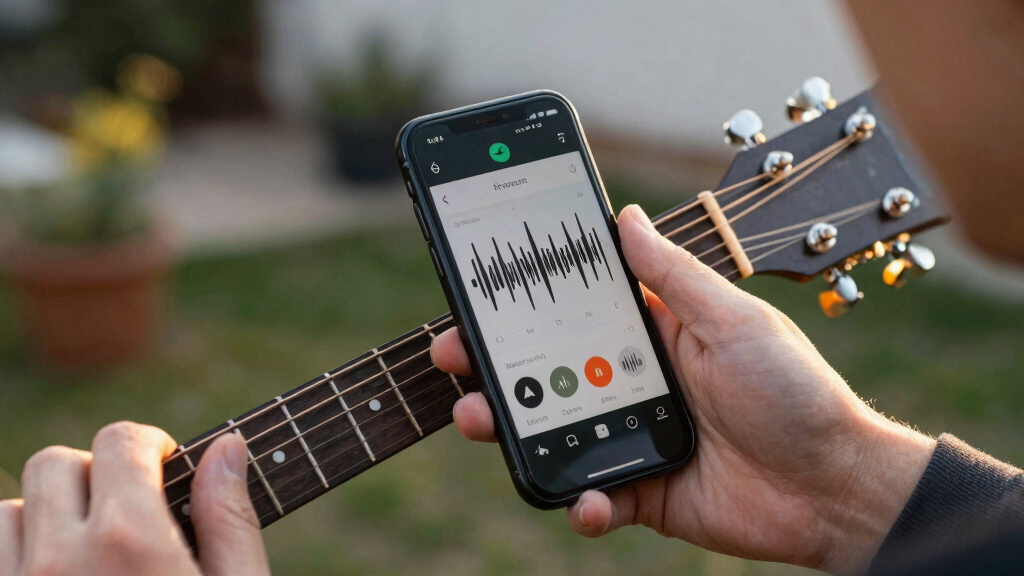
A developer has created a guitar tuner that uses a phone’s accelerometer to detect string vibrations. The app requires pressing the phone against the guitar and works best on Android devices. This approach offers a new way for musicians to tune instruments without traditional hardware.
A new guitar tuning app has been developed that uses a smartphone’s accelerometer to detect string vibrations and determine pitch, offering an alternative to traditional tuning devices.
The app functions by pressing the phone firmly against the guitar body and plucking a string. It then captures the vibrations via the phone’s accelerometer, specifically analyzing raw motion data along all axes. The strongest axis, after alias correction, indicates the string’s pitch. The app requires motion permission and performs best on Android devices with high-rate inertial measurement units (IMUs). According to the developer, the detection process involves analyzing the combined magnitude of vibrations across axes, with pitch identified from the dominant vibration frequency. The method has been demonstrated on a prototype, with the developer noting its effectiveness in real-world testing.
While the app shows promise, it currently remains in the experimental stage, with no official release or widespread adoption. The developer has shared a demonstration on Hacker News, highlighting its potential as a hardware-free tuning solution.
Why It Matters
This development is significant because it introduces a novel, accessible approach to instrument tuning, potentially reducing reliance on external hardware like clip-on tuners or microphone-based apps. For musicians, especially those who prefer using their smartphones, this method could simplify the tuning process and make it more portable. Additionally, it demonstrates innovative use of existing smartphone sensors, expanding the scope of mobile device capabilities beyond conventional applications.
As an affiliate, we earn on qualifying purchases.
Background
Traditional guitar tuners typically rely on microphones or specialized hardware to detect string pitch. Recent advances in smartphone sensor technology, particularly high-rate IMUs, have opened new possibilities for vibration detection. The idea of using accelerometers for tuning is not entirely new but has been limited by sensor sensitivity and processing constraints. This new app, based on publicly shared code and demonstrations, leverages high-frequency IMU data to analyze vibrations directly through the phone’s body, bypassing the need for external microphones. The development aligns with ongoing trends toward utilizing smartphone hardware in novel ways for musical and scientific applications.
“Press the phone firmly against the guitar body and pluck a string. Each axis trace shows raw vibration; |a| is the combined magnitude. Pitch is detected from the strongest axis (alias-corrected to the actual string frequency).”
— Developer (via Hacker News)
What Remains Unclear
It is not yet clear how accurate or reliable the app is across different guitar types, playing conditions, or phone models. The effectiveness outside controlled testing remains unverified, and user experience details are still emerging.
What’s Next
Further testing and user feedback are expected to determine the app’s accuracy and usability in real-world scenarios. The developer may release a more polished version or open-source the code for broader testing. Additional research could explore optimizing the algorithm for different devices and musical contexts.
Key Questions
How does the app detect pitch without a microphone?
The app uses the phone’s accelerometer to measure vibrations transmitted through the phone when pressed against the guitar body. It analyzes the raw motion data to identify the dominant vibration frequency, which corresponds to the string’s pitch.
What are the hardware requirements for this app?
The app requires a smartphone with a high-rate IMU, typically found in recent Android devices. It also needs motion permission to access accelerometer data.
Is this app available for download?
The app is currently in the testing phase, shared via demonstration on Hacker News. There is no official public release yet.
How accurate is this method compared to traditional tuners?
Accuracy data is still limited. Early demonstrations suggest it can identify pitch effectively in controlled conditions, but broader testing is needed to confirm reliability across different settings and devices.
Can this method be used for other string instruments?
Potentially, yes. The principle relies on vibration detection, which could extend to other stringed instruments, but further development and testing are required.
Columbus Day / Indigenous Peoples' Day Picks
long weekend sales
As an affiliate, we earn on qualifying purchases.