TL;DR

Get the latest gadgets delivered free with Prime
- Fast, free delivery on millions of items
- Prime Video, Amazon Music and more included
- Member-only deals all year
Chinese startup Tuoyuan, led by quantum researcher Mu Qiao, is reportedly developing a neutral-atom quantum computer with a target of 100 logical qubits. The target and financing details were reported by QbitAI but have not been independently verified; Tuoyuan has disclosed no hardware benchmarks or development timeline.
Chinese startup Tuoyuan, led by quantum researcher Mu Qiao, is pursuing neutral-atom quantum computing with a reported goal of building a system with 100 logical qubits, according to a QbitAI report republished by 36Kr. The company has not disclosed hardware benchmarks or a timeline, and the reported fundraising has not been independently verified.
The report identifies the company as FlipFlop Tuoyuan and describes its ambition as a fault-tolerant quantum-computing effort. Fault-tolerant systems use error correction to protect calculations from errors in physical qubits. The figure of 100 logical qubits is a reported development target, not a demonstrated capability: no processor results, error-correction specifications or schedule were provided.
QbitAI also reported that Tuoyuan raised hundreds of millions of yuan in seed and angel financing, citing people familiar with the company. It named Source Code Capital, Oasis Capital and CICC Capital among the investors, but gave no exact funding total or valuation. The Quantum Insider said those financing details could not be independently verified.
The technical background cited for Qiao includes research across neutral-atom and trapped-ion platforms. He was a shared first author and corresponding author of an August 2025 Nature study using Rydberg atoms to investigate a quantum magnet with mobile vacancies. In 2024, he led a Nature Physics study using trapped ions to simulate tunable spin models. These publications document experimental research, not a demonstration of Tuoyuan’s planned fault-tolerant computer.
The Gap Between Atoms and Logical Qubits
Tuoyuan’s reported target points to the distinction between building a processor with many physical atoms and producing a machine that can carry out reliable, error-corrected computations. Logical qubits encode information across multiple physical qubits so errors can be detected and corrected. Their practical value depends on the quality of operations and the calculations the system can sustain, not just the headline count.
The company’s progress could matter to researchers and investors tracking China’s quantum-computing sector, particularly if it turns its reported target into independently measured results. For now, the number is a development goal, with no public evidence in the report that Tuoyuan has achieved it. The difference between an ambition and a benchmark is central to judging the venture’s technical progress.
Tuoyuan’s reported interest in using AI for experimental design, data processing and equipment control could also shape its research approach. QbitAI did not provide results showing that these methods improve performance, so the idea remains a reported plan rather than a validated advantage.
As an affiliate, we earn on qualifying purchases.
Research Behind Tuoyuan’s Platform
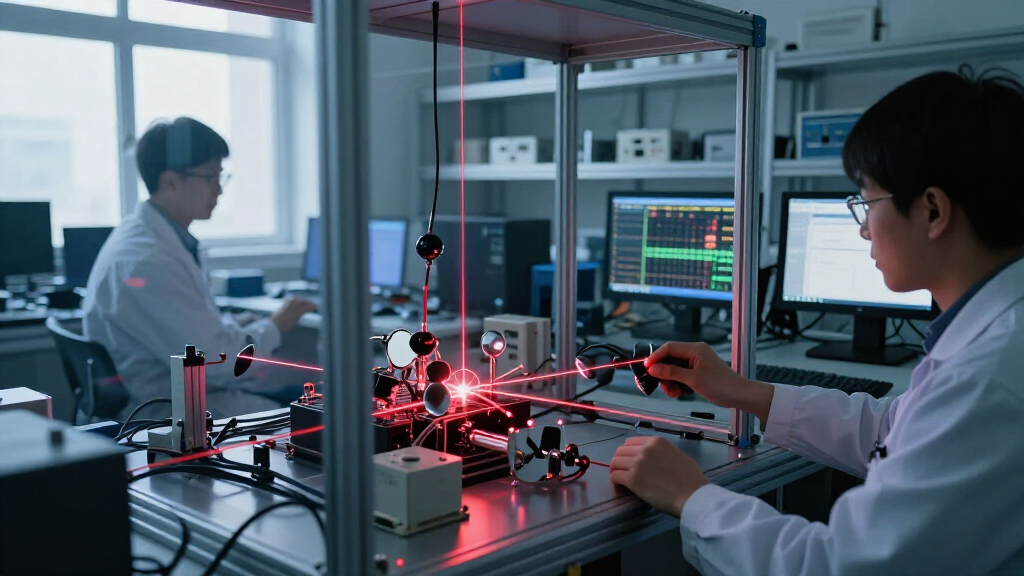
Neutral-atom processors use focused laser beams, known as optical tweezers, to trap and arrange individual atoms. Researchers can excite atoms into Rydberg states, where strong interactions can support quantum simulation and computing operations. Those techniques have made neutral atoms a subject of research for both modeling quantum systems and developing processors.
Qiao’s cited studies provide evidence of experience with two experimental platforms. The 2025 Nature paper used an array of Rydberg atoms to study interactions between magnetism and particle motion, while the 2024 Nature Physics paper used a two-dimensional trapped-ion crystal to simulate spin models. The first was a quantum-simulation result, not a general-purpose fault-tolerant computer demonstration. Neither paper establishes Tuoyuan’s current hardware capability.
“Tuoyuan is targeting a system with 100 logical qubits.”
— QbitAI, as reported by The Quantum Insider
No Benchmarks or Build Schedule
Several central details remain undisclosed or unverified. The report provides no hardware benchmarks, error rates, error-correction design, system architecture or timeline for reaching 100 logical qubits. It is also not clear how Tuoyuan defines the target or what performance it expects the system to deliver.
The reported financing lacks an exact amount, valuation and independently confirmed investor participation. The company’s reported plans for AI-assisted research have not been supported by published results. Without further information from Tuoyuan or independent measurements, readers cannot assess the project’s present technical stage, resources or likelihood of meeting its target.
Evidence Needed to Track Progress
The next useful milestones would be a statement from Tuoyuan confirming its plans and financing, followed by technical disclosures that specify its hardware, logical-qubit definition and error-correction approach. Measured performance and a development schedule would help show whether the reported target is connected to a working system.
No public launch date or next technical announcement was included in the source report. Until the company provides details or independent results emerge, the 100-logical-qubit goal and fundraising remain reported claims rather than verified achievements.
Key Questions
What is Tuoyuan reportedly developing?
The Chinese startup is reported to be pursuing neutral-atom quantum computing, with a development target of 100 logical qubits.
Has Tuoyuan built a 100-logical-qubit computer?
The report describes 100 logical qubits as a target. It provides no benchmark or evidence that Tuoyuan has achieved that capability.
What is known about Tuoyuan’s funding?
QbitAI reported seed and angel financing totaling hundreds of millions of yuan and named Source Code Capital, Oasis Capital and CICC Capital. The amount and investor details have not been independently verified.
What experience does Mu Qiao bring to the startup?
Qiao has published research on Rydberg-atom quantum simulation and trapped-ion spin-model simulation. Those papers show experimental work on different platforms, but do not demonstrate Tuoyuan’s planned computer.
When might Tuoyuan’s system be ready?
No development timeline was included in the report, and the company has not publicly disclosed one in the material provided.
Source: rss
Halloween Picks
halloween
As an affiliate, we earn on qualifying purchases.