
📊 Full opportunity report: Marketplace Matching Businesses To Vacant Small-town Storefronts on IdeaNavigator AI — validation score, market gap, and execution plan.

Get the latest gadgets delivered free with Prime
- Fast, free delivery on millions of items
- Prime Video, Amazon Music and more included
- Member-only deals all year
TL;DR
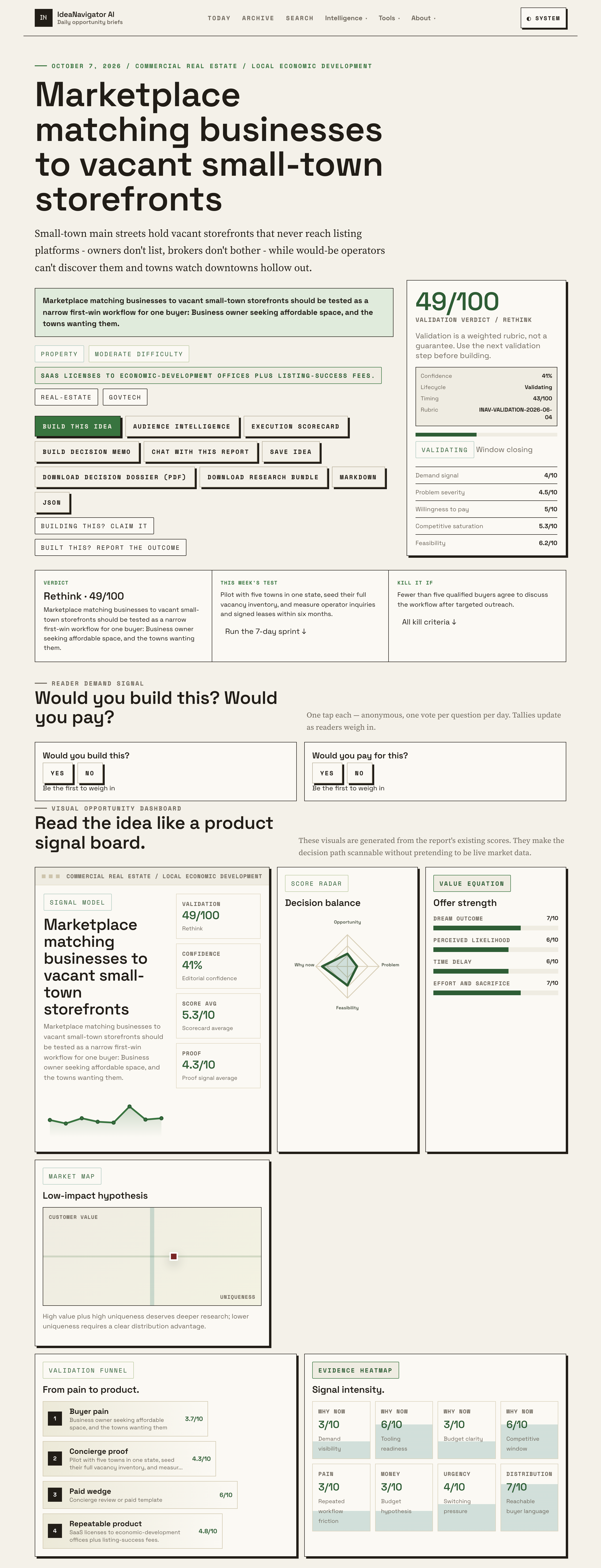
IdeaNavigator AI describes a proposed marketplace that would connect business owners with vacant small-town storefronts and route matches to local economic-development offices. It is a concept, not a launched service: the suggested test is a six-month pilot in five towns, with inquiries and signed leases as measures.
IdeaNavigator AI has proposed a marketplace connecting business owners seeking affordable space with vacant storefronts in small towns, with inquiries directed to local economic-development offices. The concept remains at the proposal stage; its suggested first test is a six-month pilot across five towns in one state, measuring operator inquiries and signed leases, according to the IdeaNavigator AI proposal.
According to the IdeaNavigator AI proposal, the service would let towns and property owners post storefront listings with photos, size, rent and available incentive programs. Business operators could search by town profile and foot-traffic data, then contact a local development office through the platform. The proposal says the office could receive the match with relevant grants attached, though it does not specify how grants would be verified or applied.
The proposed business model combines software-as-a-service licenses for economic-development offices with fees tied to successful listings. The proposal identifies no pricing, fee structure, operating company, or commercial partners. It also reports no user research, existing customer commitments, or evidence that a platform of this kind has already produced leases.
For an initial validation, IdeaNavigator AI recommends selecting five towns in one state, entering their full inventory of vacant storefronts, and tracking results over six months. The proposal names operator inquiries and signed leases as measures, but provides no target numbers for either or a definition of how a lease would be attributed to the marketplace.
Turning Vacancies Into Local Leads
The IdeaNavigator AI proposal focuses on a practical gap: a storefront can be empty without being visible to prospective tenants. It suggests that when owners do not advertise and brokers do not take on a listing, a business operator may not know the space is available. A shared inventory could give towns a way to present properties and connect interested businesses with local staff who know about incentives.
The proposal argues that a listing alone may not explain local grant programs or help an operator understand a town’s commercial conditions. Routing inquiries to a development office could bring property information and local support into the same process. Whether this produces more signed leases is an open question; the proposed pilot is intended to test that rather than establish it in advance.
The concept also offers towns a measurable outcome beyond website traffic. Inquiries and signed leases are the measures IdeaNavigator AI proposes to assess whether listings reach potential operators and lead to occupancy. The proposal provides no evidence that filling storefronts would reverse broader downtown decline, so any effect on local business activity would need separate evaluation.
As an affiliate, we earn on qualifying purchases.
The Proposed Listing-to-Lease Path
IdeaNavigator AI frames the idea around two groups: business owners seeking affordable premises and towns that want to attract them. The proposal says vacant small-town commercial spaces may not appear on listing platforms when property owners do not list them and brokers do not pursue them. In that situation, operators have fewer ways to discover available premises, while town officials may have limited means to connect them with property owners.
IdeaNavigator AI cites renewed small-town commercial interest linked to remote-work migration and grant funding available to economic-development offices as reasons to explore the idea. These are the proposal’s stated rationale, not documented findings about migration patterns, grant amounts, or demand in particular towns. The proposal names no state, participating municipality, property owner, or funding program.
The workflow described in the proposal is to collect storefront information, make it searchable using town details and foot-traffic data, and send a prospective match to the local development office. The proposed pilot would test the inventory and referral process before a wider rollout. No platform, pilot, or partnership is confirmed in the proposal.
Pilot Details Still Unconfirmed
The IdeaNavigator AI proposal does not identify a launch date, participating towns, a state, or an organization responsible for building and running the marketplace. It is also unclear whether property owners or town offices would verify rents, availability, building condition, and incentive eligibility before listings appear.
Other unresolved questions include how foot-traffic data would be collected and compared, what counts as a qualified inquiry, and how the service would distinguish leases it helped secure from agreements reached through other channels. The proposed listing-success fees are not defined, and no licensing price or grant-funding arrangement is provided. The proposal reports no pilot results or signed leases associated with the concept.
A Five-Town Test Would Follow
IdeaNavigator AI proposes a pilot in five towns within one state, with the towns entering a complete inventory of their vacant storefronts. The six-month evaluation would count operator inquiries and signed leases. The proposal announces no schedule, participating locations, recruitment plan, or threshold for success.
If a pilot proceeds, results could show whether the listings attract business operators and whether referrals to development offices help move prospects toward leases. The proposal does not say what changes would follow a weak result, whether the service would expand after a successful test, or who would publish the findings. Until those details are available, the marketplace remains a proposed workflow rather than an operating service.
Source: IdeaNavigator AI proposal
Key Questions
Has the storefront marketplace launched?
No launch is reported in the IdeaNavigator AI proposal. The marketplace is presented as a proposal, with a five-town pilot suggested as a way to test it.
How would the marketplace work?
Under the proposal, towns and property owners would post storefront details, including photos, size, rent, and incentives. Operators would browse by town information and foot-traffic data, and prospective matches would be routed to a local economic-development office.
How would the idea be tested?
IdeaNavigator AI proposes a six-month pilot in five towns in one state, with the towns’ vacant storefront inventory entered into the service. The suggested measures are operator inquiries and signed leases.
Who would pay for the service?
The proposed revenue model, as described by IdeaNavigator AI, includes software licenses for economic-development offices and fees tied to successful listings. No prices or fee terms have been specified.
Are any participating towns or leases confirmed?
The IdeaNavigator AI proposal identifies no participating towns, operators, or leases. It reports no pilot results or commitments from property owners or local governments.
Source: IdeaNavigator AI
Fall Picks
fall essentials
As an affiliate, we earn on qualifying purchases.