📊 Full opportunity report: GLP-1 Pharmacy Index on IdeaNavigator AI — validation score, market gap, and execution plan.

Get the latest gadgets delivered free — and shop member deals
- Fast, free delivery on millions of items
- Access to Prime Big Deal Days deals on October 6–7
- Prime Video, Amazon Music and more included
TL;DR
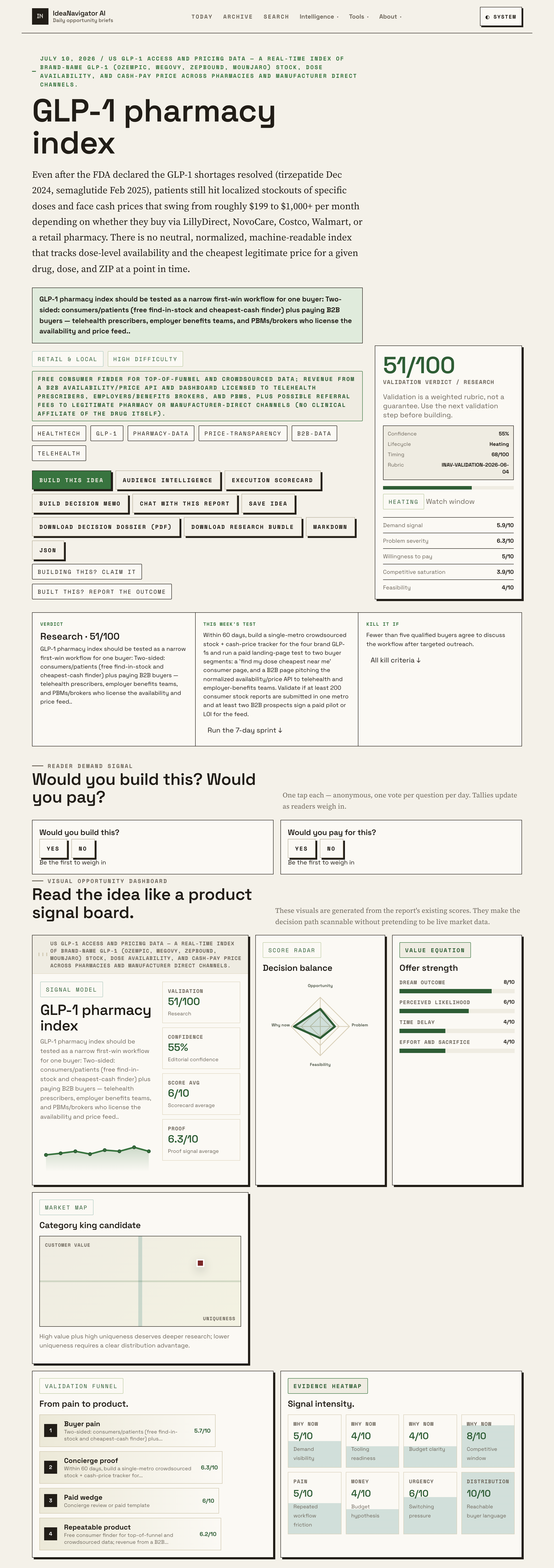
IdeaNavigator AI has proposed a GLP-1 pharmacy index that would track dose-level availability and cash prices by drug and ZIP code. The concept pairs a free patient search tool with a paid data feed for telehealth providers, employers and pharmacy benefit buyers; no launch or buyer commitments are reported.
IdeaNavigator AI has proposed a GLP-1 pharmacy index to show patients where specific doses of brand-name medicines are available and compare legitimate cash prices. The proposed service would also sell normalized availability and pricing data to telehealth prescribers, employers and pharmacy benefit buyers; the proposal describes an idea, not a launched product or a confirmed commercial deal.
The proposed consumer service would let users search four brand-name medicines—Ozempic, Wegovy, Zepbound and Mounjaro—by drug, dose and ZIP code. Its initial data would combine crowdsourced reports of local stock with publicly listed prices from manufacturer-direct programs, retail and warehouse pharmacies, and a discount-price layer. The concept also calls for alerts when a requested dose becomes available.
A business version would package the normalized availability and price information as an API or dashboard for telehealth prescribers, employer benefits teams, pharmacy benefit managers (PBMs) and brokers. The proposal suggests starting with one or two design partners. It gives no named customer, signed pilot, operating pharmacy network or evidence that the data feed has been built.
Under the suggested revenue model, patient searches would be free, while business buyers would pay to access the data. Referral fees from legitimate pharmacies or manufacturer-direct channels are described as a possible additional source of revenue. The proposal says it would not use clinical affiliate marketing for the medicines themselves.
A New Focus on Local Access
The proposal addresses a practical gap that can persist after broad supply conditions improve: availability may vary by dose and location, while cash prices depend on the seller and payment route. A patient seeking a particular dose may need to compare multiple channels, and a general statement about supply does not tell them which nearby pharmacy has that dose today or what an eligible cash purchase would cost.
For institutional buyers, the proposed index could offer a way to observe local access and price differences across channels. The proposal says employers report GLP-1 medicines account for roughly 20% of pharmacy spending, but it does not identify the employers or provide a survey method or date for that figure. If validated, a consistent feed could inform benefit planning or help telehealth services direct patients toward available options. That potential depends on data being accurate and current enough for decisions.
The concept’s value therefore rests on two linked tests: whether patients contribute enough reports to make the consumer tool useful, and whether business buyers will pay for the resulting dataset. Neither demand nor data quality has been established in the proposal.
From Shortages to Price Fragmentation
The proposal frames the opportunity as a shift from broad drug shortages to a more fragmented access problem. It says the FDA declared the tirzepatide shortage resolved in December 2024 and the semaglutide shortage resolved in February 2025. Those dates do not establish that every product, dose or pharmacy location has continuous stock; the index idea focuses on that local variation.
It also points to a growing mix of cash-pay channels, including manufacturer-direct programs such as LillyDirect and NovoCare, as well as Costco and Walmart. The proposal estimates monthly cash prices can range from about $199 to more than $1,000, depending on the drug and channel. It does not specify a single drug, dose, time period, eligibility rule or price methodology for that range, so it should be read as an illustration of variation rather than a like-for-like comparison.
The proposal further cites compounding deadlines and a TrumpRx portal launch in February 2026 as factors behind the changing market. It offers no detailed timeline or channel-by-channel documentation for those developments. Its central point is that prices and dose availability are spread across sources that may not present comparable information in one place.
Data Coverage Still Unproven
No product launch, coverage map, pharmacy data agreements, update frequency or accuracy results are given. Crowdsourced reports can become outdated as stock changes, and the proposal does not explain how reports would be checked, timestamped or reconciled with pharmacy listings. It is also unclear how the service would distinguish a listed cash price from the amount a specific patient can actually pay, which may depend on eligibility and purchase terms.
The proposal does not provide evidence that patients want to submit reports, that the four medicines and their doses can be compared consistently, or that employers and telehealth companies will pay for the data. Its estimate of a broad price range lacks enough detail to compare equivalent products. The cited spending share and changes in supply channels also lack supporting methodology in the proposal.
A 60-Day Market Test
The proposed validation plan is to build a tracker in one US metro area covering the four brand-name medicines, then test separate consumer and business landing pages. The consumer page would offer a search for the cheapest nearby option for a specified dose; the business page would pitch the normalized availability and price feed to telehealth and employer-benefits teams.
IdeaNavigator AI sets two thresholds for that test: at least 200 consumer stock reports submitted in the metro and at least two business prospects signing a paid pilot or letter of intent. Those are proposed targets, not reported results. No metro, start date, named prospects or launch schedule is specified, so whether the test has begun remains unclear.
Source: IdeaNavigator AI
Key Questions
Has the GLP-1 pharmacy index launched?
No launch is reported. The proposal describes a potential service and a plan to test it in one metro area.
Which medicines would the proposed index cover?
The initial concept names Ozempic, Wegovy, Zepbound and Mounjaro, with searches by drug, dose and ZIP code.
Who would pay for the data?
The proposed business customers include telehealth prescribers, employers and benefits brokers, PBMs, and other pharmacy benefit buyers. No paying customer or signed pilot is identified.
How would the proposal test demand?
It proposes a 60-day test in one metro, with targets of 200 consumer stock reports and two business prospects signing a paid pilot or letter of intent. The proposal does not report that either target has been met.
Source: IdeaNavigator AI
Evergreen bestsellers Picks
bestsellers
As an affiliate, we earn on qualifying purchases.