
📊 Full opportunity report: Best Quiet CPU Coolers for Sustained AI/Compute Loads on ThorstenMeyerAI.com — validation score, market gap, and execution plan.
TL;DR
This article reviews the best quiet CPU coolers suited for sustained AI and compute workloads in 2026. It covers air and liquid cooling options, emphasizing reliability, noise levels, and cooling capacity for long-duration tasks.
In 2026, the leading CPU coolers for sustained AI workloads are identified as the Noctua NH-D15 G2 for top-tier air cooling, and the Best Quiet CPU Coolers for Sustained AI/Compute Loads, offering high performance with low noise during continuous operation.
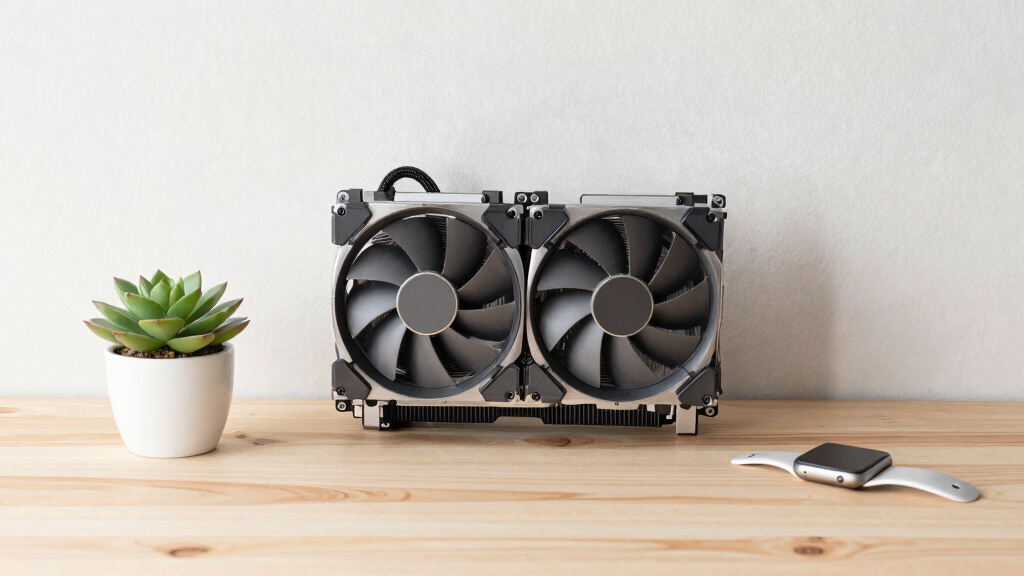
The Noctua NH-D15 G2 remains the benchmark for air cooling, delivering near-liquid cooling performance with minimal noise, making it ideal for always-on AI workstations. It features a dual-tower heatsink and 140mm fans that provide high thermal capacity at around 23–24 dBA. The Thermalright Peerless Assassin 120 SE offers a highly cost-effective alternative, providing approximately 90–95% of the performance of premium models at a third of the price, suitable for mainstream and high-end CPUs under sustained loads. For those prioritizing silence, the be quiet! Dark Rock Pro 5 is engineered for near-inaudible operation, maintaining steady temperatures even under continuous heavy workloads, with noise levels around 23.3 dBA. On the liquid cooling front, the Arctic Liquid Freezer III Pro 360 stands out as the preferred AIO option for high-TDP workloads, with a robust 360mm radiator and a reliable pump designed for all-day operation. These choices reflect the shift in cooling priorities for AI workloads, where steady thermal management and quiet operation are more critical than peak performance during short bursts.Best quiet CPU coolers
for sustained AI loads.
A cooler that’s fine for gaming bursts can run out of headroom on hour three of an inference job. What matters here isn’t peak capacity — it’s holding a steady temperature at a quiet fan speed, all day. Tap your priority in Part 3 to find your pick.
- Mainstream to high-end CPU, power-capped.
- You run it 24/7 — no pump to fail, ever.
- You want zero maintenance for years.
- Quiet matters more than the last few degrees.
- Top-tier CPU under sustained all-core load.
- A big air tower won’t physically fit (multi-GPU case).
- You want maximum sustained thermal headroom.
- You’ll accept a pump as one more moving part.
Why Quiet Cooling Matters for Long AI Tasks
For AI and compute workloads that run continuously for hours or days, maintaining a stable, low temperature without excessive noise is essential. Excessive fan noise can be disruptive in office environments, and unreliable cooling can lead to thermal throttling or hardware failure over time. The selection of a quiet, high-capacity cooler directly impacts the reliability, energy efficiency, and user comfort of AI workstations. As workloads grow more demanding, especially with high-core-count CPUs, the importance of thermal capacity and noise reduction increases, making these coolers critical components for professional AI setups.

be quiet! Pure Rock Pro 3 Black CPU Air Cooler | 6 High Performance 6mm Heat Pipes with HDT Technology | 120mm Quiet PWM Fan | AMD:AM4 AM5/Intel LGA 1700/1150/1151/1200 | Black | BK042
- High-Performance Copper Heat Pipes: 6 nickel-plated copper heat pipes for peak cooling
- Optimized 120mm PWM Fan: Pure Wings 3 fan with enhanced airflow and pressure
- Compact Offset Design: Double-tower cooler with adjustable fan height for compatibility
As an affiliate, we earn on qualifying purchases.
As an affiliate, we earn on qualifying purchases.
Evolving Cooling Needs for AI Workstations
Traditional gaming PC coolers primarily focus on peak performance for short bursts, but AI and long-duration compute tasks require sustained thermal management. In recent years, there has been a shift towards larger, more efficient heatsinks and liquid cooling solutions that can handle continuous loads without ramping fans into high noise levels. The Noctua NH-D15 G2 has set the standard for air cooling, while AIO liquid coolers like the Arctic Liquid Freezer III Pro 360 have gained prominence for their ability to maintain steady temperatures under heavy workloads. This trend reflects the increasing importance of reliable, quiet cooling in AI research, data centers, and professional workstations.
"For sustained AI workloads, cooling solutions need to prioritize thermal capacity and noise reduction over peak performance. The best coolers are those that can quietly handle continuous high loads without compromise."
— Thorsten Meyer, AI hardware expert
Remaining Questions About Cooler Longevity and Compatibility
While these coolers are recommended based on current testing and expert opinion, long-term reliability data under continuous AI workloads is still emerging. Compatibility with newer CPU sockets and case sizes may vary, and the actual noise levels can depend on specific system configurations. Additionally, the performance of liquid coolers may fluctuate over years due to pump wear or seal degradation, which remains to be fully quantified.
Future Developments in Quiet Cooling for AI Workstations
Manufacturers are expected to release next-generation coolers with improved thermal capacity, lower noise profiles, and enhanced reliability tailored for AI and data science workloads. Ongoing testing and user feedback will refine these recommendations, and new cooling technologies may emerge that further optimize performance and silence, especially as AI hardware demands continue to grow.
Key Questions
Are air coolers sufficient for high-end AI workloads?
Yes, high-end air coolers like the Noctua NH-D15 G2 are capable of handling sustained loads for most CPUs used in AI workstations, provided the workload isn't pushing extreme TDP levels continuously. For the hottest chips or very long workloads, liquid cooling may offer better thermal stability.
How important is noise level for AI workstations?
Noise level is highly relevant, especially in office environments or shared spaces. Quiet coolers reduce disruption and fatigue during long compute sessions, making them a priority for professional setups.
What are the main trade-offs between air and liquid cooling?
Air coolers are generally more reliable and maintenance-free, with no risk of pump failure. Liquid coolers typically provide better thermal capacity under sustained loads but involve more complexity and potential points of failure over time.
Will these coolers work with future CPU sockets?
Most top coolers are designed to be compatible with current mainstream sockets, but future socket changes could require adapters or new mounting hardware. Checking compatibility before purchase is recommended.
When should I consider liquid cooling over air cooling?
If your workload involves very high TDP CPUs running continuously or if noise is a critical concern, liquid cooling like the Arctic Liquid Freezer III Pro 360 may provide more stable thermal performance and quieter operation over the long term.
Source: ThorstenMeyerAI.com