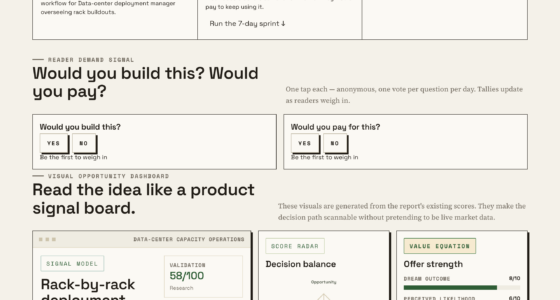

📊 Full opportunity report: AI Trading Bot — Week Two: The candidate edge collapsed on ThorstenMeyerAI.com — validation score, market gap, and execution plan.

Get the latest gadgets delivered free — and shop member deals
- Fast, free delivery on millions of items
- Access to Prime Big Deal Days deals on October 6–7
- Prime Video, Amazon Music and more included
TL;DR
After two weeks of testing, the only promising AI trading strategy has been wiped out, and all others in the fleet are losing money. The initial edge appears to have vanished, casting doubt on the approach.
The only promising AI trading strategy from initial testing was wiped out in week two, with a loss of approximately $850 overnight, leaving the entire fleet in the red.
Last week, a multi-strategy AI trading bot showed a potential edge in a BTC fair-value strategy, based on about 250 settled trades, with a small profit of roughly $800 on a $300 paper bankroll. However, in week two, this strategy lost nearly $850 in a single overnight session, reducing its equity to approximately $1.84, and resulting in a total negative P&L of $298 across roughly 750 trades.
Simultaneously, a backup hypothesis involving a maker-quoter approach was tested but failed, ending the week at about $0.49 in equity with a 22% win rate over 120 trades. Overall, the entire fleet of 25 parallel experiments is now down approximately 33% of the initial bankroll, totaling around $2,500 in losses on $7,500 deployed.
These results indicate that the initial promising edge was likely due to luck, and the broader set of strategies no longer demonstrate a viable advantage. The empirical win rate across all strategies is about 78.3%, yet the aggregate P&L remains negative, illustrating that high win rates do not guarantee profitability in short-duration binary markets.
Implications of the Strategy Collapse for AI Trading
This development underscores the difficulty of sustaining profitable edges in short-term prediction markets using AI. The failure of the initial promising strategy and the collapse of backup approaches highlight the risks of overfitting and the importance of robust, statistically significant results before deploying with real capital. For traders and developers, it serves as a cautionary tale about relying on early signals that may be statistical artifacts rather than genuine edges.
As an affiliate, we earn on qualifying purchases.
Background of AI Trading Strategy Testing
In the first week, approximately 700 paper trades were analyzed from a multi-strategy AI trading bot operating on Polymarket’s 5-minute Up/Down markets. Only one strategy showed a potential edge, characterized by a low win rate offset by large asymmetric payouts. This strategy was based on BTC fair-value estimation. However, subsequent week-two data, including an additional 500 trades, revealed the edge was illusory, with the strategy losing nearly all its gains.
Multiple other strategies, including wide-band BTC sniper variants and alternative fair-value approaches, were tested but failed to produce positive results, confirming the challenges of predicting short-term market moves in binary prediction markets. The overall fleet’s negative performance indicates that the initial positive signals were likely luck or statistical noise.
“The collapse of the initial edge after more data suggests it was likely a statistical artifact rather than a reliable strategy.”
— Thorsten Meyer, AI trading researcher
Unconfirmed Aspects of the Strategy Failure
It remains unclear whether any other undiscovered or untested strategies could still demonstrate genuine edge with further testing or larger sample sizes. The current data strongly suggest that the observed edge was a statistical anomaly, but future research could identify more robust approaches.
Next Steps for AI Trading Strategy Evaluation
Further testing with larger sample sizes and more diverse strategies is planned to confirm whether any approaches can sustain profitability. Developers will also focus on improving statistical validation methods to avoid false positives. The project team will reassess the viability of short-term prediction strategies in binary markets based on these results.
Key Questions
Does this mean AI trading strategies are useless?
Not necessarily. This specific testing showed that initial promising signals may be unreliable. However, it does not rule out the possibility of discovering robust, sustainable strategies with more extensive research and validation.
Could the losses be due to market conditions or randomness?
The results suggest that what appeared to be an edge was likely a statistical artifact. Market conditions and randomness are always factors, but the consistent failure across multiple strategies indicates a fundamental challenge in short-term prediction in these markets.
Will the project continue testing other strategies?
Yes, further testing is planned to validate new approaches, with a focus on larger samples and rigorous statistical analysis to prevent false signals.
Is real trading risk involved in this research?
No. All testing is conducted with simulated money. The results highlight the risks and uncertainties before any real capital is deployed.
Source: ThorstenMeyerAI.com
Fall Picks
fall essentials
As an affiliate, we earn on qualifying purchases.