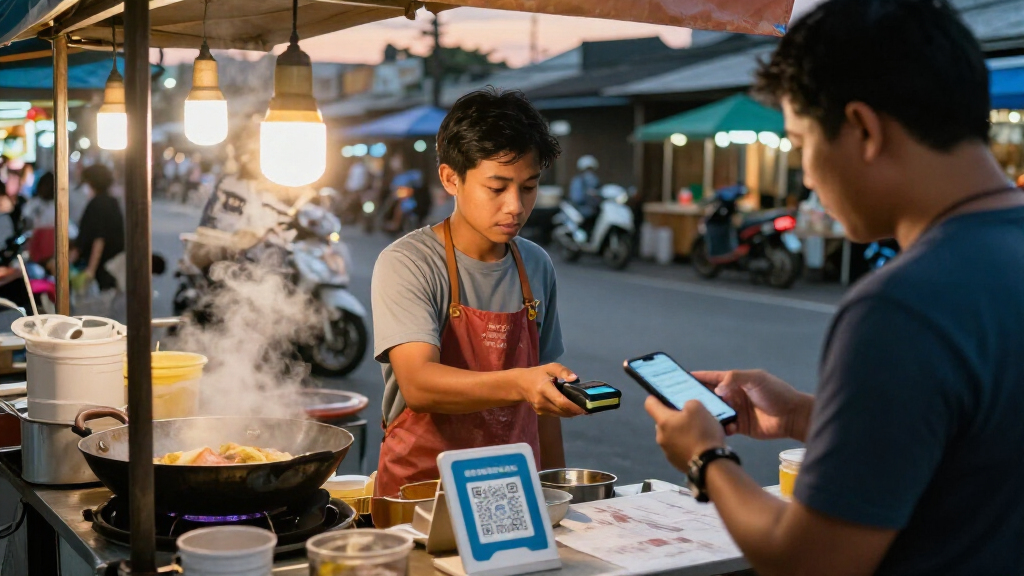

🔍 Read the full analysis: 5 Trends Behind Southeast Asia’s $368 Billion Digital Economy on ThorstenMeyerAI.com

Get the latest gadgets delivered free with Prime
- Fast, free delivery on millions of items
- Prime Video, Amazon Music and more included
- Member-only deals all year
TL;DR
Google, Temasek and Bain & Company forecast Southeast Asia’s digital economy will reach $368 billion in gross merchandise value in 2026, up 17% from 2025. Their report links the outlook to wider generative AI use but says data-center capacity, energy and consumer protections will affect how that growth develops.
Google, Temasek and Bain & Company forecast that Southeast Asia’s digital economy will reach $368 billion in gross merchandise value (GMV) in 2026, a 17% increase from 2025. The projection, in the 11th edition of their e-Conomy SEA report published October 21, ties continued online-market growth to expanding generative AI use while pointing to infrastructure, energy and consumer safeguards as constraints on adoption, as detailed in the original analysis.
The report, titled Building the Intelligent Economy, says 243 million people in Southeast Asia actively use generative AI, equivalent to 58% of the working population. It describes adoption as scaling four times faster than mobile internet did. The supplied report material does not explain how it defines an active user or the comparison method behind that adoption claim.
Its sector forecasts use different measures. E-commerce is projected to reach $226 billion in GMV, up 18% year on year; online travel, $59 billion in GMV, up 10%; online media, $44 billion in revenue, up 22%; and mobility and food delivery, $40 billion in GMV, up 15%. Digital financial services are forecast to reach $1.65 trillion in gross transaction value, up 16%. GMV, revenue and transaction value measure different activity and should not be combined as if they were components of one total.
The report also attributes business performance changes to AI-enabled personalization, reporting 10% higher e-commerce conversions and order-volume gains of as much as 75%, as well as a 10% to 20% increase in quality engagement for online media. The material provided does not identify the studies, comparison groups or time periods behind these figures, so they are report-reported results rather than established outcomes for all businesses.
AI Growth Raises Capacity Questions
The forecast matters beyond online sales because it frames AI adoption as part of the region’s next digital growth phase. If AI tools increasingly help users discover products, plan trips or complete transactions, they could change how platforms attract customers and how merchants reach them. The report’s numbers indicate consumer openness, but do not show how frequently people will delegate purchases or what protections they will demand.
According to the report, 75% of surveyed users would be willing to let AI agents compare prices and complete transactions, while 62% say they trust AI tools more than they did a year earlier. Those survey responses are not proof that consumers will routinely hand over transactions. The report also says 72% of users already rely on digital automation such as price tracking, suggesting familiarity with some automated features without establishing readiness for more consequential agent-led actions.
Growth also depends on physical capacity. The report estimates regional data-center capacity would need to expand about threefold over five years to support projected AI use. That requirement puts power availability, facility efficiency and access to cleaner energy alongside consumer demand as factors that could shape the pace and cost of expansion.
generative AI tools for online shopping
As an affiliate, we earn on qualifying purchases.
As an affiliate, we earn on qualifying purchases.
How the Report Measures Growth
The e-Conomy SEA report is an annual assessment by Google, Temasek and Bain & Company. Its 2026 edition presents generative AI as increasingly integrated into daily life and projects a digital economy total using GMV. GMV records the value of goods and services transacted through digital platforms; it is not the same as platform revenue or the value retained by companies.
The report identifies consumer protections as conditions for agent-led commerce. It says 44% of respondents want robust privacy protections, 36% want clear explanations of what AI can and cannot do, and 30% want a way to reverse transactions initiated by AI agents. These stated preferences describe survey responses, not rules already in force across the region.
On infrastructure and policy, the report points to Singapore’s Digital Infrastructure Bill, which includes binding power usage effectiveness rules, and Malaysia’s Corporate Renewable Energy Supply Scheme as a model for clean-energy access. It also identifies the ASEAN Digital Economy Framework Agreement as a planned region-wide digital trade pact expected in November 2026.
“Building the Intelligent Economy”
— Google, Temasek and Bain & Company, e-Conomy SEA 2026 report
Forecast Limits and Open Questions
The $368 billion figure is a forecast for 2026, not a final measurement of the year’s results. The supplied material does not include the full methodology, country-by-country projections or the assumptions behind the report’s projection that the digital economy could exceed $1 trillion by 2035. It also does not explain how “active” generative AI use was measured or provide the baseline for the four-times-faster adoption comparison.
The same limits apply to reported business and consumer results: underlying study details and survey methods are not provided here. The report’s projection of a 60-fold increase in AI usage by 2030 is also a forecast, dependent on factors including model costs, computing capacity, electricity supply and actual consumer behavior. The material does not quantify the cost or emissions associated with the required data-center expansion.
November Pact and Capacity Plans
The next policy milestone identified by the report is the ASEAN Digital Economy Framework Agreement, expected in November 2026. Its development may clarify plans for region-wide digital trade, but the supplied material does not detail the pact’s final provisions or confirm its completion.
Businesses and policymakers will also face decisions about data-center capacity, energy efficiency and consumer protections as AI use grows. The report gives a regional capacity estimate but does not set out project timelines or a financing plan. The 2026 market forecast can be checked against final-year results once those data are available.
Key Questions
What is the $368 billion figure measuring?
It is the report’s forecast for Southeast Asia’s 2026 digital-economy GMV, up 17% year on year. GMV measures the value of transactions through digital platforms, not company revenue.
Which sectors are included in the report’s projections?
The report gives forecasts for e-commerce, online travel, online media, mobility and food delivery, and digital financial services. Their figures use different measures, including GMV, revenue and gross transaction value, so they are not directly additive.
How widespread does the report say generative AI use is?
The report says 243 million people in Southeast Asia actively use generative AI, or 58% of the working population. The supplied material does not define how “actively use” was measured.
What could limit AI-related growth?
The report points to computing capacity, power supply, energy efficiency and consumer safeguards. It estimates data-center capacity would need to grow about threefold over five years, but does not quantify the cost or emissions of that expansion.
Primary source: Google AI · via ThorstenMeyerAI.com
Halloween Picks
halloween
As an affiliate, we earn on qualifying purchases.