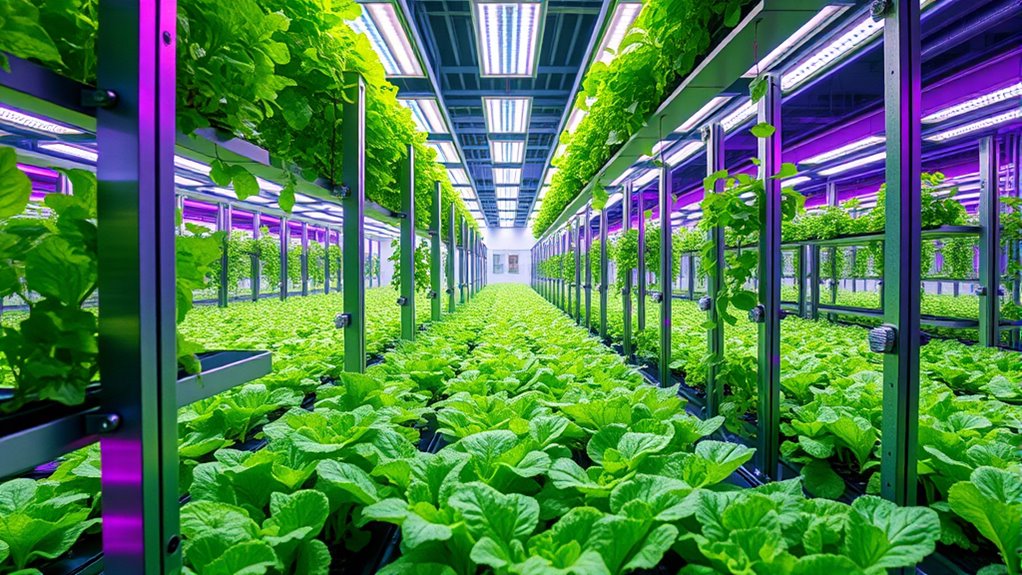

Indoor farming allows you to grow fresh food and greens all year round using advanced technology like hydroponics, aquaponics, and aeroponics. These methods recycle water and nutrients, conserving resources and minimizing land use. Controlled environments optimize light, temperature, and humidity for perfect growth, boosting crop quality while reducing pests and chemical use. By incorporating automation and smart sensors, indoor farming becomes efficient and eco-friendly. Keep exploring to discover how this innovative approach can transform your food sources.
Key Takeaways
- Indoor farming uses controlled environment agriculture (CEA) to optimize conditions for growing food and greens year-round.
- Techniques like hydroponics, aeroponics, and aquaponics enable soil-free cultivation with high water efficiency.
- Vertical farming maximizes space, allowing multiple crop layers within small indoor areas.
- Precise control of light, temperature, humidity, and CO2 enhances crop quality and flavor.
- Automation and IoT sensors improve resource use, reduce labor costs, and ensure consistent harvests.
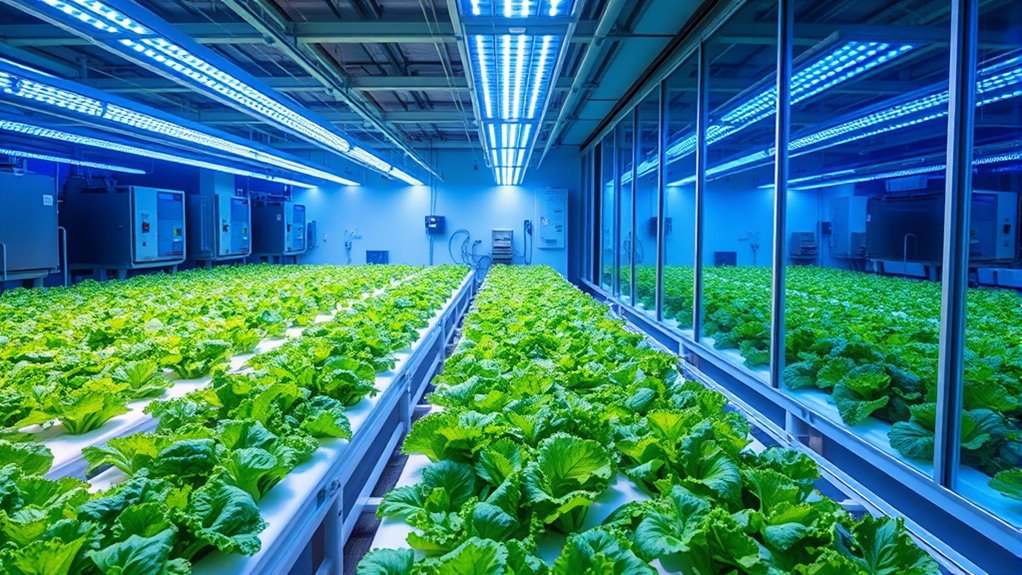
Have you ever wondered how urban areas can produce fresh, healthy food year-round despite limited space and changing climate conditions? Indoor farming makes this possible by utilizing sustainable practices and technological innovations that transform small indoor spaces into productive farms. This approach involves growing crops under carefully controlled environmental conditions, often using vertical stacking systems to maximize space efficiency. Technologies like hydroponics, aquaponics, and aeroponics allow plants to grow without soil, reducing land dependency and boosting productivity. These systems recycle water and nutrients through closed-loop setups, making water use up to 98% more efficient than traditional farming while avoiding soil degradation. Such sustainable practices help conserve resources, preserve land, and lower the environmental footprint of food production.
Controlled environment agriculture (CEA) is at the core of indoor farming. It lets you precisely regulate temperature, humidity, light, and CO2 levels, creating ideal conditions for plant growth regardless of outdoor weather or seasons. This means you can grow crops continuously throughout the year, achieving consistent harvests and improved food security. For example, farms like 26 Seasons grow strawberries year-round, demonstrating how environmental control reduces variability and risks from pests, diseases, and weather disturbances. The use of advanced lighting systems that simulate natural sunlight, combined with automation and IoT sensors, ensures plants receive the right amount of light and nutrients. These technological innovations not only maximize growth but also reduce operational costs by automating tasks like watering, nutrient delivery, and climate adjustments. Such technology also enables remote monitoring and data-driven decision-making to optimize crop production.
Indoor farming with controlled environments ensures year-round crop growth, reducing risks and optimizing efficiency through advanced technology.
Vertical farming maximizes space by stacking multiple crop layers within a confined area, making it ideal for urban environments and non-arable land. This setup dramatically reduces the need for extensive land use, helping to free up rural areas and protect natural ecosystems. Additionally, indoor farms are located close to consumers, cutting down transportation time and emissions, which considerably lowers the overall carbon footprint of food supply chains. The integration of robotics, machine learning, and smart sensors ensures resource use is refined, further lowering costs while increasing output quality. Crops grown indoors tend to be cleaner, safer, and of higher quality since the controlled environment eliminates pests and minimizes the need for chemical pesticides. Light regulation can also enhance flavor, nutrient content, and overall crop quality. Moreover, the use of precision agriculture techniques in indoor farming allows for fine-tuned resource management, boosting efficiency even further.
Economic benefits are considerable. Automation and efficient resource management decrease labor costs—by an estimated 30%—and allow for rapid crop turnover. This means fresher produce is available to consumers more frequently, supporting local economies and reducing dependency on imported food. Indoor farming combines sustainable practices with technological innovations to create a resilient, efficient, and environmentally friendly food system suitable for today’s urban landscapes. It’s a future-forward approach that addresses land scarcity, climate change, and food security by producing healthy, high-quality food year-round in the most resource-efficient way possible.

Ahopegarden Indoor Garden Hydroponics Growing System: 10 Pods Plant Germination Kit Herb Vegetable Growth Lamp Countertop with LED Grow Light – Hydrophonic Planter Grower Harvest Lettuce
High planting efficiency: Start an indoor herb garden with the Ahopegarden hydroponic growing system, which includes a water…
As an affiliate, we earn on qualifying purchases.
As an affiliate, we earn on qualifying purchases.
Frequently Asked Questions
What Are the Initial Costs of Setting up an Indoor Farm?
Your initial setup costs for an indoor farm involve a detailed cost analysis, focusing on equipment expenses and facility costs. Expect to spend on LED lighting, climate control systems, hydroponic infrastructure, and automation technology—these can range from $30,000 to over $200,000. Additionally, you’ll need to budget for building construction, insulation, and environmental controls, with total initial costs often reaching hundreds of thousands of dollars.
How Does Indoor Farming Impact Energy Consumption?
Think of indoor farming as a lighthouse shining in the darkness—bright but demanding. It consumes a lot of energy, mainly from lighting and climate control, making it costly and environmentally intensive. You can reduce this impact by integrating renewable energy sources and adopting energy efficiency technologies, like efficient LEDs and passive climate control. These steps help lower energy use, making indoor farming more sustainable and less vulnerable to rising energy prices.
What Are Common Pests in Indoor Farming Environments?
You’ll encounter common pests like aphids, whiteflies, spider mites, thrips, and fungus gnats in indoor farming environments. To guarantee effective pest management and crop protection, regularly inspect plants for signs like webbing, speckles, or visible insects. Use sticky traps, sterilize equipment, and consider biological controls to keep pests at bay. Prompt detection and integrated pest management strategies are essential to prevent infestations and maintain healthy crops indoors.
How Do Indoor Farms Ensure Crop Safety and Hygiene?
Imagine you’re in a high-tech greenhouse, like a spaceship. You guarantee crop safety by implementing strict sanitation protocols and pest management practices. You disinfect tools, surfaces, and equipment regularly, and monitor for pests and diseases. Using biological controls and maintaining ideal environmental conditions reduces risks. These steps keep your crops healthy, safe, and free from contamination, ensuring fresh produce reaches consumers while preventing microbial hazards and pest infestations.
Can Indoor Farming Be Scaled for Commercial Production?
Yes, indoor farming can be scaled for commercial production by focusing on vertical integration and market scalability. You can optimize space with vertical stacking and automate systems using AI and IoT, boosting productivity. While high initial investments pose challenges, expanding infrastructure and reducing operational costs through technological advancements make large-scale indoor farms viable. These strategies help meet growing demand, ensuring consistent supply and profitability in the competitive indoor farming market.

Barrina Vertical Grow Light T10, 42W 5000K, Full Spectrum LED Plant Light for Indoor,Standing Wide Coverage, 4FT Height with On/Off Switch and Tripod Floor Stand
Broad and Vertical Lighting: Illuminate your indoor plants with the Barrina Vertical Standing Grow Light. With its 4FT…
As an affiliate, we earn on qualifying purchases.
As an affiliate, we earn on qualifying purchases.
Conclusion
Just like Da Vinci’s innovative spirit, indoor farming pushes boundaries and transforms how we grow food. By embracing this modern revolution, you become part of a movement that’s shaping a sustainable future—think of it as planting the seeds for tomorrow’s abundance today. With each greens you nurture indoors, you’re helping turn the page from traditional methods to a new chapter of efficiency and environmental harmony. The future of food is in your hands—ready to cultivate change?

LetPot LPH-SE Hydroponics Growing System, 12 Pods Smart Herb Garden Kit Indoor, Indoor Garden, APP & WiFi Controlled, with 24W Growing LED, 5.5L Water Tank, Pump System, Automatic Timer
PATENTED SMART HYDROPONIC SYSTEM: Take your indoor gardening to the next level with our patented smart hydroponic system,…
As an affiliate, we earn on qualifying purchases.
As an affiliate, we earn on qualifying purchases.

RAINPOINT Smart Digital Wireless Plant Moisture Meter Houseplants Indoor WiFi Hub Kit with Low/High Moisture Alert,Real-time Monitor Hygrometer Sensor Outdoor Gardening Push Notification&Email
【2️⃣Two Ways Of Use】 When used alone, the large display give you an at-a-glance snapshot of current conditions….
As an affiliate, we earn on qualifying purchases.
As an affiliate, we earn on qualifying purchases.