
📊 Full opportunity report: IEP Negotiation Rehearsal Simulator For Parents on IdeaNavigator AI — validation score, market gap, and execution plan.

Get the latest gadgets delivered free — and shop member deals
- Fast, free delivery on millions of items
- Access to Prime Big Deal Days deals on October 6–7
- Prime Video, Amazon Music and more included
TL;DR
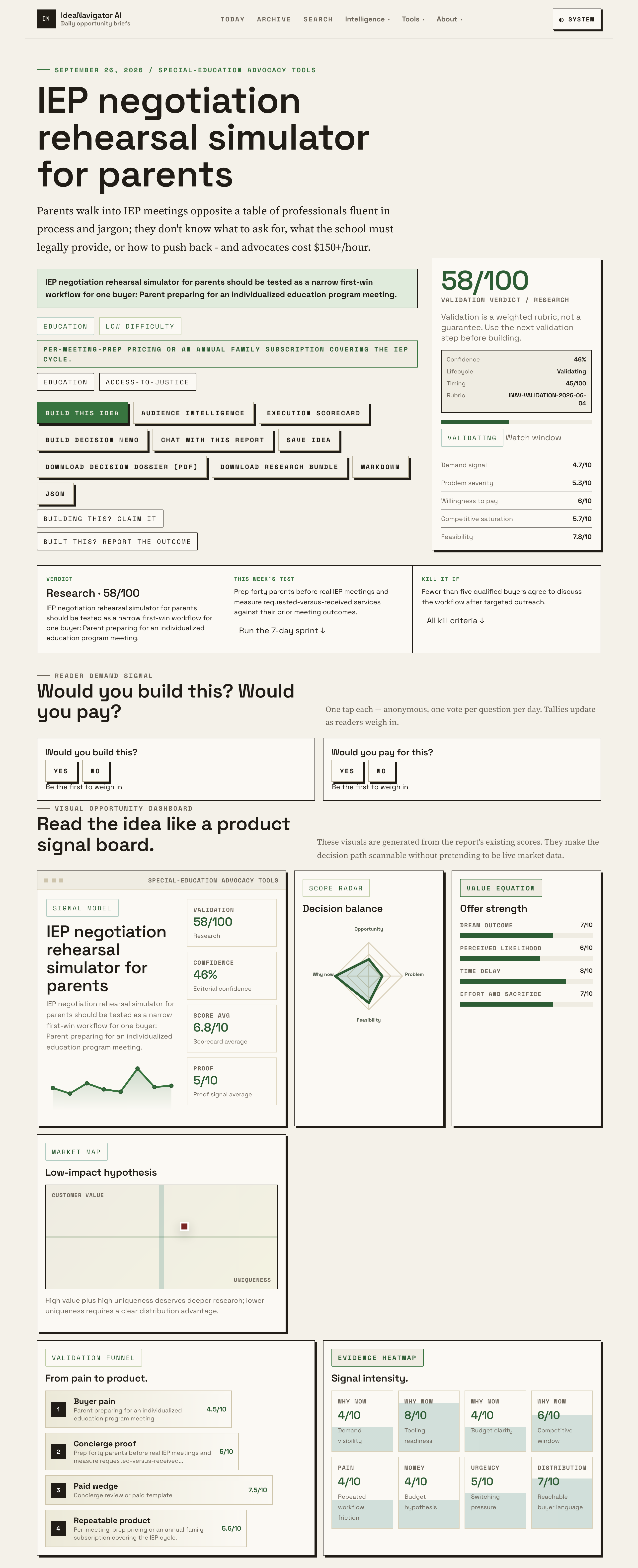
IdeaNavigator AI has outlined a proposed IEP meeting rehearsal simulator for parents, with tools to explain documents, prepare requests and practice responding to school pushback. The concept has not been reported as a launched or validated product; its suggested test is to prepare 40 parents and compare meeting outcomes with their prior experiences.
IdeaNavigator AI has proposed an IEP meeting rehearsal simulator for parents preparing to discuss a child’s services with a school team. The concept would turn a family’s current education plans and evaluation reports into plain-language explanations, a list of potential requests and a practice meeting, but no launch, test results or demonstrated outcomes were reported.
The proposed tool is aimed at one specific user: a parent preparing for an individualized education program (IEP) meeting. Parents could upload an existing IEP and evaluation reports. The simulator would explain the documents in plain language, help generate a list of requests with legal grounding, then role-play a meeting that includes realistic responses from school representatives.
The stated goal is to help parents identify questions and maintain their positions during a meeting. The proposal says families may face professionals familiar with education procedures and terminology, while private advocates can cost $150 or more per hour. That figure is presented as part of the proposal; no pricing survey or geographic breakdown was provided.
For an initial test, IdeaNavigator AI suggests preparing 40 parents before real IEP meetings and comparing the services they request with those they receive. The comparison would also use each family’s outcomes from a previous meeting. The proposal does not report that this study has started, or define how outcomes would be measured.
Testing Support Before IEP Meetings
If developed and evaluated, the simulator could offer parents a way to practice meeting conversations and organize questions before sitting down with school staff. Plain-language explanations could help families understand the documents they already have, while role-play could let them rehearse how to respond when a request is questioned or declined.
The proposal also points to the cost of individual advocacy as a reason to explore a software-based preparation option. Whether such a tool could provide useful, accurate guidance at lower cost remains unproven. Its potential value would depend on the quality of its explanations, how carefully it handles legal details and whether parents find its practice scenarios relevant to real meetings.
Top picks for "negotiation rehearsal simulator"
As an affiliate, we earn on qualifying purchases.
The Proposed Preparation Workflow
An IEP sets out an eligible student’s special education and related services. The proposed workflow starts with documents the family already has: the current IEP and evaluation reports. It then moves from explanation to preparation, producing a request list before simulating discussion with a school team.
The proposal describes this as a focused first product for one buyer rather than a broad special education platform. Possible payment models include a fee for each meeting-preparation session or an annual family subscription covering an IEP cycle. No price, product name or commercial availability was specified.
IdeaNavigator AI frames the timing around language-model role-play capabilities and pressure on special education resources. It also says identification rates are rising and meetings are becoming more adversarial. The proposal supplies no data, timeframe or independent evidence for those broader claims, so they remain rationale offered for the idea rather than verified findings about schools generally.
Accuracy and Outcomes Still Unknown
The proposal does not establish that a simulator has been built, released or used by families. It gives no evidence that language-model role-play can reproduce the range of IEP meeting interactions or that the suggested legal grounding would be accurate for a particular family’s situation.
It is also unclear how the tool would protect sensitive education and evaluation records, how often its guidance would be reviewed, or what safeguards would prevent families from treating generated explanations as individualized legal advice. No details were provided on the 40-parent test’s recruitment, comparison method, duration or criteria for success.
A Forty-Family Test Proposed
The next step described is a pilot with 40 parents preparing for actual IEP meetings. The proposed comparison would track requested and received services and consider each participant’s prior meeting outcomes. IdeaNavigator AI has not said whether it will conduct the pilot, when it might begin or who would oversee it.
Until a product and evaluation are reported, the simulator remains a concept. Evidence from a clearly defined pilot would be needed to assess whether parents find it usable and whether meeting outcomes differ from their previous experiences.
Source: IdeaNavigator AI
Key Questions
Is the IEP meeting simulator available now?
No launch or public availability was reported. The simulator is described as a proposed product concept.
What would the proposed simulator do?
It would use a parent’s IEP and evaluation reports to explain the documents, prepare a list of possible requests and role-play a meeting with school representatives.
Has the tool been shown to improve IEP outcomes?
No results were provided. The proposal recommends a test with 40 parents and a comparison of requested and received services against prior meeting outcomes.
Would the simulator replace an advocate?
The proposal presents the tool as meeting preparation and gives no evidence that it can replace an advocate or provide individualized legal advice.
Source: IdeaNavigator AI
Fall Picks
fall essentials
As an affiliate, we earn on qualifying purchases.