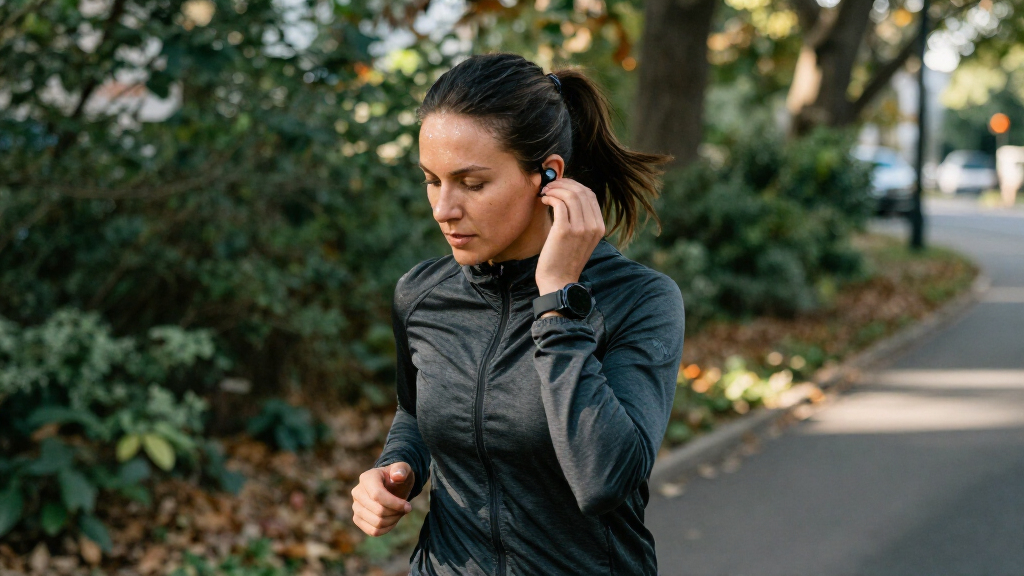

Choosing the right wireless earbuds for workouts often leads to a specific crossroads for Apple users and fitness enthusiasts alike. The decision typically narrows down to two flagship contenders: the Powerbeats Pro and the AirPods Pro. While both operate seamlessly within the Apple ecosystem, they serve fundamentally different philosophies regarding how fitness audio should function. The Powerbeats Pro, with their signature ear hooks, are built specifically to stay put during high-intensity interval training and running. In contrast, the AirPods Pro rely on a standard stem design but compensate with advanced active noise cancellation and a smaller footprint.

Get the latest gadgets delivered free with Prime
- Fast, free delivery on millions of items
- Prime Video, Amazon Music and more included
- Member-only deals all year

JBL Vibe Beam True Wireless Earbuds, Black
- ✔ Battery Life: Up to 32 hours total
- ✔ Charging: 10 mins for 2 hrs playback
- ✔ Water Resistance: Splash and dust resistant

Aptkdoe HD65 Wireless Sport Earbuds with Ear Hooks, Bluetooth 5.4, IPX7 Waterproof, Black
- ✔ Battery Life: Up to 75 hours total
- ✔ Water Resistance: IPX7 Waterproof
- ✔ Driver Size: 14.2 mm

Soundcore V20i Open-Ear True Wireless Earbuds
- ✔ Battery Life: Up to 36 hours total
- ✔ Design: Open-ear with hooks
- ✔ Driver Size: 16 mm
The core tension here is between physical security and audio isolation. If you are a runner or a HIIT athlete, the fear of losing a $250 earbud mid-sprint is a genuine concern. This is where the Powerbeats Pro excel. However, if your workout routine includes heavy gym machines, swimming pools nearby, or if you commute to the gym via public transit, the noise isolation of the AirPods Pro becomes a significant advantage. This guide breaks down the practical differences to help you decide which pair belongs in your gym bag.
At a Glance
| Criteria | Powerbeats Pro | AirPods Pro (2nd Gen) | Winner |
|---|---|---|---|
| Fit and Stability | Ear hooks provide exceptional stability | Standard fit, may shift during vigorous movement | A |
| Sweat and Water Resistance | IPX4 rated, handles heavy sweat | IP54 rated, dust and sweat resistant | B |
| Noise Isolation | Passive isolation only | Active Noise Cancellation and Transparency | B |
| Battery Life | 9 hours per charge | 6 hours per charge (ANC on) | A |
| Case Size and Portability | Large, bulky charging case | Compact, pocket-friendly case | B |
| Sound Profile | Bass-heavy, energetic | Balanced, clear mids and highs | Depends |
| Controls | Physical buttons on earbud | Force sensor on stem | A |
JBL Vibe Beam True Wireless Earbuds, Black
The JBL Vibe Beam carves out a niche for those who prioritize speed and sound quality over extreme ruggedness. Unlike the Aptkdoe HD65, which focuses on marathon-length endurance, the Vibe Beam is engineered for the modern, time-crunched gym-goer. Its standout feature is the rapid charging capability; a mere 10-minute charge delivers up to two hours of playback. This is a significant advantage over the Soundcore V20i, which requires a longer charge cycle for similar usage. The JBL Deep Bass Sound is tuned specifically for workout playlists, providing the low-end punch needed to maintain rhythm during weightlifting. However, this model uses a traditional stick-style design rather than ear hooks. While the ergonomic shape helps with fit, it does not offer the same level of mechanical security as the Aptkdoe or Soundcore during vigorous jumping or running. It is splash and dust resistant, which handles sweat well, but it lacks the IPX7 rating of the Aptkdoe, meaning it should not be submerged or exposed to heavy rain. For users who value Smart Ambient features, the JBL allows you to hear your surroundings without removing the buds, though this is less effective than the open-ear design of the Soundcore.
Pros:
- 10-minute speed charge provides up to 2 hours of playback.
- JBL Deep Bass Sound is optimized for high-energy workout music.
- Smart Ambient and TalkThru features allow for situational awareness.
- Compact charging case fits easily in gym shorts pockets.
Cons:
- Stick-style design lacks the mechanical security of ear hooks.
- Lower water resistance rating compared to IPX7 competitors.
- Closed design can feel isolating without ambient mode enabled.
Best for: Gym-goers with short, intense sessions who need fast charging and strong bass response.
Not ideal for: Outdoor runners in wet conditions or those who need absolute earbud security during high-impact jumping.
Bottom line: The JBL Vibe Beam is the best choice for convenience, offering unmatched charging speed and solid bass for indoor gym sessions.
“The JBL Vibe Beam is the best choice for convenience, offering unmatched charging speed and solid bass for indoor gym sessions.”
Aptkdoe HD65 Wireless Sport Earbuds with Ear Hooks, Bluetooth 5.4, IPX7 Waterproof, Black
If your workouts involve heavy sweating or long durations, the Aptkdoe HD65 is the most robust option in this lineup. It distinguishes itself through its IPX7 water resistance and massive battery capacity. While the JBL Vibe Beam offers quick top-ups, the Aptkdoe provides up to 15 hours of playback on a single charge and 75 hours with the case. This is more than double the total battery life of the JBL and significantly more than the Soundcore. The flexible ear hooks are a critical design choice, physically locking the earbuds in place during burpees, sprints, or cycling. This mechanical security is far superior to the friction-based fit of the JBL. The 14.2 mm drivers provide a larger soundstage than the JBL’s 8 mm drivers, though the tuning is less focused on deep bass and more on clear, balanced audio. The inclusion of a dual LED display on the charging case is a practical touch, allowing you to check battery levels at a glance without opening the case. However, the in-ear hook design can feel bulky for some users, particularly those who prefer minimalist, invisible earbuds. It is a tool built for performance, not for discreet office use.
Pros:
- IPX7 rating ensures complete protection against sweat and rain.
- 75 hours of total battery life is the highest in this comparison.
- Ear hooks provide superior stability during high-intensity movement.
- Dual LED display shows precise battery status.
Cons:
- Bulky design may be uncomfortable for sleeping or casual listening.
- Ear hooks may not fit well with certain helmet or hat configurations.
- Larger charging case takes up more pocket space.
Best for: Runners, cyclists, and athletes who need extreme battery life and waterproofing for long sessions.
Not ideal for: Users who prefer a compact, low-profile earbud or those who dislike the sensation of ear hooks.
Bottom line: The Aptkdoe HD65 is the definitive choice for endurance athletes who prioritize battery life and waterproofing over aesthetics.
“The Aptkdoe HD65 is the definitive choice for endurance athletes who prioritize battery life and waterproofing over aesthetics.”
Soundcore V20i Open-Ear True Wireless Earbuds
The Soundcore V20i takes a completely different approach to the problem of workout audio by rejecting the traditional in-ear seal. Its open-ear design allows ambient noise to enter naturally, making it the safest option for outdoor runners, cyclists, and hikers who need to hear traffic or other people. Unlike the JBL, which requires software to simulate ambient sound, the Soundcore achieves this physically. The 16 mm drivers with BassUp technology surprisingly deliver decent low-end response for an open-ear model, though they cannot match the isolation or bass depth of the JBL Vibe Beam. The adjustable ear hooks with four positions offer a customizable fit that rivals the security of the Aptkdoe, but with less bulk. The integration of the soundcore app adds significant value, offering HearID hearing profiles and EQ customization, a feature absent in the Aptkdoe and limited in the JBL. However, the open design means you will hear every clank of the weight rack and every conversation in the gym, which can be distracting if you prefer immersion. Battery life is capped at 8 hours per charge, matching the JBL but falling short of the Aptkdoe’s endurance. It is a specialized tool for those who refuse to compromise on safety.
Pros:
- Open-ear design maintains full situational awareness.
- Adjustable ear hooks provide a secure and customizable fit.
- App support includes HearID and Spatial Audio customization.
- IP55 rating handles sweat and light rain effectively.
Cons:
- Lacks sound isolation, allowing gym noise to interfere.
- Bass response is weaker than in-ear competitors.
- Battery life is limited to 8 hours per charge.
Best for: Outdoor runners and cyclists who need to hear their environment for safety reasons.
Not ideal for: Gym-goers who want to block out noise or bass enthusiasts who require deep low-end isolation.
Bottom line: The Soundcore V20i is the ideal choice for safety-conscious athletes who need to stay aware of their surroundings.
“The Soundcore V20i is the ideal choice for safety-conscious athletes who need to stay aware of their surroundings.”
As an Amazon Associate we earn from qualifying purchases.
Key Differences
The most glaring difference between these two pairs is how they interact with your body during movement. The Powerbeats Pro use an over-ear hook that locks the earbud into place. This design is virtually immune to falling out during burpees, sprints, or weightlifting where you might sweat heavily or move your head rapidly. The AirPods Pro, while comfortable for walking or light jogging, rely on a friction fit within the ear canal. For users with smaller ears or those who wear headbands, the AirPods Pro can feel less secure, leading to constant adjustments during a workout.
Audio technology represents the second major divide. The AirPods Pro feature Active Noise Cancellation, which is a game-changer for noisy gyms. It dampens the clanking of weights and loud music from gym speakers, allowing you to listen at lower volumes and protecting your hearing. The Powerbeats Pro offer no electronic noise cancellation; they rely solely on the physical seal of the ear tip. If you train in a chaotic environment, the AirPods Pro provide a focused bubble of audio that the Powerbeats simply cannot match. Conversely, if you run outdoors, the lack of ANC on the Powerbeats means you are more aware of your surroundings, which can be a safety feature.
Detailed Comparison
Fit and Stability (Powerbeats Pro wins — major)
This is the primary reason many athletes choose Powerbeats Pro. The ear hook mechanism anchors the device to the concha of your ear, creating a mechanical lock that friction-based buds cannot replicate. During high-impact activities like jump rope or box jumps, the Powerbeats remain stationary. The AirPods Pro, while improved with different tip sizes, still rely on suction and shape. For many users, vigorous head movement causes them to loosen. If your priority is ‘set it and forget it’ stability, the Powerbeats win decisively. The gap is major for runners and HIIT participants, though moderate for weightlifters who move less dynamically.
Noise Isolation and Awareness (AirPods Pro (2nd Gen) wins — major)
The AirPods Pro dominate this category due to Active Noise Cancellation. In a gym filled with loud equipment and background music, ANC reduces ambient noise significantly, allowing for clearer audio playback without cranking the volume to dangerous levels. The Powerbeats Pro offer zero electronic isolation. They block some noise via the ear tip seal, but low-frequency hums and sudden loud noises penetrate easily. However, for outdoor runners, the Powerbeats’ transparency is an asset. You hear cars and cyclists clearly without needing a specific ‘transparency mode.’ The AirPods Pro do have a transparency mode, but it is digitally processed, which some users find less natural than passive hearing.
Durability and Sweat Resistance (AirPods Pro (2nd Gen) wins — minor)
Both earbuds are rated IPX4, meaning they are splash-proof and can handle sweat and rain. However, the AirPods Pro (2nd Generation) have an IP54 rating, which adds protection against dust. This is a minor but meaningful upgrade for gym bags that accumulate chalk dust or sand. The Powerbeats Pro have larger nozzles and a more exposed design, which some users find harder to clean thoroughly after heavy sweating. While both will survive a sweaty session, the AirPods Pro’s sealed design is slightly more resilient to particulate matter over time. The difference is minor for casual users but relevant for serious athletes who train daily.
Battery Life and Charging (Powerbeats Pro wins — moderate)
The Powerbeats Pro offer a substantial advantage in raw playback time, delivering up to 9 hours on a single charge. This is enough for multiple long workouts or a full day of intermittent use without needing the case. The AirPods Pro provide around 6 hours with noise cancellation enabled. While the charging case adds extra charges to both, the frequency of recharging the earbuds themselves is lower with the Powerbeats. If you forget to charge your case regularly, the Powerbeats’ longer endurance is a significant convenience. For most users, however, the difference is manageable since both cases provide over 24 hours of total battery life.
Portability and Case Design (AirPods Pro (2nd Gen) wins — major)
The AirPods Pro charging case is compact, rounded, and slips easily into a pocket or small gym pouch. The Powerbeats Pro case is large, rectangular, and bulky due to the ear hooks. It is difficult to carry in tight leggings pockets or small running vests. This makes the AirPods Pro far superior for users who want a minimal footprint when not exercising. If you carry your earbuds everywhere, the weight and size of the Powerbeats case become a noticeable burden. The gap here is significant for minimalist commuters but negligible for those who keep the case in a large gym bag.
Powerbeats Pro: Pros and Cons
Pros:
- Unmatched stability during high-intensity movement
- Longer battery life per charge (9 hours)
- Physical buttons are easy to use with sweaty hands
- Natural sound transparency for outdoor safety
Cons:
- Bulky charging case is hard to carry
- No active noise cancellation
- Ear hooks can interfere with headphones or headbands
- Bass-heavy sound may fatigue listeners over time
AirPods Pro (2nd Gen): Pros and Cons
Pros:
- Active Noise Cancellation for noisy gyms
- Compact case fits in any pocket
- Balanced sound quality with clear vocals
- IP54 dust resistance adds durability
Cons:
- Less secure fit during vigorous activity
- Shorter battery life with ANC on (6 hours)
- Touch controls can be finicky when wet
- Higher risk of loss if earbud falls out
Who Should Choose What
Choose Powerbeats Pro if:
- You run, sprint, or do high-impact HIIT regularly
- You have struggled with earbuds falling out in the past
- You prefer physical buttons over touch controls
- You train in environments where hearing surroundings is critical for safety
Choose AirPods Pro (2nd Gen) if:
- You lift weights or do low-impact cardio in noisy gyms
- You need noise cancellation to block out gym music and chatter
- You want earbuds that are easy to carry in small pockets
- You value balanced audio quality for music variety
Skip both if: If you swim regularly, as neither is fully waterproof for submersion, or if you have very large ears where the Powerbeats hooks feel tight and the AirPods tips feel loose.
Value for Money
Both pairs sit in the premium price bracket, typically ranging from $200 to $250. The question is whether the specific features justify the cost for your lifestyle. For the dedicated athlete, the Powerbeats Pro offer better value because their core feature—stability—is something you cannot easily add to other buds. If you buy AirPods Pro and they fall out during a run, you have wasted money on a product that fails its primary job for you. Conversely, if you buy Powerbeats Pro and hate the bulk, or if you live in a noisy city and need ANC for your commute to the gym, the AirPods Pro deliver more utility per dollar. The ‘right’ value depends entirely on whether you prioritize physical security or audio isolation.
Final Verdict
For the vast majority of serious fitness enthusiasts, the Powerbeats Pro are the superior choice. Their unshakeable fit solves the most common annoyance of wireless workout earbuds: losing them mid-exercise. The lack of noise cancellation is a tradeoff worth making if you train in a controlled environment or outdoors. However, if your ‘workout’ includes a commute, a noisy gym session, and casual listening, the AirPods Pro are the more versatile and practical device. Choose the Powerbeats Pro if you need gear that survives the gym floor. Choose the AirPods Pro if you need gear that survives your daily life.
Frequently Asked Questions
Are Powerbeats Pro good for swimming?
No. While they are sweat and water-resistant (IPX4), they are not waterproof. Submerging them in a pool will likely damage them. You need specialized swim headphones for aquatic exercise.
Can I use AirPods Pro for running?
Yes, but with caution. Many users run successfully with them, especially if they use the smallest ear tip size or add aftermarket ear wings. However, they are more prone to falling out than the Powerbeats Pro during high-impact strides.
Do Powerbeats Pro have noise cancellation?
No. The Powerbeats Pro rely entirely on passive isolation from the ear tips. They do not have Active Noise Cancellation or Transparency mode features found in the AirPods Pro.
Which is more comfortable for long sessions?
Most users find the AirPods Pro more comfortable for all-day wear because they sit inside the ear and disappear. The Powerbeats Pro have an external hook that can press against pillows or hats, making them less ideal for casual, non-workout wear.