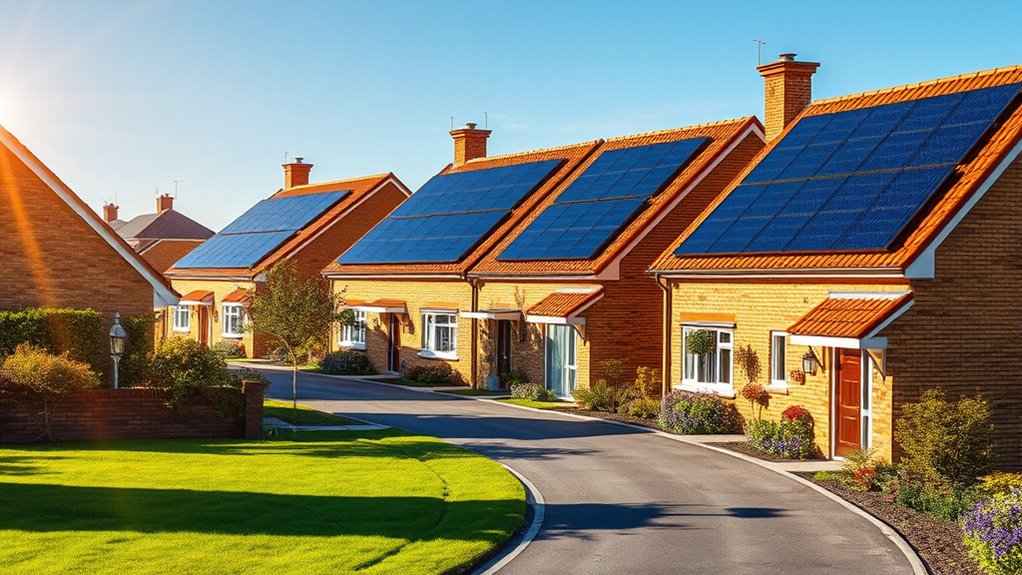

Starting in 2025, new homes in the UK will be required to have solar panels, covering at least 40% of the ground floor if feasible. This law aims to boost renewable energy, cut energy bills, and increase property values. It will also create more jobs and foster technological innovation. As solar becomes a standard feature, homes will be more sustainable and future-proof. To discover how these changes could impact you, keep exploring this bright new era.
Key Takeaways
- All new homes in England must have solar panels installed from 2025, covering at least 40% of ground floor area where feasible.
- The regulation aims to boost UK solar capacity to 45-47 GW by 2030, supporting decarbonization and energy security.
- Increased demand will grow local manufacturing, create jobs, and foster technological advancements in solar energy.
- Households will benefit from cost savings, increased property value, and government incentives like grants and financing options.
- Public and political support, including over 80% of MPs, underpins the widespread adoption of solar panels on new homes.
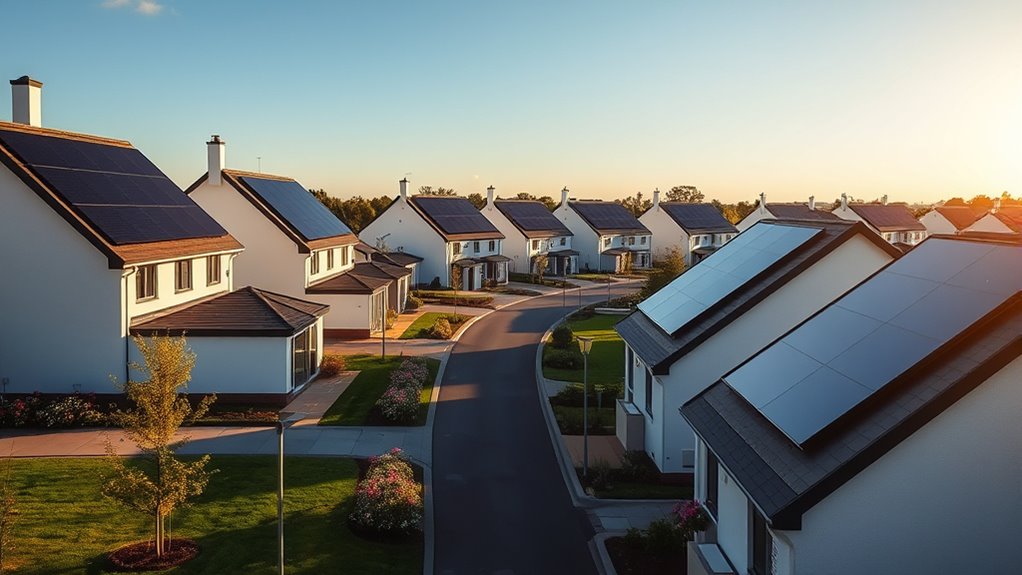
Starting in 2025, all new homes in England will be required to have solar panels installed, making renewable energy a standard feature of modern housing. This shift aims to accelerate the country’s move toward cleaner energy, reduce carbon emissions, and lower household energy bills. As a homeowner or builder, you’ll notice that the government’s policies emphasize not only the mandatory installation but also the importance of supporting industries like solar panel manufacturing. Increased demand for solar panels will boost local production, creating jobs and fostering technological advancements in solar technology. The regulations specify that developers must cover at least 40% of the ground floor area with solar panels where feasible; if not, they are required to install a “reasonable amount,” ensuring most new homes benefit from solar energy. This requirement is part of a broader push under the Future Homes Standard, scheduled to be published in autumn 2025, which mandates solar panels on the vast majority of new builds, with only rare exceptions such as properties heavily shaded. The policy also includes a target to increase the UK’s solar capacity to 45-47 GW by 2030, aligning with national decarbonization goals. Additionally, the government is actively promoting renewable energy through various outreach programs to encourage widespread adoption. The government has also introduced homeowner incentives to encourage adoption. These incentives could include grants, subsidies, or financing options aimed at reducing upfront costs, making solar installations more affordable for new homeowners. Industry experts expect these incentives to grow, helping to make solar panels a common feature in new homes, much like traditional roofing materials. The public and political support for these measures is strong; polls show that over 80% of MPs, including many from Labour, back mandatory solar panels, with additional backing for battery storage. This broad support signals that renewable energy integration is a priority for policymakers, industry stakeholders, and the public alike.
Starting in 2025, new homes in England must have solar panels covering at least 40% of the ground floor area.
Market trends reflect this momentum. Over 1.5 million UK homes already have rooftop solar, with recent installation rates surging—more than triple the figure from just a year earlier. In fact, by the end of 2024, 42% of new English homes had solar panels, compared to 13% at the start of the previous year. These figures suggest that the regulations are already influencing the market, and as the rules become fully enforced by 2027, the proportion of solar-equipped new builds will only increase. For you as a homeowner, this means future-proof housing that’s more energy-efficient, environmentally friendly, and potentially more valuable.
The economic benefits are clear. Most UK homes could save around £530 annually on energy costs thanks to rooftop solar, especially as energy prices continue to rise. Developers are exploring solar leasing models to manage upfront costs, making it easier for buyers to access solar benefits without significant initial investment. Additionally, solar panels will become a standard feature that adds value to new homes, making them more attractive to buyers. This push toward solar energy supports the UK’s broader goals to reach 45–47 GW of solar capacity by 2030, helping to decarbonize electricity and improve energy security. As a result, your new home will not only be more sustainable but also part of the UK’s bright future in renewable energy.

ECO-WORTHY 10KW Output 9.36KWH Off Grid Solar System Complete Kit for Home:12pcs 195W Solar Panels(2340W)+10KW 120V/240V Inverter (UL 1741)+ 2pcs 48V 100AH Lithium Batteries(UL 1973&UL 9540A)
[Ideally Output of 9.36KWH] The power of 9.36KWh per day under 4 hours full sunshine by the 2340W…
As an affiliate, we earn on qualifying purchases.
As an affiliate, we earn on qualifying purchases.
Frequently Asked Questions
What Are the Installation Costs for Solar Panels on New Homes?
Your installation costs for solar panels on new homes typically range from £5,500 to over £10,000, depending on system size, panel type, and additional components like batteries. Cost factors include roof complexity, location, and labour. The installation process involves equipment setup, permits, and wiring, with larger systems and premium panels costing more. Considering these factors helps you estimate expenses and plan for a smooth, efficient solar panel installation.
How Long Do Solar Panels Typically Last?
Think of solar panels as steadfast guardians of your energy needs, standing strong for about 25 to 30 years. Their durability of solar panels guarantees they weather the UK’s gentle climate, gradually losing efficiency like a slow-burning candle. After decades, they still produce power, but with less spark. With proper care, you can extend their lifespan, letting them serve you well into the future, providing reliable, clean energy.
Are Government Incentives Available for Solar Panel Installation?
Yes, government incentives are available for solar panel installation. You can access government grants like ECO4 and HUG2, which help cover costs if you qualify based on income or home energy efficiency. Additionally, there are tax incentives such as zero percent VAT on domestic solar panels. These incentives make installing solar more affordable, encouraging you to adopt renewable energy and save on long-term energy costs.
Can Existing Homes Be Retrofitted With Solar Panels Easily?
Retrofitting solar panels on existing homes can be somewhat challenging due to retrofitting challenges and historical building considerations. You’ll need to assess roof suitability, structural integrity, and obtain permissions if your home is listed or in a conservation area. Older homes may require electrical upgrades, and complex roof shapes can increase costs. Despite these hurdles, with proper planning and support, retrofitting remains a feasible way to benefit from solar energy.
What Maintenance Is Required for Solar Panel Systems?
You should follow basic maintenance routines to keep your solar panel system efficient and guarantee panel durability. Regular visual inspections help spot shading or damage early, while cleaning every 1-2 years with water and a soft sponge maintains peak performance. Schedule professional check-ups every 5-10 years to address any issues. Protect panels from debris and overgrown trees, and monitor energy output to catch potential problems early.

16 Pcs Solar Panel Grounding Lugs, Stainless Steel, Silver, Mount Bracket, Solar Grounding Clips
【Quality Materials】- The comprehensive 16-piece set offers durability and reliable performance with its silver-finished, corrosion-resistant construction. Made of…
As an affiliate, we earn on qualifying purchases.
As an affiliate, we earn on qualifying purchases.
Conclusion
By installing solar panels on every new home, you’re not just making a smart choice—you’re helping create a greener, brighter future for the UK. Imagine a world where rooftops sparkle like stars, powering homes with the sun’s endless energy. This move could revolutionize how we live, turning every house into a beacon of sustainability. Together, you and your neighbors can light up the nation with hope, making a difference that’s as vast as the sky itself.
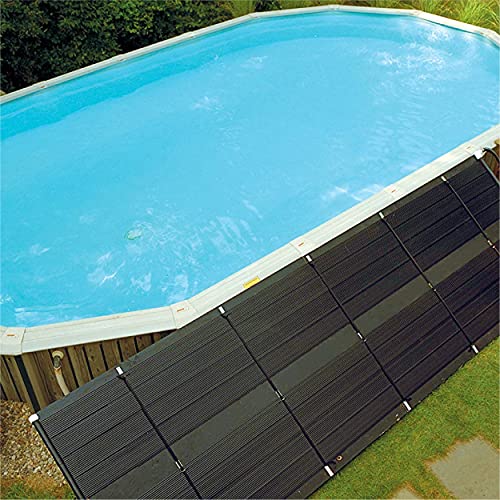
SunHeater Aboveground Pool Heating System, Includes Two 2’ x 20’ Panels (80 sq. ft.) – Solar Heater Made of Durable Polypropylene, Raises Temperature Up to 15°F – S421P, Black
SOLAR POOL HEATER – The Sunheater Solar Pool Heating System allows you to capture free heat from the…
As an affiliate, we earn on qualifying purchases.
As an affiliate, we earn on qualifying purchases.

Portable Solar Generator, 300W Portable Power Station with Foldable 60W Solar Panel,110V Pure Sine Wave 280Wh Battery Power Pack with USB DC AC Outlet for Camping Smart Devices RV Van Outdoor-Orange
Portable Generator with 60W Solar Panel Included: with a big battery pack, ZeroKor 300W power stations Generator are…
As an affiliate, we earn on qualifying purchases.
As an affiliate, we earn on qualifying purchases.