

In the realm of wide-area motion imagery (WAMI) exploitation, accurate multi-object tracking (MOT) is critical for reliable surveillance. Corvus ISR recently published a public tracker benchmark comparing two models on identical synthetic scenes with perfect ground truth, highlighting advances in tracking technology.

Get the latest gadgets delivered free — and shop member deals
- Fast, free delivery on millions of items
- Access to Prime Big Deal Days deals on October 6–7
- Prime Video, Amazon Music and more included
The baseline model, v1, employs a simple greedy nearest-neighbour approach with two-pass association and fixed velocity prediction. In contrast, v2 introduces a confirmation-based auction tracker that utilizes a three-tier auction, velocity consistency, and noise-scaled reservation to improve accuracy. Despite identical sensor detection properties, the results show a dramatic reduction in identity errors.
Specifically, in scenarios with 150 movers at 2fps, the v1 model committed about 2,042 ID switches per minute. The v2 tracker reduced this to 1,183, a 42.1% decrease. Similar improvements appeared in denser scenes with 400 movers, dropping from 14,032 to 8,040 switches, a 42.7% reduction. These numbers are significant, considering the importance of maintaining correct identities in surveillance feeds.
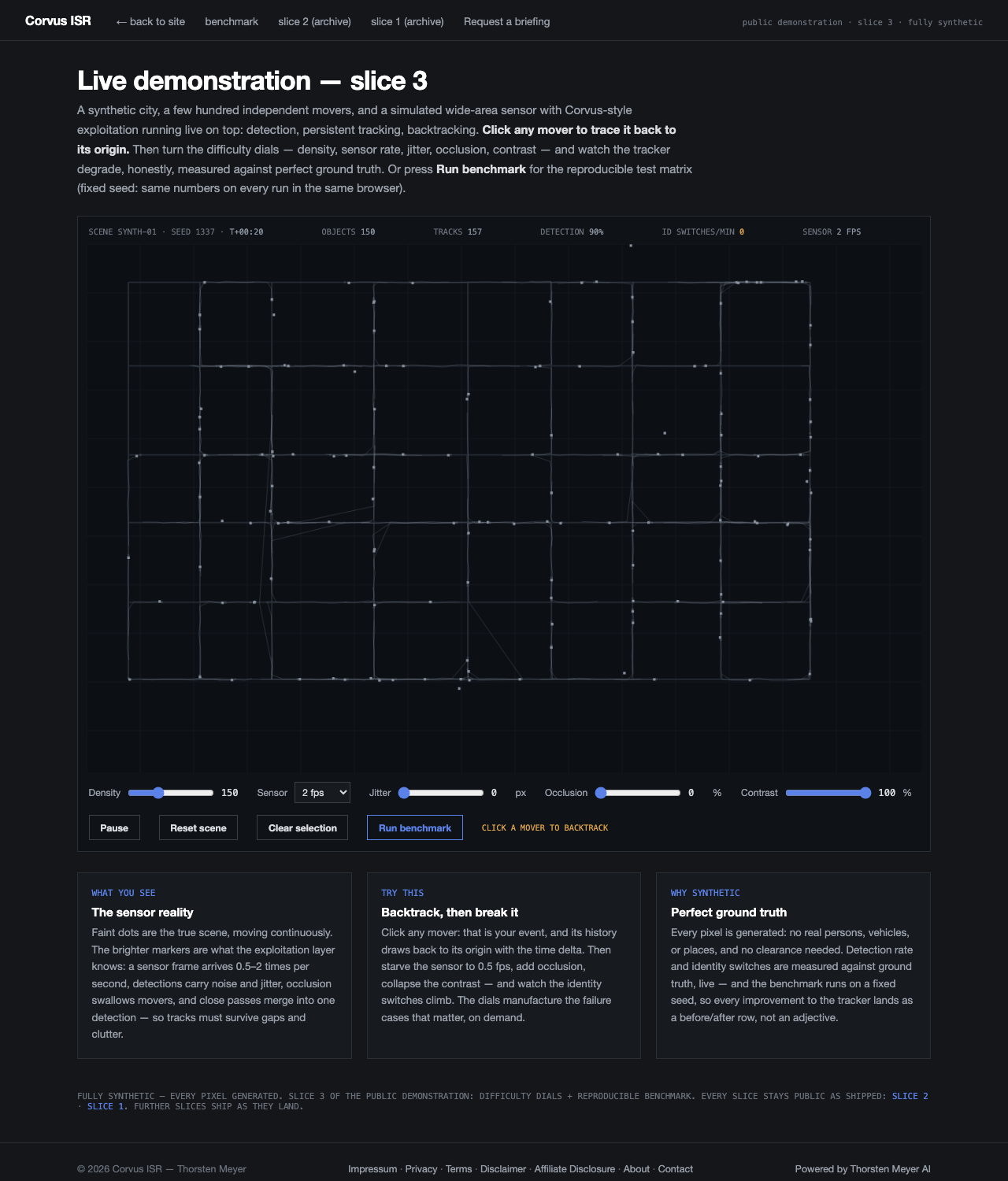
It’s important to note that the ID-switch metric used here is very strict, counting every change in the assigned identity — even re-acquisitions — making these results a meaningful measure of tracker reliability. Interestingly, even with these enhancements, all models still register thousands of identity errors under stress conditions, demonstrating the ongoing challenge of perfect tracking in complex environments.
From an engineering standpoint, v2 runs at approximately 1.2 ms per sensor tick at a density of 400 objects, comfortably achieving real-time operation within a 10ms budget. The entire process is accessible via a live demo, where anyone can reproduce the benchmark results without signing up or NDA by simply clicking ‘Run benchmark’.
Every detail is fully synthetic, with no real-world persons, vehicles, or locations involved. This synthetic environment ensures that the published failure rates truly reflect the tracker’s performance, not external noise. As the industry moves forward, such transparent benchmarking is crucial for developers aiming to improve identity stability in wide-area surveillance systems.
multi-object tracking surveillance camera
As an affiliate, we earn on qualifying purchases.
As an affiliate, we earn on qualifying purchases.
Fall Picks
fall essentials
As an affiliate, we earn on qualifying purchases.