
TL;DR

Get the latest gadgets delivered free — and shop member deals
- Fast, free delivery on millions of items
- Access to Prime Big Deal Days deals on October 6–7
- Prime Video, Amazon Music and more included
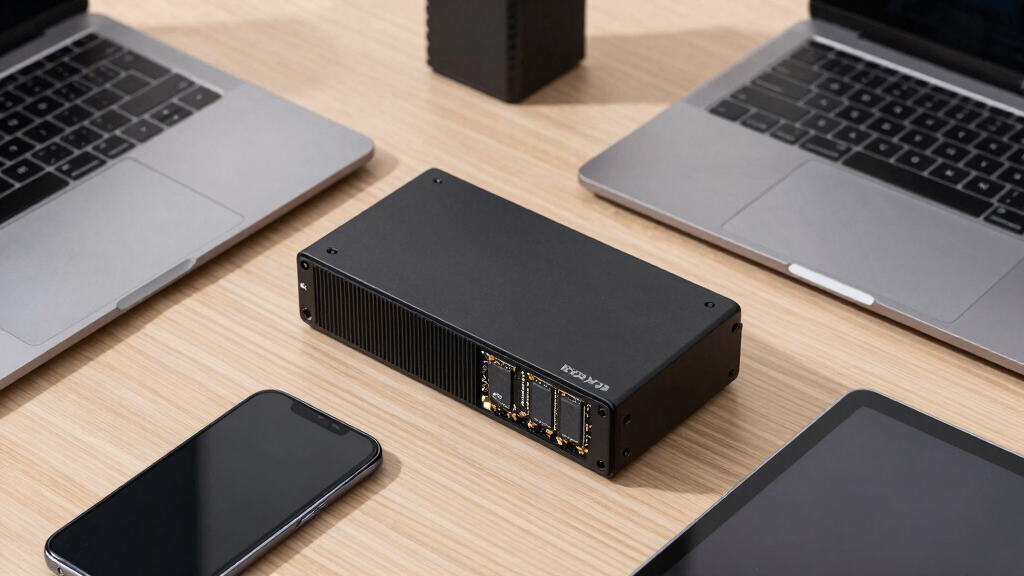
Dell and Kioxia unveiled a 2RU server capable of storing 10 petabytes of data using high-capacity SSDs. This development highlights advancements in storage density and efficiency for large-scale data infrastructure.
Dell and Kioxia have jointly announced a 2RU server capable of housing 10 petabytes of storage, utilizing Kioxia’s high-capacity LC9 SSDs. This development marks a notable increase in storage density for enterprise data centers, offering a compact solution for large-scale data management.
The server, designed by Dell with Kioxia’s LC9 high-capacity QLC SSDs, is built to deliver increased storage density in a 2RU form factor. The system incorporates multiple 245.76 TB NVMe SSDs, totaling approximately 10 PB of raw capacity, and supports high-speed data transfer with up to 5x 400 Gbps NICs. Dell has previously used Kioxia’s SSDs in its PowerEdge servers, including configurations supporting nearly 9.8 PB with 40 SSDs, indicating ongoing collaboration between the two companies.
According to Arun Narayanan, SVP at Dell, the integration of Kioxia’s SSDs enables scalable AI infrastructure without compromising performance, addressing the needs of large-scale data processing. Neville Ichhaporia, SVP at Kioxia America, noted that these servers can support large data ingestion streams, scale data lakes, and perform backups within a reduced physical footprint, potentially impacting total cost of ownership (TCO).
Why It Matters
This development extends the capabilities of storage density, allowing data centers to manage larger data volumes within smaller physical spaces. It may influence industries that rely on big data, artificial intelligence, and cloud computing by potentially reducing infrastructure costs and increasing operational efficiency. The achievement also reflects ongoing advancements in SSD technology, which could influence the enterprise storage market.
As an affiliate, we earn on qualifying purchases.
Background
Historically, enterprise storage solutions have faced limitations related to physical space and capacity. Kioxia’s LC9 SSDs, used in Dell’s servers, are among the highest capacity QLC SSDs available, with 245.76 TB per drive. Dell has integrated these SSDs into its PowerEdge line, achieving capacities approaching 10 PB in a single 2RU chassis. This announcement builds on existing collaborations and indicates a trend toward higher-density, all-flash storage systems suited for AI, data lakes, and backup applications.
“The Dell PowerEdge R7725xd combined with Kioxia’s high-capacity enterprise SSDs offers increased storage density and power efficiency, supporting scalable AI infrastructure.”
— Arun Narayanan, SVP at Dell
“These servers enable deployment of large data ingestion streams, scaling data lakes, and handling backups within a compact footprint, potentially influencing total cost of ownership.”
— Neville Ichhaporia, SVP and GM at Kioxia America
What Remains Unclear
It remains to be seen whether this 10 PB configuration will be commercially available at scale or remain in a prototype stage. Details regarding cost, power consumption, and deployment scenarios are still being developed. Additionally, the long-term reliability and performance of such dense SSD configurations require validation through real-world testing.
What’s Next
Future steps include further testing, validation, and potential commercial deployment of these high-capacity servers. Industry observers anticipate additional announcements from other SSD manufacturers regarding high-density storage solutions, with possible integration into broader data center architectures in the upcoming months.
Key Questions
How does this 10 PB server compare to existing storage solutions?
This server exceeds the capacity of typical enterprise storage solutions in a 2RU form factor, offering significantly higher storage density than most current configurations, which generally support a few PBs per chassis.
What are the main applications for this high-capacity server?
It is intended for large-scale AI training, data lakes, backup and recovery, and other data-intensive workloads requiring substantial storage within a compact form factor.
Are these SSDs reliable for long-term enterprise use?
Kioxia’s SSDs are designed for enterprise environments; however, long-term reliability data for such dense configurations are still being collected as deployment progresses.
Will this technology reduce overall data center costs?
Potentially, by increasing storage density and reducing physical space and power requirements, it can contribute to lowering total cost of ownership, though specific savings depend on deployment scenarios.
Fall Picks
fall essentials
As an affiliate, we earn on qualifying purchases.