
TL;DR
A user successfully repurposed a Nintendo Switch to run Klipper firmware on an aging Prusa MK3S 3D printer, increasing its speed by 90%. This modification significantly reduces print times and enhances quality. The development highlights creative ways to extend older hardware capabilities.
A hobbyist has successfully used a jailbroken Nintendo Switch to run advanced firmware on an older Prusa MK3S 3D printer, boosting its printing speed by approximately 90% and reducing a standard print from 90 minutes to under nine minutes. This development showcases innovative use of gaming hardware to enhance 3D printing performance, attracting interest among tech enthusiasts and makers.
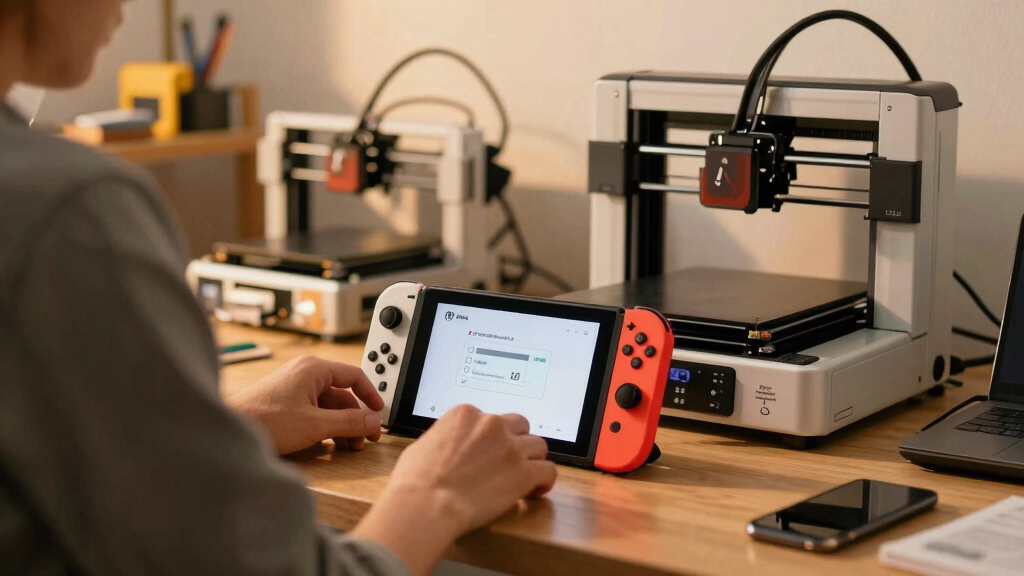
The modder, known as Cocoanix, demonstrated the process by installing Klipper firmware onto a Nintendo Switch running Ubuntu Linux. This setup allows the Switch’s quad-core Nvidia SoC to handle the printer’s motion planning, relieving the 8-bit microcontroller on the MK3S. The result was a print of the 3DBenchy tugboat completed in approximately 8 minutes and 41 seconds, compared to the usual 90 minutes.
According to Cocoanix, the upgrade not only speeds up printing but also improves output quality by reducing vibrations, ringing, and ghosting. The setup uses the Mainsail/Fluidd web dashboard for control, making it accessible and configurable through simple text files. The modification leverages the Switch’s touchscreen, providing a user-friendly interface, though the hardware remains primarily a proof of concept rather than a commercial solution.
Why It Matters
This achievement demonstrates how existing consumer hardware like the Nintendo Switch can be repurposed for high-performance tasks beyond gaming. It highlights potential cost-effective upgrades for older 3D printers, extending their useful life and capabilities. For the maker community, it opens new avenues for hardware customization and optimization, emphasizing the importance of software and firmware in hardware performance.

MYPUQIAO Repair Tool Kit for Nintendo Switch/Switch Lite/Switch OLED/Switch 2 – Includes PH000 (+1.5), Y00 (Y2.0) Screwdrivers, Pry Bar, Triangle Paddle.(NS-4)
- Compatible Devices: Switch, Switch Lite, OLED, Switch 2
- Complete Repair Kit: Includes screwdrivers, pry bar, triangle paddle
- High-Quality S2 Steel: Magnetic, precision screwdrivers for secure grip
As an affiliate, we earn on qualifying purchases.
As an affiliate, we earn on qualifying purchases.
Background
Prior to this, many 3D printer enthusiasts used small single-board computers like Raspberry Pi to run Klipper firmware, which improves speed and quality. The use of a Nintendo Switch for this purpose is novel due to its integrated touchscreen, portability, and powerful Nvidia SoC. The modification builds on existing efforts to enhance older printers, but the Switch’s combination of hardware and display makes it particularly appealing for hobbyists seeking a compact, all-in-one solution.
“Using the Switch with Klipper turned our aging Prusa MK3S into a high-speed machine capable of printing in under nine minutes.”
— Cocoanix
“This demonstration highlights how consumer electronics can be creatively adapted to extend the lifespan and performance of older 3D printers.”
— Tom’s Hardware
What Remains Unclear
It is not yet clear how stable and reliable this setup is for long-term or continuous operation. The modification appears to be experimental, and there are questions about hardware durability, firmware stability, and safety considerations that remain unaddressed.
What’s Next
Further testing is expected to evaluate the long-term reliability of the Switch-based setup. The maker community may explore similar modifications, and manufacturers might consider official support or alternative solutions for enhancing older printers. Additional updates could include refining the installation process and improving hardware compatibility.
Key Questions
Can this modification be applied to other 3D printers?
Potentially, yes. The process relies on installing Klipper firmware and connecting the Switch, which could be adapted for other printers compatible with Klipper. However, hardware differences may require specific adjustments.
Is using a Nintendo Switch safe for this purpose?
As with any hardware modification, there are risks involved, including voiding warranties and potential hardware damage. The setup is experimental and should be undertaken by experienced users aware of these risks.
Does this improve print quality or just speed?
Both. The use of Klipper on the Switch not only accelerates printing but also reduces vibrations and artifacts like ringing, leading to better overall quality.
Will this setup be commercially available?
No. Currently, this is a DIY project demonstrated by a hobbyist. Commercial adoption would require official support and validation.