
This checklist is for technology news readers who want useful gadgets for reading, recording, capturing, and sharing what they find. It brings together six picks that can support different parts of a tech focused routine.

Get the latest gadgets delivered free with Prime
- Fast, free delivery on millions of items
- Prime Video, Amazon Music and more included
- Member-only deals all year
The sections are organized by product category, from an e-ink reader and phone lens to storage, capture, audio, and projection. Each one explains why the slot matters and what to check before choosing a device.
Use the look-for points to compare each pick with your devices and habits. Check ports, fit, and compatibility against your own gear, then use the verdict and bottom line to decide whether the product suits your setup.
E-Ink Reader
An e-ink reader can give long-form reading its own place in a gadget setup. The Amazon Kindle Scribe Colorsoft 64GB (Newest Model) – 11″ Color Display is the pick for this slot, and its name identifies a color display and 64GB capacity. Consider how you read: article length, where you read, and whether you want a dedicated device alongside your phone or computer.
A common buying mistake is choosing by screen description alone. Think about reading comfort and how the device fits your routine, including whether you expect to hold it for extended sessions or carry it between locations. Confirm the display and storage details on the listing, and check that the reading services and file types you use are supported. The product name alone does not establish those details.
Also consider handheld fit before committing. An 11-inch display may suit a desk or lap better than a small bag or one-handed reading; compare the listed dimensions and weight with your preferred reading posture. If you annotate or organize notes, verify the specific tools and workflow you need rather than assuming they are included. Match the reader to your habits first, then assess its place in your tech reading kit.
What to look for:
- Confirm support for the reading services and file types you use.
- Check listed dimensions and weight against your reading posture.
- Verify how the color display handles the content you read.
- Confirm available storage meets your offline reading needs.
- Check whether annotation features match your workflow.
Amazon Kindle Scribe Colorsoft 64GB (Newest Model) – 11" Color Display with Pen

The Kindle Scribe features an 11-inch Colorsoft display with a paper-like texture, offering a smooth writing experience and high-contrast color. It supports note-taking, document annotation, and AI-powered tools, all in a lightweight, glare-free design suitable for reading and writing on the go.
Pros:
- Large, high-contrast color display for reading and writing
- Responsive, paper-like textured surface for natural writing
- Long battery life lasting weeks
- Supports note-taking, annotations, and AI tools
Cons:
- Limited to reading and writing functions, not a full tablet
- Pen requires no charging but may have limited features compared to other styluses
Best for: Readers who want a separate device with a color display.
Not ideal for: Readers who prioritize compact, one-handed reading.
Bottom line: Check supported content, dimensions, and reading comfort before making this your dedicated reader.
Smartphone Camera Lens
A clip-on lens can add another way to frame photos using a phone you already carry. The APEXEL 10X Telephoto and Macro Clip-On Phone Lens combines two named lens types, so consider whether both distant subjects and close-up details matter to your photography. This slot is most useful when you can identify the kinds of shots you want to make and check whether the lens can work with your phone.
One common mistake is assuming a clip-on lens fits every camera layout. Phone models differ, so confirm camera alignment, clip range, and the required clearance around the camera bump or case. Check the product’s compatibility information against your exact phone, and see whether it must be used with a particular camera app. A lens that cannot sit correctly over the intended camera may not suit your setup.
Think through practical handling as well. Consider whether you are comfortable attaching and removing a lens, carrying it safely, and keeping it aligned while shooting. For macro use, check the listed working distance and whether focusing requires a steady hand or support. For telephoto use, review sample images or specifications from the product listing to understand the intended results. Choose it for a clear shooting purpose, not just the magnification in its name.
What to look for:
- Verify compatibility with your exact phone model and camera layout.
- Check whether your phone case must be removed for mounting.
- Confirm which camera app or camera module the lens uses.
- Review listed working distance for macro shots.
- Check how the lens is carried and protected between uses.
APEXEL 10X Telephoto and Macro Clip-On Phone Lens

This dual-purpose clip-on lens combines 10X telephoto magnification with a macro lens that focuses from 8 inches. Its 12-element, multi-coated optical design is intended to reduce glare and distortion, and the lightweight lens is compatible with many iPhone, Samsung Galaxy, and other smartphones.
Pros:
- Combines telephoto and macro lenses in one clip-on design
- Lightweight at 5.12 oz and portable
- Universal clip attaches without tools
- Multi-layer coating is designed to reduce glare and distortion
Cons:
- Does not include image stabilization
- Requires manual focusing
Best for: Phone photographers who want telephoto and macro options.
Not ideal for: Users who need a lens guaranteed to fit any phone.
Bottom line: Match the clip and camera alignment to your phone before choosing this lens.
Portable SSD
Portable storage can help keep project files and media together across a tech workflow. The Samsung T9 Portable SSD 4TB, USB 3.2 Gen 2×2 External SSD, Up to 2,000 names a 4TB capacity and a USB interface, making connection compatibility a key consideration. Decide what you will store, where you will use the drive, and which computers or devices need to access it.
A common mistake is treating a connector shape as proof of full compatibility or speed. Check the ports and supported USB standards on each device, and confirm whether cables or adapters are needed. The listing’s “up to” performance language describes a ceiling; real-world transfer rates depend on the host connection, file sizes, and other conditions. Ensure your planned devices and workflow can make use of the interface described.
Think about capacity planning before relying on a single drive. Estimate the space your working files require and whether you need another copy elsewhere. Check the SSD’s dimensions, included cable details, and operating-system support in the listing. If you plan to edit directly from the drive, verify that your software and host device support that workflow. A portable SSD is most useful when its capacity, connection, and backup plan all fit how you work.
What to look for:
- Confirm USB standard support on every device you plan to connect.
- Check which cables are included and whether adapters are needed.
- Estimate usable capacity for your working files and media.
- Review dimensions and portability for your everyday carry.
- Verify operating-system and direct-editing compatibility.
Samsung T9 Portable SSD 4TB, USB 3.2 Gen 2×2 External SSD, Up to 2,000 MB/s
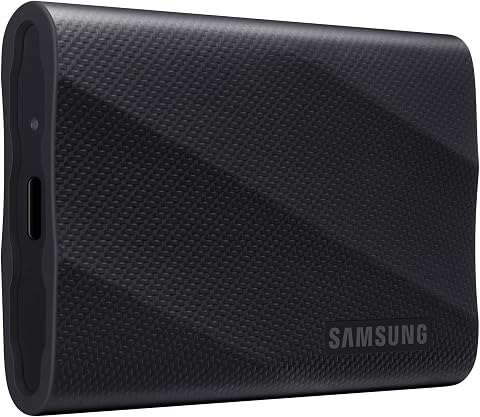
The Samsung T9 Portable SSD delivers up to 2,000 MB/s sequential read and write speeds over a USB 3.2 Gen 2×2 interface, making large file transfers fast and reliable. With a 4 TB capacity, rugged drop resistance, dynamic thermal guard, and AES‑256 hardware encryption, it’s built for creators who need performance and durability on the go.
Pros:
- Blazing transfer speeds up to 2 GB/s when paired with a compatible USB‑C port.
- Large 4 TB storage capacity for extensive media libraries and projects.
- Dynamic Thermal Guard keeps the drive cool during sustained heavy use.
- Rugged design tolerates drops up to 9.8 ft and includes AES‑256 encryption.
Cons:
- Maximum speeds require a USB 3.2 Gen 2×2 host and UASP‑enabled cable; slower on older ports.
- Performance can vary depending on the host device’s configuration.
Best for: Readers moving large files among compatible devices.
Not ideal for: Setups without a matching USB connection or adapter.
Bottom line: Confirm host compatibility and plan a second copy for important files.
USB-C Capture Card
A capture card can connect a gaming system to a recording or streaming setup. The Elgato 4K Capture Card for PS5, Xbox Series X/S, Switch 2 names several consoles, which makes checking the exact console model and connection path especially important. Decide whether you want to record, stream, or simply route gameplay, since those uses can involve different software and hardware requirements.
A frequent mistake is assuming a console name alone guarantees compatibility with every setup. Check the capture card’s required ports, supported resolutions and refresh rates, and whether your computer meets the listed requirements. Confirm HDMI signal handling for the console and display combination you intend to use. Some console features or content may affect capture; consult the product documentation and platform guidance for your specific use.
Consider workflow fit before buying. Verify which recording or streaming applications are supported, how audio is routed, and whether a pass-through connection is part of the setup you need. Check the included cables and whether USB-C is the host connection or another part of the product’s design. Make a simple connection map from console to card to computer and display, then compare every port and capability with the product details.
What to look for:
- Match the exact console model to the product’s compatibility list.
- Confirm supported resolutions and refresh rates for your setup.
- Check computer requirements and supported capture software.
- Verify audio routing and display pass-through needs.
- Confirm included cables and the role of each connection.
Elgato 4K Capture Card for PS5, Xbox Series X/S, Switch 2

The Elgato 4K Capture Card allows users to record gameplay in 4K60 quality with vivid colors and cinematic detail. It supports high frame rates, HDR10, and is compatible across multiple platforms including PS5, Xbox Series X/S, and Switch 2.
Pros:
- High-quality 4K60 recording with vivid colors
- Supports high frame rates for smooth gameplay capture
- HDR10 support for brilliant HDR content
- Cross-platform compatibility
Cons:
- Requires compatible hardware and software setup
- No mention of bundled accessories or software
Best for: Console players building a compatible recording or streaming workflow.
Not ideal for: Users who have not checked their computer and display requirements.
Bottom line: Map your console, computer, and display connections before selecting this card.
Bluetooth Audio Recorder
Audio glasses can combine eyewear with open-ear listening, which may appeal to someone who wants audio without traditional headphones. The Bluetooth Audio Glasses with Blue Light Filtering and Open-Ear Speaker describes those features, but its name does not establish whether it records audio. Treat recording as a separate requirement and verify it in the full product listing before considering these glasses for interviews or field notes.
A common mistake is choosing frames for their audio description without checking fit and lens needs. Review frame dimensions, nose and temple fit, lens options, and whether the filtering feature suits your intended use. If you wear prescription glasses, confirm whether these can accommodate your prescription or whether a compatible version is offered. Comfort matters when a device is worn throughout a reporting or listening session.
For Bluetooth use, check device compatibility, pairing steps, controls, microphone details, and battery information in the listing. Open-ear sound can interact with surrounding noise, so consider where you expect to listen and whether privacy matters. If your goal is to record, confirm recording capability, storage or phone connection, and how recordings are accessed. Make the decision around verified capabilities and a comfortable fit, rather than assuming every audio function from the product name.
What to look for:
- Confirm whether audio recording is actually supported.
- Check frame measurements and prescription lens options.
- Verify Bluetooth compatibility with your phone or other devices.
- Review microphone, controls, and battery details in the listing.
- Consider listening privacy and performance in your usual environments.
Bluetooth Audio Glasses with Blue Light Filtering and Open-Ear Speakers
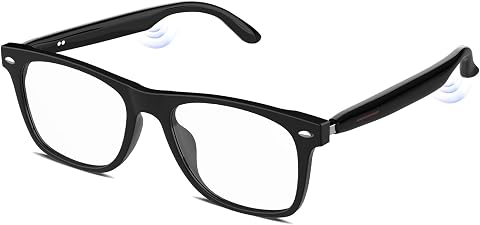
Lightweight rectangular glasses with Bluetooth audio, open-ear speakers, a built-in microphone, and blue light filtering lenses. Touch controls handle calls, playback, and voice assistant access; automatic wear detection powers the glasses on and off.
Pros:
- Open-ear speakers and noise-reduction microphone support music and hands-free calls.
- Automatic wear detection powers on the glasses when worn and shuts them down after removal.
- Touch controls support calls, playback, and voice assistant access.
- Lightweight design weighs about 33 g.
Cons:
- Not water resistant.
- Playback time is limited to 4–6 hours per charge.
Best for: Listeners seeking Bluetooth audio in a glasses format.
Not ideal for: Buyers who need verified recording functionality without checking specs.
Bottom line: Verify recording features and eyewear fit before treating these as an audio recorder.
Mini Projector
A pocket-sized projector can bring a larger image to places where a television or monitor is not practical. The AKASO Pocket-Sized DLP Portable Projector with Wi-Fi, HDMI, Rechargeab names DLP, Wi-Fi, HDMI, and rechargeable operation, making it a flexible-sounding option for a portable setup. Consider where you will project and which source devices you want to connect.
A common mistake is buying a projector without checking the room and image requirements. Review the listed brightness, resolution, supported image size, and recommended projection distance, then compare them with your intended space. Check Wi-Fi requirements and the streaming or screen-sharing methods supported; Wi-Fi in a product name does not guarantee compatibility with every app or device. For HDMI use, confirm the source device’s output and any needed adapter.
Also plan for power and placement. Confirm battery details and whether the projector can be used while charging, as well as the time needed between sessions. Check for focus and keystone adjustment, audio options, and any tripod or stand requirements in the listing. A small projector still needs a suitable surface and controlled lighting. Match its specifications to your room and source devices before expecting a particular image size or viewing experience.
What to look for:
- Compare listed brightness and resolution with your room needs.
- Check projection distance and supported image size.
- Verify Wi-Fi, streaming, and screen-sharing compatibility.
- Confirm HDMI adapters or cables required for your sources.
- Review battery details, placement options, and audio connections.
AKASO Pocket-Sized DLP Portable Projector with Wi-Fi, HDMI, Rechargeable Battery

This compact DLP projector supports up to 1080p input and projects images up to 130 inches, with 50 ANSI lumens of brightness and a 1000:1 contrast ratio. It has Wi-Fi screen mirroring, Type-C, HDMI, AV, and Micro SD connections, plus a built-in rechargeable battery, speaker, remote, and tripod.
Pros:
- Compact, lightweight design with a built-in rechargeable battery
- Offers wired connections and wireless screen mirroring
- Includes a remote control, tripod, and HDMI cables
- Supports projection up to 130 inches
Cons:
- 50 ANSI lumens brightness is best suited to dark environments
- Battery runs for up to 2.5 hours
- Some copyrighted streaming content cannot be mirrored or played through HDMI
Best for: People who want a portable display option for compatible sources.
Not ideal for: Viewers who need a guaranteed bright image in every room.
Bottom line: Check image specifications, room conditions, and source connections before choosing this projector.
Use a budget-first buying order by starting with the device that solves your most frequent task. Check your existing phone, computer, console, and display before adding accessories; compatibility may matter more than adding another category to your kit. Then compare storage, reading, capture, audio, and projection needs against your actual routine.
You can build this checklist one useful piece at a time. Verify the details that matter to your devices, choose the pick that fits your next project, and leave room to reassess as your habits change. A focused setup is easier to use and easier to improve.