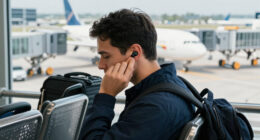
Travel earbuds have to do more than sound good: they need to reduce steady cabin noise, stay comfortable through long stretches, fit in a small bag, and last between charging opportunities. The Bose QuietComfort Ultra Earbuds and Sony WF-1000XM5 are both premium true wireless models, but they emphasize different parts of that job.

Get the latest gadgets delivered free with Prime
- Fast, free delivery on millions of items
- Prime Video, Amazon Music and more included
- Member-only deals all year

Soundcore P30i Noise Cancelling Earbuds with Charging Case Phone Stand
- ✔ Connectivity: Bluetooth 5.4
- ✔ Noise control: Adaptive ANC and transparency mode; reduction stated up to 42 dB
- ✔ Drivers: 10 mm

JBL Vibe Beam – True Wireless Earbuds – Black
- ✔ Connectivity: Bluetooth 5; stated range 10 m
- ✔ Drivers: 8 mm dynamic drivers
- ✔ Sound feature: JBL Deep Bass Sound

Soundcore by Anker P20i True Wireless Earbuds, with Big Bass, 30H Playtime
- ✔ Connectivity: Bluetooth 5.3; stated range 10 m
- ✔ Drivers: 10 mm dynamic drivers
- ✔ Noise control: Passive noise cancellation
Bose has the edge when active noise cancellation and comfort are the main priorities, especially on long flights. Sony answers with longer rated battery life, a smaller charging case, and a lower launch price, while still offering strong noise cancellation. This comparison focuses on the practical travel tradeoff: choose Bose for the quieter, more comfortable ride; choose Sony for a compact all-rounder that costs less and lasts longer on paper.
At a Glance
| Criteria | Bose QuietComfort Ultra Earbuds | Sony WF-1000XM5 | Winner |
|---|---|---|---|
| Noise cancellation | Class-leading cancellation, particularly effective against steady low-frequency travel noise. | Very strong cancellation, though Bose generally suppresses travel noise more effectively. | A |
| Long-trip comfort | Secure fit with several eartip and stability-band sizes; fit comfort varies by ear. | Small, light earbuds; foam eartips can feel secure but may not suit every listener. | Depends |
| Battery life | Up to 6 hours per charge with Immersive Audio off; case provides additional charges. | Up to 8 hours per charge with noise cancellation on, plus case charges. | B |
| Case size and portability | Larger case than Sony’s, so it takes more pocket or pouch space. | More compact case that is easier to carry in a pocket or small travel pouch. | B |
| Calls and cabin use | Good call handling, though crowded or windy settings can challenge either model. | Good call quality for earbuds of this type, with performance depending on surroundings. | Tie |
| Price and value | Higher-priced premium option; the extra cost mainly buys stronger cancellation and Bose’s sound modes. | Usually less expensive than Bose; stronger value if its slightly weaker cancellation meets your needs. | B |
Soundcore P30i Noise Cancelling Earbuds with Charging Case Phone Stand
The Soundcore P30i earns the top spot because it is the most complete match for the changing soundscape of a trip. Adaptive active noise cancelling is designed to reduce outside noise, and transparency mode gives us a way to hear more of our surroundings without removing the earbuds. That flexibility is more useful across a travel day than the JBL Vibe Beam’s Smart Ambient features alone when we want dedicated noise cancellation for a noisy stretch.Battery claims need context: the P30i is listed for up to 45 hours with the case, but up to 25 hours with ANC enabled. The earbuds themselves are listed for up to six hours per charge with ANC, down from ten hours without it. That difference matters on long routes: we get the noise-control advantage, but should expect more frequent top-ups. A ten-minute quick charge is listed for up to two hours of use, which can help during a short stop.The case’s built-in phone stand is a distinctive convenience for watching a downloaded show at a gate or on a tray table, though it adds a functional feature rather than proving the case is the smallest here. Compared with the P20i, the P30i adds ANC and four microphones, while the P20i’s lanyard-forward portability may suit lighter packers better. We would choose the P30i when noise control is the deciding factor; its ANC runtime and listed 0.1 kg weight deserve consideration if a compact, long-lasting setup is the priority.
Pros:
- Adaptive ANC and transparency mode suit changing travel environments.
- Up to 45 hours total playtime is stated without ANC.
- Phone-stand case supports hands-free viewing during stops.
- Four microphones and AI-enhanced calls support voice pickup on the move.
Cons:
- Stated total playtime drops to up to 25 hours with ANC enabled.
- ANC runtime is listed at up to six hours per charge.
- The listed product weight is 0.1 kg; shoppers focused on minimal carry weight may prefer another option.
Best for: Travelers who want active noise cancelling, transparency mode, and a case that can prop up a phone for hands-free viewing.
Not ideal for: People prioritizing the longest possible battery with ANC on, a particularly small case, or a clearly specified low product weight.
Bottom line: For most travel days, the P30i is the strongest choice here because it pairs active noise control with useful case features, provided we plan around its shorter ANC battery life.
“For most travel days, the P30i is the strongest choice here because it pairs active noise control with useful case features, provided we plan around its shorter ANC battery life.”
JBL Vibe Beam – True Wireless Earbuds – Black
The JBL Vibe Beam is the simpler travel companion for buyers who want a generous stated total battery figure and useful awareness modes without making dedicated ANC the centerpiece. JBL lists up to 32 hours total, split into up to eight hours in the earbuds and 24 more in the case. A ten-minute speed charge is said to add up to two hours, a practical cushion when a connection or boarding window leaves little time to recharge.Its Smart Ambient features address a different need from the P30i. TalkThru is intended to make quick conversations easier, while Ambient Aware lets outside sound remain audible as music plays. Those modes can be convenient in a station or airport, but the supplied description does not specify active noise cancelling for the Vibe Beam. If the main aim is to quiet a plane cabin, the P30i is the clearer fit; the JBL instead favors uncomplicated endurance and awareness.The closed, stick-style design is described as comfortable and helps exclude external sound, while splash and dust resistance adds reassurance around everyday travel exposure. The description does not provide an IP rating, so we should not compare its protection directly with the P30i’s IP54. JBL’s VoiceAware feature lets callers balance how much of their own voice they hear, but the supplied details do not state a microphone count. We would pick it for a simpler listening routine; skip it if active noise cancelling is essential or you want more explicit protection and ANC runtime specifications.
Pros:
- Up to 32 hours of stated total playtime, including 24 hours from the case.
- Ten-minute speed charge is listed for up to two additional hours.
- Smart Ambient includes TalkThru and Ambient Aware modes.
- Splash and dust resistance is described, and VoiceAware supports call adjustment.
Cons:
- The supplied details do not establish active noise cancelling.
- The eight-hour earbud runtime is shorter than the P20i’s and P30i’s stated ten hours without ANC.
- No specific IP rating is included in the supplied information.
Best for: Travelers who want a simple, battery-focused pair with quick charging and ambient modes for short interactions.
Not ideal for: People who need specified active noise cancelling for flights or want a listed IP rating and detailed microphone specifications.
Bottom line: The Vibe Beam is a sensible battery-first travel pick when ambient awareness is enough, but the P30i is better for blocking cabin noise.
“The Vibe Beam is a sensible battery-first travel pick when ambient awareness is enough, but the P30i is better for blocking cabin noise.”
Soundcore by Anker P20i True Wireless Earbuds, with Big Bass, 30H Playtime
The Soundcore P20i is the pick for travelers who value a small, clip-friendly setup and control over their sound more than active noise cancelling. Its compact case has an attached lanyard, so we can clip it to a bag or keep it easy to find in a crowded carry-on. With up to 30 hours total playtime and up to ten hours per charge, the stated endurance is competitive with the P30i when ANC is off, though it trails the P30i’s maximum total and the JBL’s listed total.Its 10 mm drivers are paired with an app offering 22 EQ presets and customizable controls. That makes the P20i more adjustable than the supplied Vibe Beam information, which describes JBL Deep Bass Sound but not app-based EQ. Find My Earbuds is another practical detail if one slips between seat cushions. Two microphones and AI call processing are listed, although the P30i’s four-microphone specification gives it the stronger on-paper call setup.The travel limitation is clear: the P20i lists passive noise cancellation, not active noise cancelling. That may be enough for casual listening, but it is a less convincing choice for a noisy flight than the P30i, whose adaptive ANC is specifically listed. The P20i also has water resistance described without an IP rating in the supplied details. We recommend it for light packers who like to tailor bass and controls; travelers focused on quieter cabins should move up to the P30i, while buyers who want a simpler ambient mode and longer stated total should consider the JBL.
Pros:
- Compact, lightweight case includes a lanyard for clipping to a bag or keys.
- Up to 30 hours total playtime and ten hours per charge are stated.
- Soundcore app offers 22 EQ presets and control customization.
- Find My Earbuds and quick charging add practical trip conveniences.
Cons:
- Noise control is listed as passive rather than active ANC.
- Two microphones are listed, fewer than the P30i’s four.
- Supplied details describe water resistance without an IP rating.
Best for: Light packers who want a compact, lanyard-equipped case, customizable EQ, and long stated playback without needing ANC.
Not ideal for: Frequent flyers who want active noise cancelling or buyers seeking a clearly specified water-resistance rating.
Bottom line: Choose the P20i for compact carrying and sound customization, but choose the P30i if reducing travel noise matters more than keeping the case simple.
“Choose the P20i for compact carrying and sound customization, but choose the P30i if reducing travel noise matters more than keeping the case simple.”
As an Amazon Associate we earn from qualifying purchases.
Key Differences
The most consequential difference is how well each pair reduces noise over a long journey. Bose is the safer choice if aircraft rumble, train noise, or other steady background sound makes it hard to rest or listen at a comfortable volume. Sony also cancels noise very well, but Bose has the advantage for travelers who put quiet first. The gap matters most on noisy routes and less in quieter settings.
Sony counters with a smaller case and a longer stated listening time with noise cancellation enabled: up to eight hours per charge versus Bose’s six with Immersive Audio off. That can mean fewer charging interruptions, though actual runtime varies with volume, settings, calls, and battery age. Comfort is personal: Bose supplies multiple fit options, while Sony’s foam tips may seal well but feel less suitable for some ears. Because prices shift, Sony is the better value for most travelers unless Bose’s stronger cancellation or fit is worth the premium to you.
Detailed Comparison
Noise cancellation (Bose QuietComfort Ultra Earbuds wins — moderate)
Bose wins; the gap is moderate. Both models are strong at reducing ambient sound, but Bose is generally the better choice for the low, continuous noise of an aircraft cabin or train. Sony can make travel substantially quieter too, so the difference is not a reason for every passenger to pay more. Pick Bose if reducing rumble is central to your trip; pick Sony if very good cancellation is enough.
Long-trip comfort (moderate difference)
This depends on your ears; there is no universal winner. Bose includes multiple eartip and stability-band sizes to help secure the earbuds, while Sony’s lighter, smaller design and foam tips appeal to some listeners. Neither fit works for everyone. A comfortable seal matters for hours of listening and for noise cancellation, so buy from a retailer with a suitable return policy if you cannot try them first.
Battery life (Sony WF-1000XM5 wins — moderate)
Sony wins; the stated gap is moderate. Sony rates the WF-1000XM5 for up to eight hours with noise cancellation on; Bose rates the QuietComfort Ultra for up to six hours with Immersive Audio off. On paper, Sony gives you more time before reaching for the case. Real runtime varies with settings and use, but frequent flyers who listen through long travel days have a practical reason to favor Sony.
Case size and portability (Sony WF-1000XM5 wins — minor)
Sony wins; the difference is minor but useful. The WF-1000XM5’s case is more compact, while Bose’s case takes up more room. Both remain pocketable, but the smaller Sony case fits more easily alongside a passport, charger, and other travel essentials. Give this extra weight if you carry a small bag or want earbuds that disappear into a pocket.
Calls and everyday travel use (minor difference)
This is close; neither is a clear travel-call winner for every situation. Both can handle ordinary calls, but earbuds can struggle when announcements, wind, or conversation compete with your voice. Microphone results depend on the environment and how the earbuds fit. If frequent calls in loud public places are essential, neither pair should be bought on noise cancellation claims alone; compare current call samples or consider a headset designed around microphone performance.
Price and value (Sony WF-1000XM5 wins — moderate)
Sony wins for value; the difference is moderate. The WF-1000XM5 typically costs less than Bose’s flagship earbuds while offering strong cancellation, longer rated battery life, and a smaller case. Bose’s premium is easier to justify for travelers who place a high value on its stronger noise reduction or prefer its fit. If you do not need that advantage, Sony leaves more of your budget available for other travel gear.
Bose QuietComfort Ultra Earbuds: Pros and Cons
Pros:
- Stronger noise cancellation for steady travel noise.
- Multiple eartip and stability-band sizes for fit adjustments.
- A compelling choice for long journeys where quiet matters most.
Cons:
- Higher price than Sony in typical pricing.
- Shorter rated listening time with cancellation on and Immersive Audio off.
- Larger case takes up more space.
Sony WF-1000XM5: Pros and Cons
Pros:
- Longer rated battery life with noise cancellation on.
- Smaller, easier-to-carry case.
- Usually lower-priced while still delivering strong cancellation.
Cons:
- Noise cancellation is a step behind Bose in especially noisy travel settings.
- Foam eartips may not suit every listener.
- Actual battery life varies with settings and use.
Who Should Choose What
Choose Bose QuietComfort Ultra Earbuds if:
- You fly or ride trains often and want the strongest available reduction in steady cabin noise.
- You are willing to pay more for Bose’s noise-cancellation advantage.
- Bose’s fit options feel more comfortable in your ears during extended listening.
Choose Sony WF-1000XM5 if:
- You want a smaller case and longer rated listening time between charges.
- You want strong noise cancellation at a lower typical price.
- You travel with limited bag space and prefer an all-rounder over the strongest cancellation.
Skip both if: Neither fits comfortably, you need dependable microphone performance in very loud settings, or your budget favors a lower-cost pair over premium noise cancellation.
Value for Money
Sony is the better value for most travelers because it combines strong noise cancellation with longer rated battery life and a more compact case, usually at a lower price. Bose’s premium is worth paying when its stronger cancellation will noticeably improve noisy flights or when its fit works better for you. If most of your listening happens in quieter places, or you can tolerate a little more background rumble, Sony’s savings make more sense. Compare current sale prices, since discounts can narrow or reverse the gap.
Final Verdict
Choose the Bose QuietComfort Ultra Earbuds if the quietest possible cabin experience is your priority and you are comfortable paying extra for that advantage. Choose the Sony WF-1000XM5 if you want the better travel value: it is more compact, lasts longer per charge on its rated figures, and costs less while still offering very strong cancellation.
For most travelers, Sony is the more sensible purchase. Bose is the clear specialist choice for people who travel frequently in loud conditions and care more about reducing noise than about case size, battery advantage, or price. Fit can change the result, so comfort should be the final check before buying.
Frequently Asked Questions
Which earbuds block airplane noise better?
The Bose QuietComfort Ultra Earbuds generally have the advantage against steady aircraft rumble. Sony’s WF-1000XM5 also offers strong noise cancellation, so it remains a good choice if you want to spend less or prefer its smaller case.
Which lasts longer on a charge?
Sony rates the WF-1000XM5 for up to eight hours with noise cancellation on. Bose rates the QuietComfort Ultra for up to six hours with Immersive Audio off. Actual runtime varies with volume, features, and use.
Are Sony or Bose earbuds more comfortable for long flights?
Comfort depends on your ears. Bose includes multiple tip and stability-band sizes, while Sony uses foam eartips and a smaller earbud design. A secure, comfortable seal is personal, so try the fit if possible and check the return terms before purchase.
Are the Bose earbuds worth paying more for?
They can be worth the premium if you often travel in noisy cabins and Bose’s stronger cancellation makes rest or listening easier. If you mainly want strong cancellation, longer rated battery life, and a compact case, Sony is usually the better value.
Evergreen bestsellers Picks

Samsung 55-Inch QN70H Neo QLED 4K Smart TV (2026)

Ninja Foodi 8-Quart DualZone 6-in-1 Air Fryer, Grey (DZ201)

Dyson V9 Motorbar Cordless Vacuum
As an affiliate, we earn on qualifying purchases.