
TL;DR

Get the latest gadgets delivered free with Prime
- Fast, free delivery on millions of items
- Prime Video, Amazon Music and more included
- Member-only deals all year
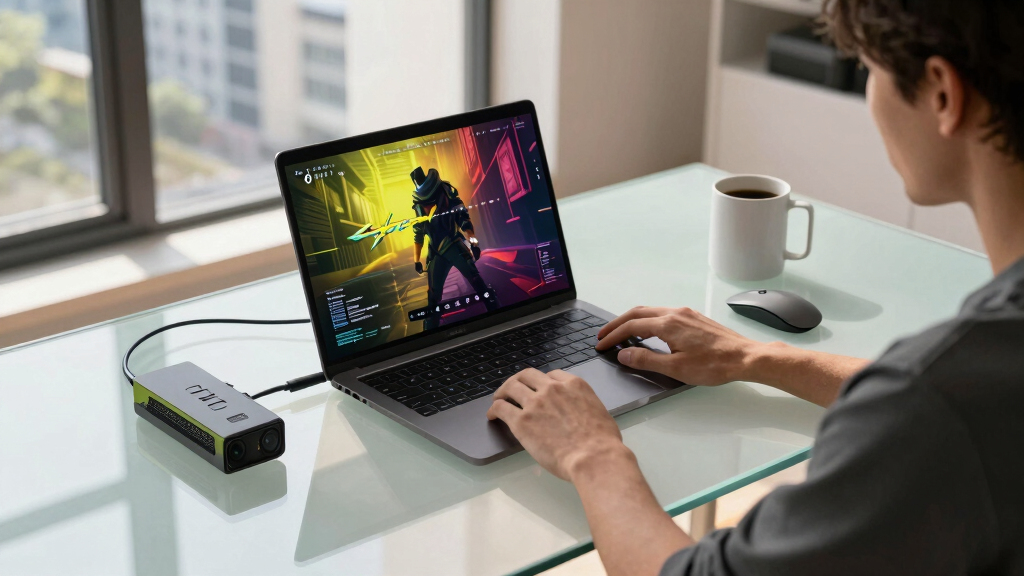
A developer has demonstrated that an M5 Max MacBook Pro can run an Nvidia RTX 5090 eGPU and play Cyberpunk 2077 at over 100 FPS using frame generation. The setup involves complex virtualization and tweaks, highlighting potential but current limitations.
A software engineer has successfully connected Nvidia’s RTX 5090 graphics card to an M5 Max MacBook Pro using a virtualized Linux environment and eGPU dock, achieving over 100 FPS in Cyberpunk 2077 with frame generation enabled. This demonstrates the potential for high-end gaming on Apple Silicon Macs, despite current technical challenges.
Scott J. Goldman, a software engineer, managed to run an Nvidia RTX 5090 GPU on an M5 Max MacBook Pro through virtualization and an eGPU dock, a process not officially supported due to Apple’s hardware and driver limitations. His testing showed that with frame generation enabled, Cyberpunk 2077 could reach over 100 FPS at the RT Ultra preset, even with the overhead of virtualization and Thunderbolt connection.
However, performance drops significantly without frame generation, with FPS falling below 50 on the MacBook Air and just above 60 on the M5 Max. The bottleneck appears to be the FEX translation layer, which causes about a 50% performance penalty compared to native ARM processing. Benchmarks like Geekbench 6 confirmed this performance hit, and other games like Shadow of the Tomb Raider and Crysis Remastered showed lower frame rates.
Why It Matters
This development highlights that, while technically possible, high-end gaming on Apple Silicon Macs via eGPU and Nvidia GPUs remains complex and inefficient currently. It underscores the limitations of current virtualization and driver support, but also suggests potential for future improvements that could make gaming on Macs more feasible for enthusiasts.
As an affiliate, we earn on qualifying purchases.
Background
Apple’s M5 Max chip is among the fastest ARM-based silicon, capable of competing with high-end desktop CPUs. Despite this, native support for Nvidia GPUs on Macs is absent, and eGPU use has been limited due to driver and OS restrictions. Prior efforts to connect external GPUs to Apple Silicon Macs have faced significant hurdles, making this recent demonstration notable as an experimental proof of concept.
“Gaming on an RTX 5090 via a MacBook can deliver a great experience in modern AAA games, as long as frame generation is enabled.”
— Scott J. Goldman
“The main bottleneck is the FEX translation layer, which is hampering performance on Apple silicon-powered MacBooks.”
— Scott J. Goldman
What Remains Unclear
It remains unclear how scalable or practical this setup is for everyday gaming, given the complex setup process, performance limitations, and potential stability issues. The long-term support for Nvidia GPUs on Macs via virtualization is also uncertain, as Apple’s hardware and driver policies evolve.
What’s Next
Future developments may include software updates from Apple or Nvidia that improve driver support and virtualization efficiency. Further testing could explore other games, different hardware configurations, and potential optimizations to reduce performance penalties.
Key Questions
Can this setup be used for regular gaming on a Mac?
Currently, the process is complex and not practical for everyday gaming due to performance issues and setup difficulty. It is primarily a proof of concept.
Will Apple support Nvidia GPUs natively in the future?
There is no official indication from Apple about supporting Nvidia GPUs on Macs, and current limitations are largely hardware and driver-related.
Does enabling frame generation require specific hardware or software?
Frame generation is a feature available in some modern GPUs and software, and in this test, it was used to achieve higher FPS. Its availability depends on the GPU and software used.
How stable is this virtualization-based setup?
The setup involves complex virtualization and tweaks, which can lead to stability issues and crashes. It is not recommended for regular use yet.
What does this mean for Mac gamers?
This demonstrates potential but highlights current technical barriers. Better support from Apple and GPU vendors is needed to make high-end gaming feasible on Macs.
Halloween Picks
halloween
As an affiliate, we earn on qualifying purchases.