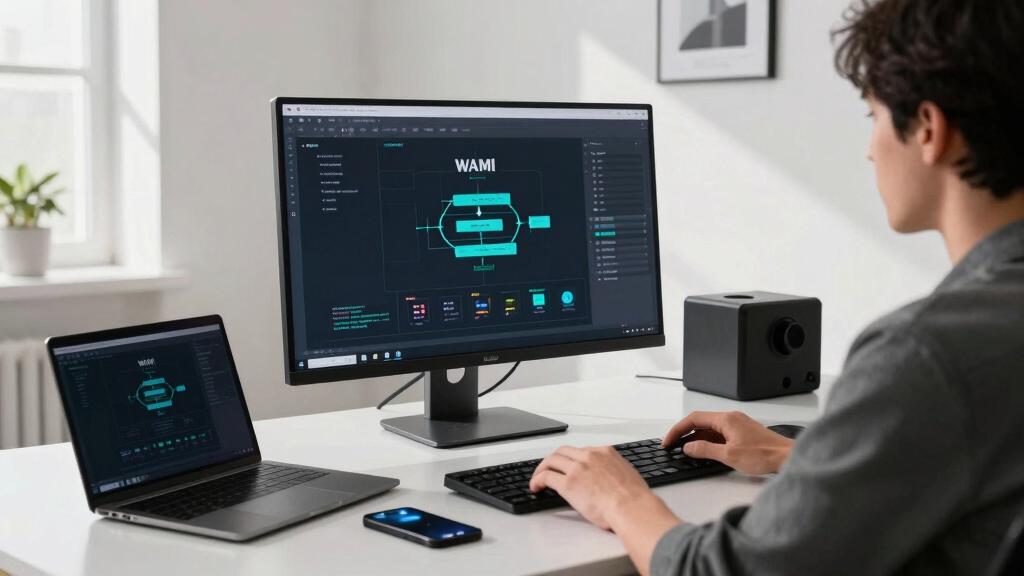

📊 Full opportunity report: Building Corvus ISR In Public, Day 1: A WAMI Exploitation Stack, Starting From Synthetic Data on ThorstenMeyerAI.com — validation score, market gap, and execution plan.

Get the latest gadgets delivered free — and shop member deals
- Fast, free delivery on millions of items
- Access to Prime Big Deal Days deals on October 6–7
- Prime Video, Amazon Music and more included
TL;DR
Corvus ISR begins its public development with a synthetic WAMI exploitation stack, featuring live detection and tracking in the browser. This marks the first step in a broader effort to democratize WAMI analysis software.
Thorsten Meyer has publicly launched the first stage of Corvus ISR, a new wide-area motion imagery (WAMI) exploitation stack, featuring a synthetic scene with live detection and tracking in a browser. This marks the start of a transparent, iterative development process aimed at addressing the exploitation gap in WAMI analysis software, especially for European and other non-US markets.
Corvus ISR is designed to detect, track, and index moving objects in large-scale WAMI scenes, creating a queryable motion database. The initial artifact is a browser-based synthetic scene with hundreds of moving vehicles, a configurable sensor, and a live detection and tracking system that displays bounding boxes, persistent IDs, and trail histories. This demonstration is deliberately minimal, focusing on geometric detection without deep learning, to establish a measurable, testable pipeline.
Developed by Thorsten Meyer, the project emphasizes transparency by publishing incremental code and results, with the goal of fostering an open development environment. The product strategy includes two editions: a Sovereign version for air-gapped deployment and a Governed version for EU cloud compliance, reflecting the growing importance of data sovereignty and regulatory considerations in ISR software procurement.
CORVUS ISR · synthetic WAMI scene — live detect & track
BUILD IN PUBLIC · DAY 1 ARTIFACTImplications for WAMI Exploitation Software Development
This initiative signifies a shift toward open, transparent development of advanced WAMI analysis tools, challenging the existing closed, US-controlled software ecosystem. By starting with synthetic data, Corvus aims to build a robust, benchmarked pipeline before transitioning to real-world data, potentially lowering barriers for European and allied nations to develop independent ISR capabilities. The project also highlights the strategic importance of data custody and jurisdiction in defense procurement, aligning with broader geopolitical trends.
browser-based WAMI detection software
As an affiliate, we earn on qualifying purchases.
As an affiliate, we earn on qualifying purchases.
The Challenge of WAMI Data and Current Market Gaps
WAMI sensors produce gigapixel-scale imagery, capturing entire cities at high frame rates, resulting in data volumes that far exceed traditional ISR collection. Historically, collection has outpaced exploitation, with data stored for post-hoc analysis by specialized analysts. The proprietary and closed nature of current software solutions has limited access outside the US, prompting a demand for open, customizable alternatives. Previous efforts have struggled with synthetic-to-real transfer and legal restrictions, making initial development on synthetic data a strategic choice.
Thorsten Meyer’s approach builds on this context by emphasizing synthetic data for initial development, aiming to create a transparent, adaptable exploitation stack that can be validated against perfect ground truth before tackling real data complexities.
“Corvus starts life on fully synthetic WAMI. It’s legally clean, infinitely labeled, and deliberately hard, allowing us to benchmark and improve detection and tracking before touching operational data.”
— Thorsten Meyer
Unresolved Questions About Real-World Transition
It remains unclear how well the synthetic-based pipeline will transfer to real WAMI data, which is more complex, noisy, and subject to legal restrictions. The effectiveness of the detection and tracking algorithms on real scenes, and the process for adapting synthetic models to operational environments, are still under development.
Additionally, the scalability and performance of the system in full operational scenarios, as well as integration with existing ISR workflows, are yet to be demonstrated.
Next Steps for Corvus ISR Development and Validation
The immediate focus is on refining the synthetic scene generation, improving detection and tracking robustness, and expanding the pipeline’s capabilities. The team plans to publish incremental updates and code, encouraging external validation and collaboration.
Following this, efforts will shift toward testing with real WAMI data, addressing transfer challenges, and developing deployment-ready versions for both sovereign and cloud environments. User feedback and operational testing will guide further development.
Key Questions
Why is Corvus ISR starting with synthetic data?
Using synthetic data allows for legally clean, perfectly labeled, and customizable scenes, enabling robust benchmarking and development without legal or privacy concerns associated with real surveillance footage.
What are the main goals of Corvus ISR?
The project aims to create an open, transparent WAMI exploitation stack that detects, tracks, and indexes moving objects, providing a queryable database for operators controlling their data infrastructure.
How does Corvus ISR address data sovereignty concerns?
It offers two editions: a Sovereign version for air-gapped deployment and a Governed version for EU cloud compliance, aligning with regional data control requirements.
When will real WAMI data be integrated?
The timeline is still uncertain, but initial focus is on refining synthetic pipelines before transitioning to real data, which will require additional development to handle complexities and legal restrictions.
What does this mean for the future of WAMI analysis?
This open approach could democratize access to advanced WAMI exploitation tools, reducing reliance on US-controlled software and fostering independent capabilities in allied nations.
Source: ThorstenMeyerAI.com
Fall Picks
fall essentials
As an affiliate, we earn on qualifying purchases.