
📊 Full opportunity report: Workflow Audit That Shows What's Ready To Automate on IdeaNavigator AI — validation score, market gap, and execution plan.

Get the latest gadgets delivered free with Prime
- Fast, free delivery on millions of items
- Prime Video, Amazon Music and more included
- Member-only deals all year
TL;DR
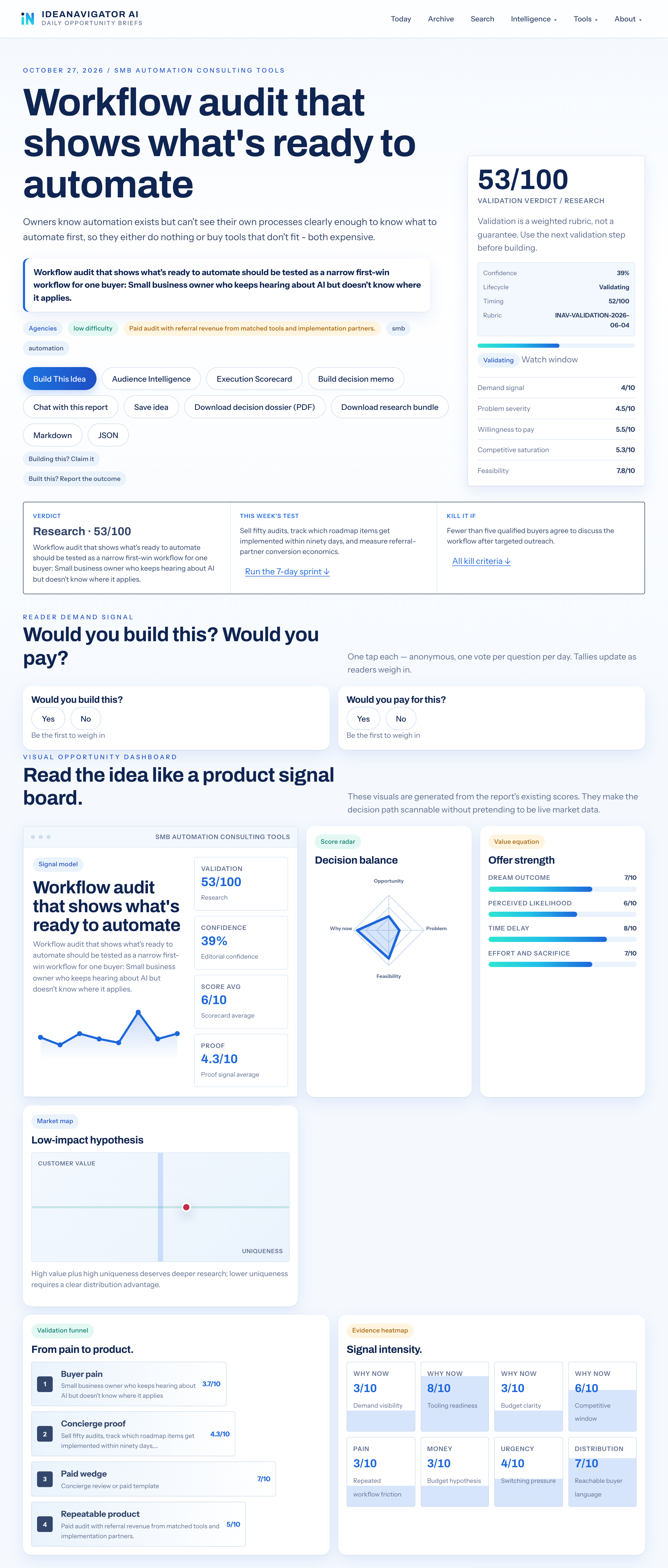
A proposed workflow-audit product would interview small-business owners, map their operations and rank tasks by automation readiness, potential return and difficulty. The idea has not been validated: its suggested test is to sell 50 audits and track implementation and referral conversions over 90 days.
IdeaNavigator AI has outlined a proposed workflow-audit service for small-business owners who are unsure where automation fits into their operations. In its concept description, the company says the service would map a business’s processes, score tasks for automation readiness, potential return and difficulty, then provide a sequenced 90-day plan. The description does not show that the service has launched or that customers have bought it.
IdeaNavigator AI says the concept addresses owners who hear about AI and automation but cannot readily identify which of their own tasks are suitable for them. The proposal argues that this uncertainty can lead either to doing nothing or buying tools that do not fit the business. It characterizes those outcomes as costly, but provides no data quantifying the losses or showing how often they occur.
According to the concept description, the proposed minimum viable product is a guided interview about a company’s operations. It would turn an owner’s answers into a process map, assess each workflow against readiness, return on investment and implementation difficulty, and arrange recommendations into a 90-day roadmap. It would also suggest tools matched to individual steps. These are proposed features, not confirmed capabilities of an available product.
IdeaNavigator AI proposes combining a paid audit with referral revenue when customers adopt recommended tools or hire implementation partners. To test the idea, its proposal calls for selling 50 audits, tracking which roadmap recommendations are implemented within 90 days, and measuring conversion economics for referral partners. The description provides no sales, implementation or revenue results.
Business concept · validation pending
Workflow Audit That Shows What’s Ready To Automate
A proposed service would map small-business operations, rank tasks by automation readiness, potential return and difficulty, then lay out a 90-day action plan. The concept has not been validated with reported sales or customer results.
Start with the work. Then decide which tools fit.
IdeaNavigator AI’s proposed approach to automation decisionsNo launch or sales reported
Sequenced recommendations
Paid audits to sell
Track implementation
What the audit would deliver
A guided interview would turn an owner’s description of daily operations into a prioritized set of possible automation projects.
Map the operation
Interview the owner about recurring work and assemble a process map. The concept does not describe how interview details would be verified.
Rank each workflow
Score tasks for readiness, potential return on investment and implementation difficulty. No scoring method or accuracy evidence is provided.
Recommend next steps
Arrange projects into a 90-day roadmap and suggest tools for individual steps. These are proposed features, not confirmed product capabilities.
A route from uncertainty to action
Proposed service flowDescribe
Owner explains the business’s recurring operations.
Map
Interview answers become a process map.
Prioritize
Tasks are ranked by readiness, return and effort.
Implement
Roadmap steps and tool matches guide action.
Illustrative scale only. The concept provides no scoring formula, example ratings or evidence that scores predict successful implementation.
What must be proven
For the audit to be useful, its judgments need to be credible, its advice usable and its economics clear to customers.
Will owners pay?
No price, customer count or evidence of willingness to pay is reported. The 50-sale goal is a proposed test, not achieved traction.
Can it assess work reliably?
Scoring rules, interview verification and adjustments for business size, regulation or software are not explained.
How are referrals handled?
The proposed model includes referral revenue from tools or implementation partners. Selection criteria and disclosure terms are unspecified.
Do recommendations pay off?
No customer results, savings estimates or implementation outcomes are reported. A 90-day window may not capture longer-term effects.
The proposed 50-audit test
IdeaNavigator AI proposes selling audits and following each customer’s roadmap for 90 days. No test results have been reported.
Paid audits proposed as an initial validation milestone.
How many owners buy an audit?
Which roadmap items are acted on within 90 days?
Do owners find the analysis useful and accurate?
Do matched tools or partners convert, and on what terms?
Key questions
What the concept description says—and what remains unknown.
What is the proposed workflow audit?
A service that would interview a small-business owner, map processes, rank tasks by readiness, potential return and difficulty, and produce a 90-day roadmap with tool suggestions.
Is it already available?
The material describes a product concept and validation plan. It gives no launch date, purchase link or evidence of completed customer audits.
How might it make money?
The suggested model combines paid audit fees with possible referral revenue from software tools and implementation partners. Pricing and disclosure terms are unspecified.
How would the idea be tested?
The proposal calls for 50 audit sales, tracking roadmap implementation within 90 days and measuring referral conversions. No results are reported.
A Practical Route to Automation Decisions
For a small-business owner, the central question is often not whether automation tools exist but which recurring task is worth addressing first. A process map paired with practical rankings could make that decision more concrete than a general list of AI products. The proposed 90-day sequence also frames adoption as a set of steps rather than a single broad technology purchase.
The model’s value would depend on whether its recommendations are accurate and usable. A paid assessment could reduce wasted spending if it helps owners avoid tools that do not match their processes. But that benefit remains a hypothesis to test, not an established outcome. Owners would need to judge the audit’s price against the quality of its analysis and any implementation costs that follow.
Referral payments create a further consideration for customers: recommendations could generate revenue for the service as well as solve a workflow problem. The proposal does not explain how tool matches would be selected or whether paid referrals would be disclosed. Those details would matter to the credibility of the audit, particularly if the product is meant to offer an independent assessment.
Products Worth Considering

Samsung 32-Inch Odyssey OLED G8 (G80SH) 4K Gaming Monitor

Jackery HomePower 1000 Plus v2 Portable Power Station

Bose QuietComfort Wireless Bluetooth Headphones with Active Noise Cancellation, Mic, USB‑C Charging, Deep Bass, 24‑Hour Battery – White Smok
As an affiliate, we earn on qualifying purchases.
Why Process Mapping Is the Proposed Starting Point
IdeaNavigator AI places the idea within the market for small-business automation consulting tools. Its concept description identifies the expansion of AI tools as a source of decision paralysis: business owners may face more options without having a clear account of the work those tools could support. This is the company’s explanation for why a guided audit may be timely, rather than evidence of measured demand.
The proposal’s response is to start with the business’s existing operations, then connect specific processes to possible tools and implementation support. IdeaNavigator AI says guided process-mapping interviews have become automatable by large language models, making a structured audit a possible product format. The description provides no technical details, test results or comparisons with human-led consulting, so the quality and cost advantages of that approach are not established.
Demand, Accuracy and Referral Terms
Commercial demand remains unproven. IdeaNavigator AI’s concept description provides no evidence that small-business owners will pay for an audit, what price they would accept, or which types of businesses would benefit most. The proposed target of 50 sales is a validation test, not a reported customer count.
The description also does not explain how the service would verify information gathered in an interview, calculate readiness or return, and account for differences in business size, regulation and existing software. A roadmap could be misleading if owners’ descriptions omit important steps or if recommendations rely on assumptions that are not checked. The concept gives no scoring method or evidence that its estimates would predict successful implementation.
Referral economics and implementation outcomes are also unknown. The material reports no conversion rates, partner terms or customer results, and does not explain how recommendations would be kept impartial. The proposal specifies tracking roadmap items implemented within 90 days, but that timeframe may not capture every project’s cost, benefit or longer-term performance.
The Proposed 50-Audit Test
IdeaNavigator AI’s proposal describes the next step as selling 50 audits and following each customer’s roadmap for 90 days. The test would record which recommendations are implemented and examine whether matched tools or implementation partners convert into referrals. Those measures could provide an initial indication of buyer interest and whether customers act on the advice.
The material describing the idea announces no launch date, audit price, recruitment plan or results. Until a test is conducted and its findings are reported, the concept should be treated as an unvalidated business proposal rather than a proven service. Useful reporting milestones would include the number of audits sold, implementation rates, customer feedback, the basis for scoring recommendations and the economics of any referral arrangements.
Key Questions
What is the proposed workflow audit?
IdeaNavigator AI describes it as a proposed service that would interview a small-business owner, map operational processes and rank tasks by automation readiness, potential return and difficulty. The planned output includes a 90-day roadmap and suggested tools.
Is the audit already available?
The IdeaNavigator AI material describes a product concept and a validation plan, not a confirmed launch. It provides no release date, purchase link or evidence of completed customer audits.
How would the proposed service make money?
IdeaNavigator AI’s suggested model combines fees for audits with potential referral revenue from tools and implementation partners. Pricing, partner terms and referral disclosures have not been specified.
How would the idea be tested?
The proposal recommends selling 50 audits, tracking which roadmap items customers implement within 90 days, and measuring conversions through referral partners. IdeaNavigator AI reports no results from that test.
What is not yet known about the recommendations?
The concept description does not explain its scoring method or show whether the recommendations lead to measurable savings or successful implementations. Their accuracy and value for different kinds of small businesses remain untested.
Source: IdeaNavigator AI