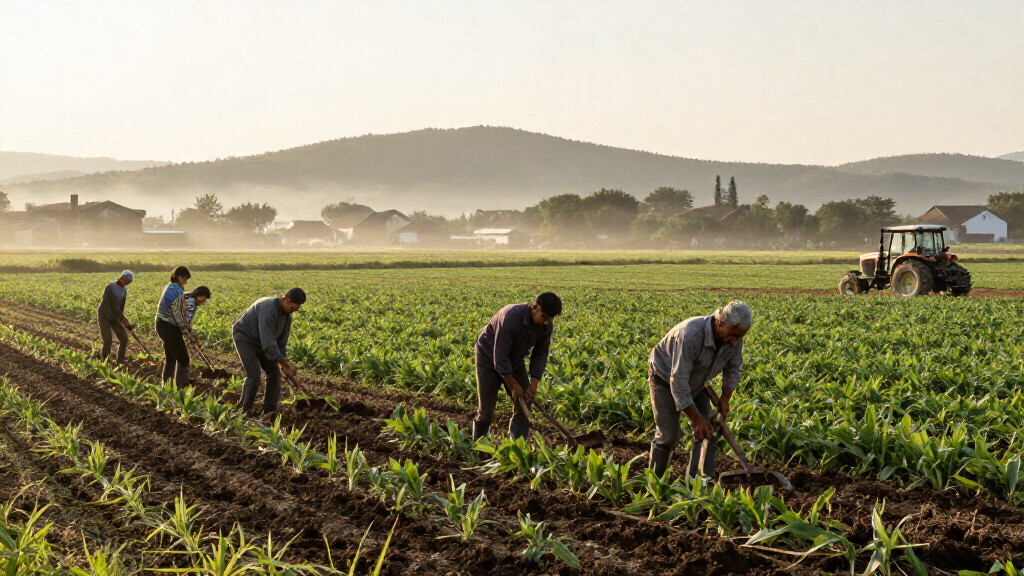

🔍 Read the full analysis: When Almost Everyone Farmed on ThorstenMeyerAI.com

Get the latest gadgets delivered free with Prime
- Fast, free delivery on millions of items
- Prime Video, Amazon Music and more included
- Member-only deals all year
TL;DR
A ThorstenMeyerAI.com article published November 3, 2026, traces the long decline in farming’s share of employment, from about 73.7% of the U.S. labor force in 1800 to roughly 1.5% today. It attributes the shift to successive changes in tools, fertilizer and crop breeding, while noting that about 928 million people still work in agriculture worldwide.
Thorsten Meyer published the second installment of his “Work After Work” series on November 3, examining how farming went from employing most workers in the United States to about 1.5% of the U.S. workforce today. The historical account argues that the change unfolded over roughly two centuries through successive improvements in tools, fertilizer and crop varieties—not a single moment of automation—and says 928 million people worldwide still work in agriculture.
Meyer cites economic historian Stanley Lebergott’s estimate, published by the U.S. Census Bureau, that 1.4 million of the 1.9 million people in the U.S. labor force in 1800 worked in agriculture, or 73.7%. The estimate covers workers aged 10 and older and includes about 530,000 enslaved people. Figures before 1840 are reconstructions rather than census counts; the same series puts the agricultural share even higher in 1810. “About three in four” is therefore a rounded description of an uncertain early measure, not a precise count.
The article presents the shift as a chain of changes. It points to an 1837 steel plough associated with John Deere, later mechanized equipment, and the development of synthetic ammonia fertilizer. It also describes the adoption of short-stalk wheat in India and Pakistan in the mid-1960s. Citing Indian official statistics, Meyer reports that India’s wheat harvest increased from 12.3 million tonnes in 1964–65 to 26.4 million tonnes in 1971–72, then reached 117.5 million tonnes in the 2024–25 third advance estimate.
The article says agricultural employment’s share can decline before the number of farm workers does. In the United States, the number of farm workers continued to rise until about 11.8 million around 1910, according to Meyer’s account. In Germany, the agricultural share fell from 43% to 25% between 1882 and 1939 while the number of farm workers remained between 8 million and 10 million. These examples distinguish a sector’s share of the workforce from its absolute headcount.
The history matters because it shows that a smaller workforce in a sector does not automatically mean lower production. Meyer cites data showing that global cereal harvests grew 4.2-fold from 1961, while the world’s population grew 2.7-fold over the same period. He also reports that U.S. farm output in 2023 was nearly three times its 1948 level, with only a small rise in total inputs. These figures support the article’s central distinction: productivity can rise even as fewer workers are needed relative to the rest of the economy.
The consequences were not simply that farm work disappeared. As agriculture’s share declined, employment expanded in other parts of the economy, though the source does not quantify where each former farm worker went or how transitions differed by place and period. The historical case is relevant to current debates about automation because it documents a major sectoral shift, but it does not establish that changes in other industries will follow the same pace or have the same effects.
Meyer’s forward-looking claim is explicitly a thesis, not a fact: he suggests automation could eventually affect as much as 90% of a sector within a decade or a few decades. Agriculture’s roughly 200-year U.S. transformation offers a caution against treating that forecast as a settled timetable.
Products Worth Considering

Apple Watch Series 12 GPS 46mm Smartwatch

Anker SOLIX C1000 Gen 2 Portable Power Station with 200W Solar Panel

Sony WH-1000XM5 Wireless Noise-Canceling Over-Ear Headphones, Black, International Version
As an affiliate, we earn on qualifying purchases.
A Two-Century Shift in Farming
The article places the U.S. experience alongside estimates from other countries. Japanese economic historians reconstructed a primary-sector share of about 85% in 1872, a category that included farming, forestry and fishing. Germany’s first official occupational count cited in the article put agriculture and forestry at 43.4% of workers in 1882, though it may have undercounted women working on family farms. China’s employment series began in 1952 with 83.5% in the primary sector, while India’s 1951 census counted cultivators and agricultural laborers as 69.7% of workers. These figures come from different dates and methods, so they are comparisons of broad patterns, not a single synchronized dataset.
Meyer’s explanation begins with the limits of labor-intensive farming. Before modern machinery and inputs, households relied heavily on human and animal muscle, hand tools and weather, restricting how much food a farm could produce. The article then follows three broad developments: tools that made cultivation and harvesting more efficient, chemical fertilizer that supplied usable nitrogen, and crop breeding that raised yields under suitable conditions.
For the fertilizer milestone, Meyer cites Fritz Haber’s 1908 ammonia-synthesis patent and the start of industrial ammonia production in 1913. For crop breeding, he cites the spread of dwarf wheat associated with Norman Borlaug in India and Pakistan in the 1960s. The source frames these as parts of a long sequence; it does not attribute agricultural productivity gains to any one invention alone.
“The share fell long before the headcount.”
— Thorsten Meyer, in the November 3, 2026 article
Historical Measures Have Limits
The early U.S. figures are estimates, not direct census counts, and the 1800 labor-force series includes enslaved people. Cross-country comparisons also rely on distinct definitions: some figures cover agriculture alone, while others use the broader primary sector or include forestry and fishing. The German count may omit some women’s farm work. Those limitations make broad trends clearer than exact comparisons.
The article does not provide a full account of how people leaving agriculture moved into other occupations, nor does it break out the distributional effects of mechanization, fertilizer or crop breeding. Its global total of 928 million agricultural workers is attributed to a 2025 International Labour Organization estimate, but the supplied material does not detail the estimate’s methodology. Meyer’s projection that automation could affect up to 90% of a sector is speculative; the timing, sectors involved and meaning of that threshold are not established.
The Series Turns to Factories
The article identifies itself as Episode 2, Arc 1 of “Work After Work.” Meyer says the next installment, Episode 3, will cover mechanical reapers, threshers and tractors, extending the account of how farm tools changed agricultural work. No publication date for that episode is given in the source material.
For now, the article’s evidence supports a historical account rather than a forecast about the next wave of automation. Further installments may add detail about the movement of workers between sectors and about how changes in farming compare with developments in factories and offices.
Key Questions
How many U.S. workers farmed around 1800?
The article cites a 73.7% estimate for 1800: 1.4 million of a labor force of 1.9 million people aged 10 and older. The figure is a historical estimate, not a census count, and includes enslaved workers.
How many people work in agriculture worldwide?
Meyer cites an International Labour Organization estimate for 2025 of 928 million people, roughly one in four workers worldwide. The article also says agriculture accounts for about 43% of workers in India, compared with about 1.5% in the United States and about 1% in Germany.
No. The article says the U.S. farm-worker headcount continued rising until about 11.8 million around 1910, even as agriculture’s share of employment began to fall. A declining share and a declining headcount are different measures.
What changes helped reduce the labor needed in farming?
The article points to a sequence that included improved ploughs and machinery, synthetic fertilizer and higher-yield crop varieties such as short-stalk wheat. It presents these as contributing developments, not as a single cause of the entire change.
Does farming’s history prove that automation will affect 90% of another sector soon?
No. Meyer describes that figure as his thesis, not a fact. The article offers farming as a historical case study but does not establish a timetable or show that other sectors will change at the same rate.
Source: ThorstenMeyerAI.com