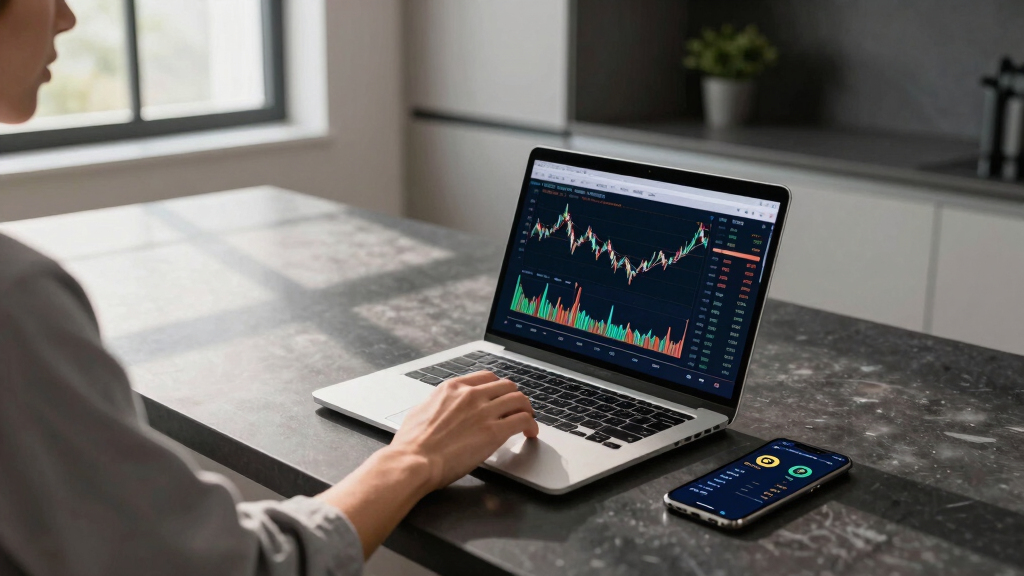

📊 Full opportunity report: Week Three — Foundation model vs Brownian motion. Kronos on five-minute BTC. on ThorstenMeyerAI.com — validation score, market gap, and execution plan.

Get the latest gadgets delivered free — and shop member deals
- Fast, free delivery on millions of items
- Access to Prime Big Deal Days deals on October 6–7
- Prime Video, Amazon Music and more included
TL;DR
A recent study tested Kronos, an open-source foundation model, against a Brownian motion baseline for 5-minute Bitcoin price predictions. The results show Kronos does not outperform Brownian motion on out-of-sample data, questioning its immediate use in trading strategies.
Recent testing shows that Kronos, an open-source foundation model trained on global crypto data, does not outperform the traditional Brownian motion model in predicting 5-minute Bitcoin price movements, based on out-of-sample data.
Researchers conducted a detailed comparison between Kronos-small, a foundation model with 24.7 million parameters, and a geometric Brownian motion baseline, using a dataset of 497 Bitcoin trades recorded over several weeks. The test aimed to determine if a modern learned model could surpass the classical assumption of market randomness in short-term predictions.
The methodology involved reconstructing the market context for each trade, predicting the probability of Bitcoin closing above the open price at five minutes, and evaluating model performance using metrics such as Brier score, log-loss, and hypothetical profit and loss. The models were tested on the entire sample and separately on an out-of-sample subset of 249 trades, which had never been seen during training.
The results showed that Brownian motion achieved a Brier score of 0.188 on the out-of-sample data, while Kronos scored 0.189, with the difference being statistically insignificant. Both models performed similarly, with market-implied probabilities falling between the two, indicating that Kronos did not provide a meaningful edge over the classical model in this context.
As a consequence, the authors concluded that integrating Kronos into a live trading bot, as initially planned, is not justified based on current data. The test underscores the challenge of developing predictive models that can consistently outperform simple stochastic assumptions in high-frequency crypto markets.
Implications for AI in Short-Term Crypto Trading
The findings suggest that even sophisticated foundation models like Kronos may not offer a significant advantage over traditional models for short-term Bitcoin predictions at five-minute intervals. This challenges the assumption that larger, learned models automatically translate into better trading signals in noisy, high-frequency markets.
For traders and researchers, it emphasizes the importance of rigorous out-of-sample testing and cautious integration of AI models into live strategies. The result also highlights the resilience of simple stochastic models in certain market conditions, raising questions about the cost-benefit ratio of deploying complex AI in high-frequency trading contexts.
Bitcoin 5-minute trading indicator
As an affiliate, we earn on qualifying purchases.
As an affiliate, we earn on qualifying purchases.
Background on Model Testing and Market Assumptions
Over the past weeks, a paper-trading bot called Polybot has been used to evaluate various predictive models against Polymarket’s 5-minute crypto markets. Initial findings indicated that most “edges” detected by the bot were mechanical artifacts that did not survive out-of-sample testing. The traditional approach employed a geometric Brownian motion model, a 100-year-old mathematical assumption, to estimate short-term price probabilities.
Given the limitations observed, the question arose whether a modern, learned model trained on extensive market data could outperform the Brownian baseline. Kronos, an open-source foundation model trained on millions of candlesticks from global exchanges, was identified as a promising candidate for this purpose. Prior to this test, Kronos was explicitly described as a research model, not a trading system, designed for academic exploration rather than live deployment.
“Kronos, despite its sophistication, did not outperform the traditional Brownian motion model in out-of-sample predictions for 5-minute Bitcoin trades.”
— Thorsten Meyer
Unresolved Questions About Model Performance
It remains unclear whether different configurations, larger models, or alternative training data could yield better results. The current test results are specific to Kronos-small and the particular market conditions during the testing period. Further research is needed to determine if future models can surpass Brownian motion in similar short-term prediction tasks.
Next Steps for AI and Crypto Market Prediction
Researchers plan to test larger versions of Kronos and other foundation models on different time horizons and market conditions. Additional out-of-sample evaluations, including live trading simulations, are expected to clarify whether AI can reliably outperform classical models in high-frequency crypto trading. The ongoing research aims to refine model architectures and training methods to improve predictive accuracy.
Key Questions
Does this mean AI models are useless for crypto trading?
Not necessarily. While this specific test shows Kronos did not outperform a Brownian baseline for 5-minute Bitcoin predictions, other models or configurations might perform better in different contexts or timeframes. Further research is needed.
Can a simple Brownian motion model still be useful?
Yes. The results reinforce that classical stochastic models can be surprisingly effective in certain high-frequency trading scenarios, especially when more complex models do not demonstrate clear advantages in out-of-sample testing.
Will the results change with larger or more trained models?
This remains an open question. Future experiments with larger models or different training data could potentially yield different outcomes, but current evidence suggests caution in expecting immediate gains from AI in short-term crypto prediction.
What does this mean for traders considering AI tools?
Traders should approach AI-based predictions critically and rely on rigorous out-of-sample testing. Complex models require careful validation before being integrated into live strategies, especially in volatile markets like crypto.
Source: ThorstenMeyerAI.com
Fall Picks
fall essentials
As an affiliate, we earn on qualifying purchases.