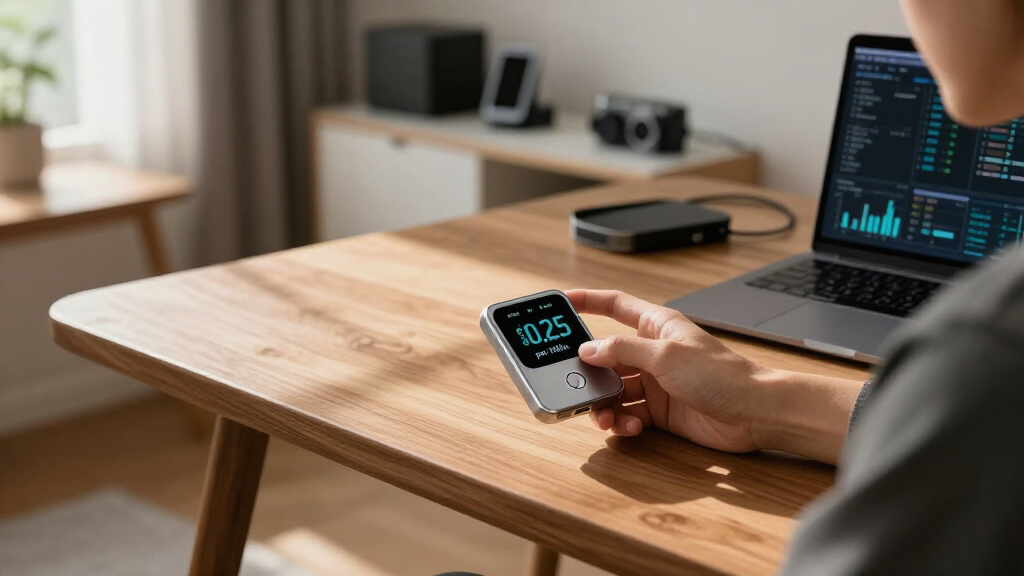

📊 Full opportunity report: The Ninth Point: What DeepSeek-V4-Flash-High Actually Proves At $0.25 Per Million on ThorstenMeyerAI.com — validation score, market gap, and execution plan.
Prime for Young Adults — start your free trial
Fast free delivery, streaming and member deals for eligible 18–24 year olds.
Try it freeAs an affiliate, we earn on qualifying purchases.
TL;DR
DeepSeek-V4-Flash-High, an open-weight model, has shown a notable performance increase after post-training, achieving a high rating at about $0.25 per million tokens. This challenges assumptions about capability and cost in AI model development.
DeepSeek-V4-Flash-High has demonstrated a significant increase in its performance rating following a post-training update, despite remaining at the same price point of approximately $0.25 per million tokens. This development suggests that post-training adjustments can substantially enhance capability without additional costs, challenging traditional views on model scaling and expense.
On July 31, 2026, the creators of DeepSeek-V4-Flash-High released a post-training update that improved its Arena score by about 145 points. The model, based on a sparse mixture-of-experts architecture with 284 billion parameters, remains at the same price of roughly $0.25 per million tokens, as per its published API rates. The update involved no change in parameters, architecture, or context window but added native support for OpenAI Responses API and compatibility with Codex-style coding clients.
This performance boost was observed on Arena’s leaderboard, where the post-training version scored significantly higher than the April checkpoint. The rating increase was confirmed by Arena’s voting, which showed that the model’s performance improved despite the unchanged cost structure, indicating post-training as a key lever for capability enhancement.
An MIT-licensed mixture-of-experts sits nine points behind the second-best model on the board at roughly one fifteenth of its price — and 128 points behind the leader at roughly one eighty-second. The rating is one day old and marked preliminary. The shape of the curve is the story anyway.
▲ Preliminary rating · ±18 · 1,319 of 510,194 votesSix models nothing else beats on both score and price at once. The horizontal axis is logarithmic — every gridline is roughly a tenfold price increase.
Both checkpoints sit on the board simultaneously — a rare clean record of what re-post-training alone is worth on frozen weights at a frozen price.
- Original public release
- Chat Completions API
- Re-post-trained for agentic work
- Native Responses API, Codex-adapted
- MIT weights on Hugging Face, DSpark module attached
Arena reports a conservative rating — mu minus three sigma — and the row is one day old. The bias cuts both ways.
Nothing here should be read as a settled ranking. The durable claim is narrower: at the price actually published, a model of this class being on the frontier at all is the fact worth recording.
A 284B MoE with 13B active, expert weights in FP4, is approximately the shape of model that already runs on high-memory Apple silicon.
- MIT means MIT. Commercial use, modification, redistribution — no bespoke licence to interpret, no acceptable-use policy to monitor.
- Runnable in principle. FP4 experts and 13B-active sparsity put per-token compute near a mid-size dense model, within reach of a 512GB unified-memory machine.
- Post-training is the cheap lever. +145 points on frozen weights signals more gains of this kind, from every open-weight lab.
- Vendor benchmarks are vendor benchmarks. Terminal-Bench, Cybergym and DeepSWE numbers come from DeepSeek’s own harness; agent scores are harness-sensitive.
- One task family. Frontend code voting is not a general capability measure, and sub-boards disagree with the Overall board.
- Self-hosting buys sovereignty, not savings. At $0.25 per million blended, the hosted API undercuts your own electricity and depreciation for most workloads.
For the first time, the model asking the question carries an MIT licence.
Implications of Post-Training Performance Gains
This development challenges the common assumption that only larger, more expensive models can achieve high performance. The ability to boost capability through post-training at a fixed cost suggests a new paradigm for AI development, where efficiency and cost-effectiveness are maximized by leveraging post-training techniques rather than scaling parameters alone. For users and developers, this could mean more accessible high-performance models without escalating costs, especially under open licensing conditions like MIT.
AI model performance evaluation tools
As an affiliate, we earn on qualifying purchases.
As an affiliate, we earn on qualifying purchases.
Recent Advances in Model Post-Training and Cost Dynamics
DeepSeek-V4-Flash-High was initially released on April 24, 2026, as part of a wave of models leveraging sparse mixture-of-experts architectures. The model's core architecture remained unchanged in the July update, but the post-training process—conducted on the same checkpoint—resulted in a performance increase of approximately 145 points on Arena's leaderboard. This update coincides with a broader industry trend of using post-training techniques to improve models without additional parameters or retraining costs.
Prior to this, capability improvements were typically associated with training new models or increasing parameters, often at significant expense. The recent performance leap indicates that post-training can be a cost-effective alternative, especially for models with open licenses like MIT, which permit modification and redistribution without licensing fees.
Uncertainty Over Long-Term Performance Stability
It is not yet clear whether the performance gains from post-training are stable over time or subject to fluctuations as votes and ratings evolve. The current ratings are preliminary, marked with ±18 uncertainty, and may shift as more votes are cast and the model's performance is further validated.
Additionally, it remains uncertain how broadly applicable this approach is across different models and tasks, or whether similar gains can be reliably achieved in other architectures without retraining from scratch.
Monitoring Post-Training Impact and Industry Adoption
Further validation of DeepSeek-V4-Flash-High's performance stability and applicability will come as more votes are accumulated and additional benchmarks are conducted. Developers and researchers are expected to explore post-training techniques more extensively, potentially leading to new standards for cost-effective model enhancement. Continued updates from Arena and other benchmarking platforms will clarify the long-term significance of this development.
Key Questions
What is the significance of the recent performance boost in DeepSeek-V4-Flash-High?
The boost demonstrates that post-training can significantly improve a model's capabilities without additional parameters or costs, challenging traditional scaling assumptions.
Does this mean larger models are no longer necessary for high performance?
Not necessarily. While post-training offers a cost-effective way to boost performance, larger models still provide inherent advantages for certain tasks. This development highlights an alternative approach rather than replacing scale entirely.
Is the performance increase confirmed or still uncertain?
The increase is based on preliminary ratings with an uncertainty margin of ±18 votes. Further votes and validation are needed to confirm the stability and significance of the boost.
Can this approach be applied to other models?
It is possible, but effectiveness may vary depending on architecture and training data. The industry is likely to experiment with post-training techniques more extensively in the coming months.
What does this mean for licensing and open models?
Since DeepSeek-V4-Flash-High is MIT-licensed, modifications and improvements through post-training are permitted without licensing fees, potentially encouraging wider adoption of such techniques.
Source: ThorstenMeyerAI.com
Fall yard work Picks
leaf blowers
As an affiliate, we earn on qualifying purchases.