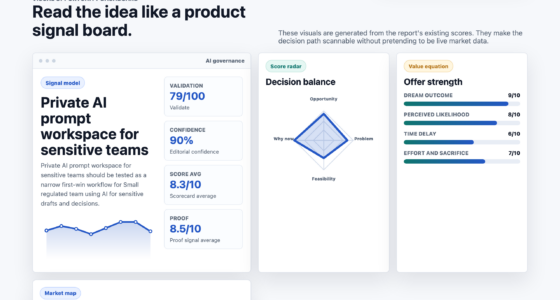

📊 Full opportunity report: NicheCommand: A Firehose Becomes A Shortlist on ThorstenMeyerAI.com — validation score, market gap, and execution plan.
Listen free for 30 days with Audible
Thousands of audiobooks and originals — cancel anytime.
Start your free trialAs an affiliate, we earn on qualifying purchases.
TL;DR
NicheCommand transforms the overwhelming daily flood of expired domains into a prioritized, auditable shortlist. It automates filtering, classification, and scoring, enabling faster, more reliable domain acquisitions.
NicheCommand, a domain intelligence platform, has launched a system that converts the vast daily influx of expired domains into a focused, ranked shortlist. This development aims to address the longstanding challenge of efficiently identifying valuable domains amid millions of junk names, helping users act faster and with greater confidence.
The platform ingests the daily drop list of expired domains and applies zero-cost filtering rules to eliminate roughly 95% of junk names automatically. It then enriches the remaining candidates with data from the Wayback Machine, live registration status, and classification into specific business verticals such as finance, SaaS, or local services. Each domain is scored based on tailored weights for its vertical, and the results are organized into a tiered queue: S (highest priority), A (shortlist), B (review), and C (out of scope).
A firehose becomes a shortlist.
Hundreds of thousands of domains expire every day; a handful were real businesses. NicheCommand ingests the drop list, kills the junk with zero-cost rules, enriches survivors with real history, classifies and scores each, and hands you a tiered triage queue — every signal sourced, every decision recorded.
Every signal carries its source
Each fact — snapshot counts, name analysis, keyword hits — is an append-only ledger row with source, fetch time, and a pointer to the raw evidence.
Scores that show their work
A per-component breakdown sums exactly to the 0–100 score, and every classification stores the model, prompt version, confidence, and a written rationale.
Nothing drops silently
Every run and per-domain outcome — including rejections, with reasons — is an event. If a name isn’t in your queue, the system tells you why.
A few are real businesses. Be the one who finds them first.
Independent commentary, produced with AI assistance under human editorial oversight. The views are the author’s own and may change. This describes a product’s design and stated features — not business, financial, legal, or investment advice. Acquiring expired domains carries legal, trademark, and commercial risk that is the buyer’s own responsibility to assess; filtering and scoring figures are the product’s own framing, not guarantees. The Wayback Machine, RDAP, and other names are trademarks of their respective owners; mention does not imply endorsement.
Implications for Domain Investors and Resellers
This system automates a process that previously took hours of manual research, enabling domain investors, brokers, and businesses to act more swiftly on valuable expired domains. Its transparent, auditable signals foster trust and allow users to justify decisions to partners or clients, potentially increasing acquisition success and reducing wasted effort.
domain research and analysis tools
As an affiliate, we earn on qualifying purchases.
As an affiliate, we earn on qualifying purchases.
Background on Domain Drop Challenges
Every day, hundreds of thousands of domains expire, most of which are worthless junk. Historically, finding valuable domains among these drops has relied on manual filtering, guesswork, and limited data sources, making the process inefficient and inconsistent. Existing tools often lack transparency, leading to decisions based on opaque signals or vibes. NicheCommand aims to overhaul this approach by providing a disciplined, data-driven pipeline that automates and documents every step, ensuring repeatability and accountability.
“NicheCommand turns the overwhelming flood of expired domains into a manageable, auditable shortlist, making the process faster, more transparent, and more reliable.”
— Thorsten Meyer, founder of ThorstenMeyerAI.com
Unclear Aspects of Platform Adoption and Effectiveness
It is not yet clear how widely NicheCommand will be adopted by the target user base or how it compares in effectiveness to existing manual or semi-automated workflows. Long-term performance metrics, such as success rate in acquiring high-value domains, are still to be established, and user feedback is pending.
Next Steps for Deployment and User Feedback
NicheCommand plans to roll out the platform to early adopters in the coming months, gather user feedback, and refine its scoring models and vertical playbooks. Broad availability is expected later this year, alongside potential integrations with popular domain marketplaces and broker platforms. Monitoring real-world success stories will be key to validating its impact.
Key Questions
How does NicheCommand filter out junk domains?
It applies zero-cost, rule-based filters that eliminate roughly 95% of junk names based on patterns, spam indicators, and other heuristics, before performing more expensive enrichment steps.
Can users customize scoring for different business verticals?
Yes, users can retune weights and keywords for each vertical, tailoring the scoring and tiering to their specific acquisition strategies.
Is the platform transparent about how scores are calculated?
Absolutely. Every signal, score component, and classification is recorded with its source and rationale, enabling users to audit decisions and understand why domains are ranked as they are.
Will NicheCommand integrate with domain marketplaces?
Integration plans are in development, aiming to streamline the process from shortlist to acquisition, but specifics have not yet been announced.
What kinds of domains does NicheCommand focus on?
The platform supports multiple verticals, including finance, SaaS, local services, and more, each with tailored classification and scoring models to suit different types of valuable domains.
Source: ThorstenMeyerAI.com
NFL season / tailgating Picks
team gear
As an affiliate, we earn on qualifying purchases.