📊 Full opportunity report: Empty Trust Tracker on IdeaNavigator AI — validation score, market gap, and execution plan.

Get the latest gadgets delivered free — and shop member deals
- Fast, free delivery on millions of items
- Access to Prime Big Deal Days deals on October 6–7
- Prime Video, Amazon Music and more included
TL;DR
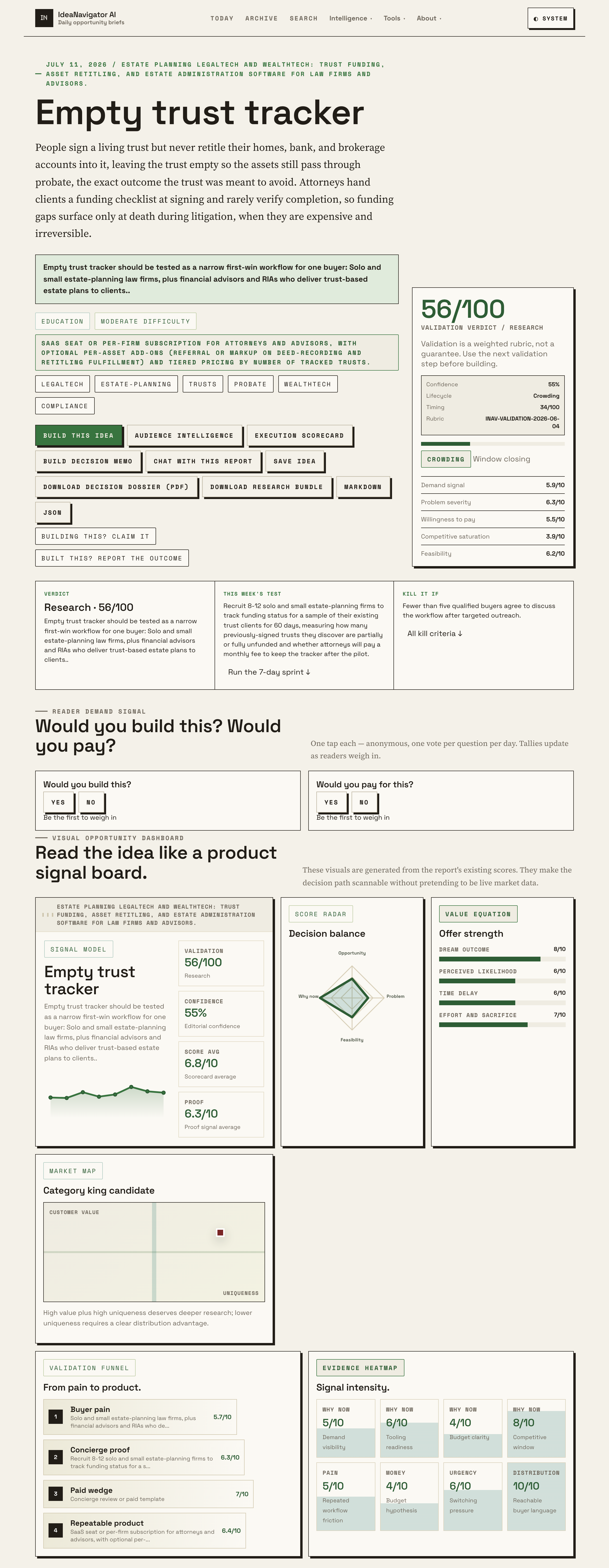
IdeaNavigator AI has outlined an early-stage business opportunity for software that tracks whether clients transfer assets into living trusts after signing. The proposal has not been described as a launched product or tested service; its suggested next step is a 60-day pilot with 8 to 12 small firms.
IdeaNavigator AI has proposed a trust-funding tracker for small estate-planning law firms and financial advisers, aimed at identifying assets clients have not transferred into their living trusts. The concept addresses a gap between signing trust documents and retitling property and accounts, but it remains a business proposal; no product launch or pilot results are reported.
The proposed software would let an attorney or adviser create a funding checklist for each trust, covering assets such as real estate, bank and brokerage accounts, business interests and beneficiary designations. Staff could mark each item pending, in progress or confirmed funded, then attach supporting records such as a recorded deed or an updated account statement. Automated reminders would prompt clients to complete outstanding steps.
A firm dashboard would summarize the funding status of its clients’ trusts, including each trust’s percentage of listed assets marked funded. The proposal is aimed at solo and small estate-planning practices and at financial advisers or registered investment advisers that provide trust-based estate plans. Possible revenue models include subscriptions priced by firm or seat, tiers based on the number of trusts tracked, and optional fees or referrals for deed-recording and retitling services.
To test demand, IdeaNavigator AI proposes recruiting 8 to 12 firms for a 60-day pilot. Participants would track a sample of existing clients’ trusts and measure how many signed trusts appear partly or wholly unfunded. The pilot would also test whether firms would pay a monthly fee to continue using the tracker. No participating firms, pricing, pilot findings or release schedule have been identified.
The Gap After Trust Signing
A living trust can only manage assets that have been properly transferred into it or otherwise connected to it through the estate plan. If a home or financial account remains in an individual’s name, that asset may not receive the intended treatment under the trust. Tracking completion after signing could give a firm a way to identify missing steps while a client can still address them.
The proposal’s practical value depends on whether firms can verify funding reliably and whether clients act on reminders. A status dashboard would organize information, but it would not itself transfer ownership or establish that every asset is legally handled as intended. The idea would therefore sit alongside legal and financial work already required to fund a trust, rather than replace it.
For readers considering a trust, the proposal highlights a procedural issue: signing the document may not finish the work. The details differ by asset and situation, and the proposed tracker has not been shown to prevent probate or resolve disputes. Its potential relevance is in helping professionals follow up on tasks that might otherwise be left to clients to complete on their own.
Why Funding Can Be Missed
The proposal describes trust funding as a manual, fragmented process. At signing, an attorney may give a client a checklist for transferring or retitling assets, then have limited visibility into whether the client completed those tasks. Information may be spread across deeds, account statements and communications with multiple institutions, making follow-up difficult for a small practice.
IdeaNavigator AI says that only about 11% of Americans hold a trust, but the proposal does not specify the survey, date or definition behind that figure. It also points to interest among advisers in offering funded estate plans and says deed-funding services priced from $250 indicate a market for related services. Those points are part of the opportunity assessment; they do not establish demand for a tracking product or a specific market size.
The proposed tracker would address the follow-up and recordkeeping layer. It would not perform every transfer itself. Some assets may require legal documents, institution-specific forms or professional guidance, and the proposal does not describe how the software would handle those differences or confirm that evidence is sufficient.
Pilot Results and Verification
The proposal does not say whether any firms have agreed to participate, whether a prototype exists or whether clients would use automated reminders. It also provides no pilot results or confirmed pricing. The proposed 60-day test is intended to determine how often firms find partly or fully unfunded trusts and whether they would pay to keep using the service.
It remains unclear how the tracker would validate documents, protect sensitive financial and property records, or distinguish a completed transfer from paperwork that is still pending. The proposal does not set out integrations with banks, brokerages or county recording systems, nor does it explain responsibility for reviewing uploaded proof. These operational details would affect how much work the tool saves and how dependable its status labels are.
The 11% trust-ownership figure and the claim that current drafting software leaves this follow-up gap are not accompanied by underlying research or named products in the proposal. The scale of unmet demand, the frequency of costly funding failures and the willingness of small firms to pay therefore remain unverified.
A 60-Day Firm Pilot
The next proposed step is to recruit 8 to 12 solo and small firms and have them track funding progress for a sample of existing trust clients over 60 days. The test would count how many signed trusts are found to be partly or fully unfunded and ask participating firms whether they would subscribe after the pilot.
No start date, participating firms or public reporting plan has been provided. If the pilot proceeds, its results could clarify whether firms can collect reliable funding evidence, how often follow-up changes client records, and which pricing approach is acceptable. Until those details emerge, the tracker should be understood as an early-stage product concept rather than an established service.
Source: IdeaNavigator AI
Key Questions
What is an empty trust?
In this proposal, an empty trust is a signed living trust with assets that have not been transferred or retitled into it. The label is shorthand; the status and legal effect depend on the trust terms and the asset.
Has the tracker launched?
No launch is reported. IdeaNavigator AI describes a product opportunity and a proposed pilot, with no prototype, release date or participating firms identified.
Who would use the proposed tracker?
The intended customers are solo and small estate-planning law firms, along with financial advisers and registered investment advisers that deliver trust-based estate plans.
What would the proposed pilot measure?
A 60-day pilot with 8 to 12 firms would track a sample of existing clients’ trusts, count how many appear partly or fully unfunded, and test whether firms would pay a monthly subscription afterward.
Source: IdeaNavigator AI
Halloween Picks
halloween
As an affiliate, we earn on qualifying purchases.