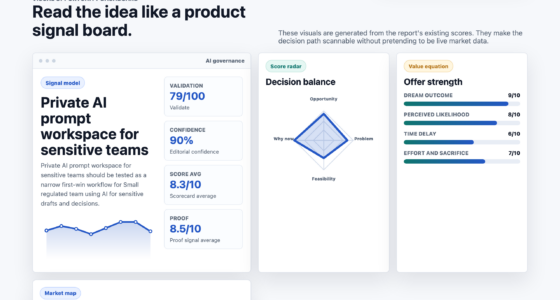
📊 Full opportunity report: A Skill Is a Folder, Not a Prompt: What Anthropic Learned Running Hundreds of Them on ThorstenMeyerAI.com — validation score, market gap, and execution plan.

Get the latest gadgets delivered free with Prime
- Fast, free delivery on millions of items
- Prime Video, Amazon Music and more included
- Member-only deals all year
TL;DR
Anthropic has demonstrated that treating AI ‘Skills’ as folders containing instructions, scripts, and assets improves organizational consistency and knowledge retention. This approach shifts from prompt-based tasks to durable, reusable units, offering strategic benefits for AI deployment.
Anthropic has revealed that its internal AI capabilities are organized into ‘Skills’ structured as folders, not just prompts, marking a significant shift in how organizations deploy and maintain AI systems. This approach enhances consistency, onboarding, and continuous improvement, making AI assets more durable and shareable across teams, according to a detailed internal write-up from a Claude Code engineer.
Unlike traditional prompt engineering, a Skill is defined as a folder that contains instructions, reference documents, scripts, templates, data, and configuration. This structure allows AI agents to discover, read, and execute the contents dynamically, creating a more robust and maintainable system.
Anthropic’s internal experience shows that organizing AI capabilities into such folders results in more consistent output, faster onboarding for new team members, and compound improvements over time. The company reports dedicating significant engineer time to perfecting Skills in key categories such as verification, data analysis, and automation, viewing Skills as an appreciating asset rather than a cost.
Furthermore, the company identified nine core categories of Skills, including library referencing, product verification, code scaffolding, and infrastructure operations, which serve as a map for organizations to identify gaps and prioritize development efforts.
Technical lessons emphasize that effective Skills should avoid restating obvious information, instead focusing on non-obvious, specific knowledge and including ‘gotchas’—trap points that capture institutional memory and prevent errors. Descriptions of Skills serve as trigger definitions, ensuring the agent activates the right Skills based on user input.
A Skill is a folder, not a prompt
Anthropic published what it learned running hundreds of Skills across its own engineering org. Read as a business memo, the point is bigger than a coding trick: this is how ad-hoc prompting becomes durable institutional capability — the SOPs your agents actually follow, versioned and shared.
“A Skill is just a clever markdown prompt you save in a file.”
A folder the agent can discover, read & run — instructions, scripts, references, templates, config & on-demand hooks.
The knowledge of how your organization actually operates can be captured, versioned, shared & executed — and the thing capturing it is a humble folder with a script and a gotchas list inside. For the builder, that’s context engineering with real tools attached. For whoever owns the budget, it’s the difference between AI that starts from zero every morning and an asset that compounds. Caveats: best practices are still evolving, checked-in Skills cost context, and curation beats accumulation. Start with one Skill, one gotcha, and the category that catches your mistakes.
Implications for AI Deployment and Organizational Knowledge
This approach fundamentally shifts how organizations think about AI capabilities, moving from ad-hoc prompting to structured, reusable units that embed institutional knowledge. It enhances consistency in output, accelerates onboarding, and creates a scalable asset that improves over time, potentially transforming enterprise AI practices.
By framing Skills as containers of operational knowledge, companies can better manage complex workflows, automate routine tasks reliably, and reduce errors, making AI deployment more strategic and sustainable.
AI automation script management tools
As an affiliate, we earn on qualifying purchases.
As an affiliate, we earn on qualifying purchases.
Internal Innovations in AI Skill Management
Until now, most AI teams relied on prompt engineering—crafting specific instructions each time a task was run. Anthropic’s internal experience shows that this method is fragile and inefficient, leading to inconsistent results and high onboarding costs.
The company’s recent publication documents a transition to a folder-based model, where Skills encapsulate all necessary knowledge and scripts, enabling agents to execute complex tasks reliably. This shift reflects broader industry trends towards modular, maintainable AI systems, but Anthropic’s detailed internal case provides a rare glimpse into practical implementation.
Prior efforts focused on prompt optimization; now, the emphasis is on building durable assets that can be versioned, shared, and improved systematically.
“Treating Skills as folders containing instructions and scripts fundamentally changes how organizations can deploy AI, making capabilities more durable and scalable.”
— Thorsten Meyer, AI researcher
Unanswered Questions About Implementation and Scalability
It is not yet clear how widely this folder-based Skills approach has been adopted outside Anthropic or how it performs at scale in different organizational contexts. Details about integration with existing workflows and tooling are still emerging, and the long-term impact on AI performance and maintenance remains to be seen.
Next Steps for Broader Adoption and Validation
Organizations interested in this approach will likely experiment with cataloging their own Skills, focusing on critical categories like verification and automation. Further case studies and technical benchmarks are expected to clarify how this model scales and integrates with enterprise AI systems. Anthropic may also release tools or frameworks to facilitate adoption.
Key Questions
How is a Skill different from a prompt?
A Skill is a folder containing instructions, scripts, and assets that enable consistent, reusable AI capabilities. Unlike prompts, which are single-use instructions, Skills are durable containers designed for ongoing use and improvement.
What are the main benefits of organizing Skills as folders?
This structure improves output consistency, accelerates onboarding, and allows continuous refinement, turning AI capabilities into strategic organizational assets.
Can this approach be applied outside of Anthropic?
While Anthropic’s internal experience is promising, broader industry adoption depends on developing compatible tools and workflows. Early experiments suggest potential, but widespread validation is pending.
What categories of Skills did Anthropic identify?
They include library referencing, product verification, data analysis, business automation, code scaffolding, quality review, deployment, runbooks, and infrastructure operations.
What remains uncertain about this approach?
It is unclear how well this model scales across diverse organizations and workflows, and how it impacts long-term AI maintenance and performance.
Source: ThorstenMeyerAI.com
Columbus Day / Indigenous Peoples' Day Picks
long weekend sales
As an affiliate, we earn on qualifying purchases.