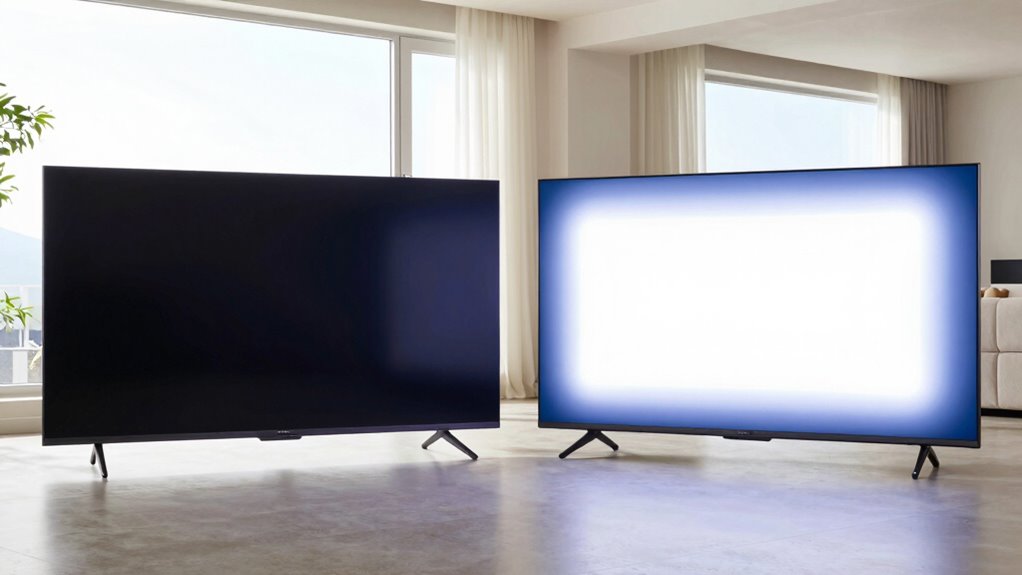

In bright rooms, Mini-LED TVs outperform OLEDs because they deliver higher peak brightness and handle ambient light better. OLEDs, while offering stunning contrast and true blacks, can struggle with visibility in well-lit environments due to their lower brightness levels. If you want vibrant, clear images in bright settings, Mini-LED is the smarter choice. To understand the key differences and how each technology impacts your viewing experience, keep exploring what sets them apart.
Key Takeaways
- Mini-LED offers higher peak brightness, making it better suited for bright room viewing compared to OLED.
- OLED’s lower brightness can cause glare or washout in brightly lit environments.
- Mini-LED’s localized dimming enhances contrast and visibility in high ambient light.
- OLED displays may struggle with visibility in bright settings due to lower luminance levels.
- For bright rooms, Mini-LED generally provides clearer, more vibrant images than OLED.

Are OLED and Mini-LED displays truly different, or just variations of the same technology? If you’re trying to decide which is better for bright rooms, understanding their fundamental differences can make a big difference. Both offer impressive visuals, but they do so through fundamentally different mechanisms, impacting key factors like color accuracy and power consumption.
OLED and Mini-LED differ fundamentally, impacting brightness, contrast, and power efficiency—choosing the right depends on your viewing environment.
OLED screens are renowned for their exceptional color accuracy because each pixel emits its own light. This means that when displaying dark scenes, OLED displays can turn off individual pixels completely, resulting in true blacks and vibrant colors. In bright environments, though, OLEDs might struggle a bit because their brightness levels are typically lower than those of Mini-LEDs. This can impact how vivid and punchy colors appear in well-lit rooms, even if the color accuracy remains high. But since OLEDs don’t require a backlight, they typically consume less power when displaying darker images, making them more energy-efficient in certain scenarios.
Mini-LED displays, on the other hand, use thousands of tiny LEDs behind the screen to create a bright, high-contrast picture. These LEDs can be dimmed or turned off independently, allowing Mini-LED screens to produce much higher peak brightness levels than OLEDs. This ability makes them better suited for bright rooms, where ambient light can wash out less luminous screens. Their increased brightness enhances color vibrancy and contrast, making images pop even in daylight. However, because Mini-LEDs rely on a backlight system, they may struggle with achieving perfect black levels and can sometimes produce a slight halo effect around bright objects on dark backgrounds.
In terms of power consumption, OLEDs tend to be more efficient when displaying darker content because individual pixels are turned off completely. When viewing bright scenes, however, their power use increases, but they still generally remain more energy-efficient than traditional LCDs. Mini-LED displays often consume more power overall, especially when showing bright images, due to the backlight system that needs to illuminate large portions of the screen.
Mini-LED 4K TV
As an affiliate, we earn on qualifying purchases.
As an affiliate, we earn on qualifying purchases.
Frequently Asked Questions
How Does Color Accuracy Compare Between OLED and Mini-Led?
You’ll find OLED screens generally offer better color accuracy because of superior color calibration and broader gamut coverage. They produce richer, more vibrant colors with precise details, especially in dark scenes. Mini-LED displays can also deliver good color, but they often rely on local dimming which may lead to slight color inconsistencies. Overall, OLEDs tend to excel in delivering more accurate and consistent colors for your viewing experience.
Which Display Type Has a Longer Overall Lifespan?
You might think OLEDs last longer because they’re newer, but mini-LEDs actually have a longer overall lifespan. OLED panels are more prone to burn-in concerns, which can affect durability over time, especially with static images. Mini-LEDs, with their backlit design, tend to be more durable and resistant to burn-in. So, if panel longevity matters most, mini-LEDs generally outperform OLEDs in the long run.
Are There Differences in Power Consumption in Bright Rooms?
In bright rooms, you’ll notice differences in power consumption between OLED and Mini-LED displays. Mini-LEDs tend to be more power-efficient because they use local dimming to reduce energy consumption when displaying dark scenes, whereas OLEDs can consume more power during bright, vivid images due to their self-emissive pixels. If power efficiency is your priority, Mini-LEDs generally offer better energy savings in well-lit environments.
Can Mini-Leds Achieve True Black Levels Like OLEDS?
Mini-LEDs can’t quite reach the true black levels of OLEDs, like trying to catch a shadow that keeps slipping away. Black level challenges stem from less effective local dimming, which affects contrast and detail in dark scenes. While Mini-LEDs offer impressive brightness and decent black levels, they still struggle with achieving the perfect darkness that OLEDs consistently deliver. So, for absolute black, OLEDs remain the top choice.
What Is the Cost Difference Between OLED and Mini-Led TVS?
You’ll find that OLED TVs generally cost more than Mini-LED models, with a notable pricing comparison favoring Mini-LEDs for budget-conscious buyers. The higher price of OLEDs reflects their advanced panel technology and superior contrast. When considering installation costs, both types are similar, but OLEDs may require more careful handling due to their delicate screens. Overall, Mini-LEDs offer a more affordable option without sacrificing too much picture quality.
OLED TV for bright rooms
As an affiliate, we earn on qualifying purchases.
As an affiliate, we earn on qualifying purchases.
Conclusion
So, which display truly dominates in bright rooms? OLED’s stunning contrast or Mini-LED’s impressive brightness—each has its secrets. But the real question is, which will you choose when the lights are on and the stakes are high? As technology evolves, one thing’s for sure: the battle isn’t over yet. Are you ready to see what the future holds? The best choice might surprise you—stay tuned, because this showdown is far from finished.
high brightness LED TV
As an affiliate, we earn on qualifying purchases.
As an affiliate, we earn on qualifying purchases.
local dimming TV
As an affiliate, we earn on qualifying purchases.
As an affiliate, we earn on qualifying purchases.