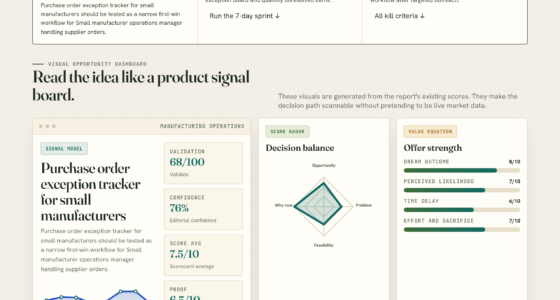

📊 Full opportunity report: Kimi K3: The Gap Closed Six Months Early — And China Stopped Competing On Price on ThorstenMeyerAI.com — validation score, market gap, and execution plan.
TL;DR
Moonshot AI’s Kimi K3, with 2.8 trillion parameters, has reached the AI frontier six months early. Priced at $3 per million input tokens, it now competes on capability, not cost, challenging previous Chinese AI assumptions.
Moonshot AI announced the release of its Kimi K3 model yesterday, achieving a major AI capability milestone six months earlier than analysts predicted. The model, with 2.8 trillion parameters, is now the largest open-weight AI model and is priced at $3 per million input tokens, matching Western mid-tier models like Claude Sonnet 5. This marks a significant shift in Chinese AI strategy, moving away from cost competitiveness toward capability parity.
The Kimi K3 model, officially launched on July 16, is powered by a highly sparse Mixture-of-Experts architecture, with 16 of 896 experts active per token, and supports 1,048,576-token context, including native text, image, and video input. It is now available via API, Kimi app, and Playground. Despite the high parameter count, Moonshot has not disclosed the active parameter count, which is crucial for understanding compute requirements.
Independent benchmarking places Kimi K3 at 57.1 on the Artificial Analysis Intelligence Index v4.1, just 0.54 points behind leading models like Sol Max and Fable 5. It outperforms previous Chinese models and is close to Western counterparts, with some evaluations placing it first in certain tasks. The model’s release signifies that Chinese labs have achieved capabilities once thought to be at least six months away, with some analysts expecting such advancements only by early 2027.
Pricing at $3 per million input tokens and $15 per million output tokens, Kimi K3 is the most expensive Chinese model to date, aligning its cost with Western mid-tier models like Claude Sonnet 5. This indicates a strategic shift: Chinese AI vendors are no longer competing solely on price but on performance and capability, challenging the long-held narrative of Chinese AI as a cost-effective alternative.
Kimi K3: the gap closed six months early — and China stopped competing on price
Every write-up today says “China caught up.” True — and the less interesting half. The other half: K3 costs 5× its predecessor, making it the most expensive Chinese model ever, priced at exact parity with Claude Sonnet 5. A benchmark is a claim. A price is a claim the vendor has to live with.
For two years the thesis was “cheap alternative.” Moonshot just abandoned it. Vendors discount when they’re compensating for something — Moonshot has stopped compensating. With Sonnet 5’s intro rate at $2/$10 through 31 Aug, K3 currently costs 50% more than the model it’s priced against. The competition just moved from cheap vs good to good vs good at the same price, with one of them open — and you can’t answer that with a discount.
The story we’ve told: export controls forced Chinese labs into efficiency. But K3 is 2.8T — the largest open model ever, ~3× K2, vs DeepSeek V4-Pro’s 1.6T. That’s not more with less. That’s more with more. Caveat: sparse MoE, active params undisclosed — total ≠ FLOPs. But if the controls were binding at the frontier, this model shouldn’t exist.
Anthropic has accused Moonshot, Z.AI, MiniMax, Alibaba & DeepSeek of “illicit” distillation — possibly well-founded; I can’t assess it. But one day earlier, Thinking Machines said Inkling’s post-training bootstrapped on Kimi K2.5 — reported as ecosystem health. Same verb, different flag, different word. If the distinction is real, someone should articulate it.
Two things changed, neither in the headlines. The discount is gone — anyone whose China strategy was “they’re cheaper” needs a new strategy. And the controls didn’t work — six months early, biggest model ever, from a lab that was supposed to be compute-starved, while Washington’s options narrow to loosening restrictions on its own labs, criminalising distillation, or subsidising American open weights. That’s not containment. It’s a menu of concessions. The gap is 2.8 points and closing. The price is Sonnet’s. The weights are ten days out. Everything that matters happens on 27 July.
Implications of Early Capabilities and Pricing Shift
The early arrival of Kimi K3 at the AI frontier and its high pricing signal a fundamental change in Chinese AI strategy. It suggests that Chinese labs are now capable of developing large-scale, high-performance models without relying solely on efficiency or cost advantages. This shifts the competitive landscape from price wars to capability battles, potentially intensifying global AI competition.
For users and industry watchers, this development raises questions about the future of AI dominance, the effectiveness of export controls, and the potential for Chinese models to challenge Western leaders on equal footing. It also indicates that the narrative of Chinese AI as a cheap, lower-tier alternative is no longer valid at the frontier, which could influence adoption, investment, and regulatory policies worldwide.

Generative AI on AWS: Building Context-Aware Multimodal Reasoning Applications
As an affiliate, we earn on qualifying purchases.
As an affiliate, we earn on qualifying purchases.
Background on Chinese AI Development and Market Expectations
For two years, Chinese AI labs focused on efficiency and cost reduction, partly driven by export controls that limited access to high-end silicon and compute resources. Analysts predicted that China would reach the AI frontier around early 2027, with models approaching 3 trillion parameters expected only then.
Moonshot AI’s previous models, including the K2 family, hovered between 500 billion and 1 trillion parameters, with a focus on efficiency and scaled-down compute. The general assumption was that export restrictions forced Chinese labs into more efficient, smaller models, delaying their ability to compete on capability.
However, the release of Kimi K3 with 2.8 trillion parameters—nearly triple its predecessor—contradicts the efficiency-only narrative. It indicates that either export controls are less effective than believed, or that domestic silicon and innovation are enabling larger, more capable models despite restrictions.
This development has prompted discussions about the actual impact of export controls, the state of Chinese AI research, and whether policy measures are achieving their intended goal of limiting China’s frontier capabilities.
“Our most capable model to date, with 2.8 trillion parameters, demonstrates that Chinese AI can now compete on capability, not just cost.”
— Yutong Zhang, President of Moonshot AI
Unresolved Questions About Compute and Cap Active Parameters
It remains unclear what the active parameter count of Kimi K3 is, as Moonshot has not disclosed this detail. The total 2.8 trillion parameters include sparsely activated experts, so the actual compute required may differ significantly from headline figures.
Additionally, the impact of export controls on this development is still debated. If large-scale models like Kimi K3 can be built domestically despite restrictions, it raises questions about policy effectiveness and the future of AI regulation.
Further details on training compute, silicon sourcing, and the internal architecture of Kimi K3 are expected but have not yet been released, leaving some aspects of the model’s capabilities and development process uncertain.
Next Steps for Industry and Policy Makers
Moonshot AI plans to release the model weights by July 27, which will enable third-party verification of the model’s size and capabilities. This will clarify the active parameter count and the true compute requirements.
Industry analysts will closely monitor whether other Chinese labs follow suit with similarly large, high-performance models, signaling a new phase of capability-driven competition.
Policy discussions are likely to intensify around export controls and domestic silicon development, especially if large models like Kimi K3 prove feasible without restrictions. Governments may reassess current policies based on these technological advances.
Finally, the broader AI community will evaluate how Kimi K3 performs across various benchmarks and real-world applications, determining whether it truly shifts the global competitive balance.
Key Questions
What makes Kimi K3 different from previous Chinese models?
Kimi K3 has 2.8 trillion parameters, making it the largest open-weight Chinese model, and supports native text, image, and video input with a highly sparse architecture, marking a significant leap in capability.
Why is the pricing of Kimi K3 significant?
At $3 per million input tokens, Kimi K3 is priced at Western mid-tier levels, indicating Chinese models are no longer competing solely on cost but on performance, challenging previous assumptions about Chinese AI competitiveness.
What are the implications for export controls?
If China can develop models like Kimi K3 domestically despite export restrictions, it suggests that current policies may be less effective than intended, potentially prompting policy reevaluation.
When will the weights of Kimi K3 be released for independent verification?
Moonshot AI has promised to release the model weights by July 27, 2026, which will allow third-party analysis of the model’s true size and capabilities.
What does this development mean for global AI competition?
It signals that China has reached the AI frontier earlier than expected, shifting the competition from cost to capability, and potentially challenging Western dominance in high-end AI models.
Source: ThorstenMeyerAI.com