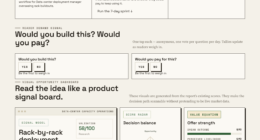
📊 Full opportunity report: Signal: Four Frontier-Class Open Models in Eight Weeks — China’s Release Cadence Is the Story on ThorstenMeyerAI.com — validation score, market gap, and execution plan.
TL;DR
Over eight weeks, Chinese labs launched four frontier-class open-weight models, marking an unprecedented release cadence. This rapid pace impacts global AI competitiveness and strategic dependencies.
Chinese laboratories have released four frontier-class open-weight AI models within a span of just eight weeks, starting with DeepSeek V4 on April 24 and concluding with Kimi K2.7-Code and GLM-5.2 in mid-June. This rapid cadence underscores a significant shift in the AI landscape, with Chinese labs now maintaining a near-weekly release cycle that challenges Western dominance in open AI models.
Between late April and mid-June 2026, Chinese labs introduced four major open models: DeepSeek V4, MiniMax M3, Kimi K2.7-Code, and GLM-5.2. All are downloadable, with most under permissive MIT-class licenses, and are priced significantly lower than Western API offerings. BenchLM’s July rankings place DeepSeek V4 Pro at the top of the Chinese field with a score of 87, just six points behind the proprietary leader at 93, making it the closest open-weight model to the closed frontier.
Chinese labs such as DeepSeek, Z.ai, Moonshot, and Alibaba have each developed distinct models targeting different niches—cost-efficiency, long-horizon stability, and broad self-hosting capabilities. The Chinese open field has expanded from one lab two years ago to four today, with capabilities rapidly approaching or surpassing some Western models. Meanwhile, Western efforts like Meta’s open models have stalled, and the most capable open-source models lag behind Chinese counterparts in raw performance.
Four Frontier-Class Open Models in Eight Weeks
China’s Release Cadence Is the Story
Same-day-verified market pulse · July 13, 2026
The production line — spring 2026
The board this week — BenchLM overall score, July 2026
Gift & complication — the European read
The gift
Frontier-adjacent capability, permissive licenses, weeks-long refresh cycle. This cadence is what makes serious on-premises AI economically thinkable in 2026.
The complication
Still a dependency — geopolitical, not technical. Hosted Chinese APIs fall under Chinese data law; many Western agencies won’t touch the weights at all. Licensing generosity is a policy, not a law of nature.
The signal: if your infrastructure strategy assumes open models improve slowly, it’s already wrong. If it assumes the current licensing generosity is permanent, it’s unhedged.
Implications for Global AI Competition and Sovereignty
This rapid release cadence signals a shift in the global AI landscape, with Chinese labs now leading in the speed of open model development. The availability of high-capability, permissively licensed models at low cost makes self-hosted AI more feasible for enterprises and governments, especially in regions like Europe seeking sovereignty. However, dependency on Chinese-origin models introduces geopolitical and regulatory challenges, as many Western entities remain cautious or outright exclude such models due to data laws and export restrictions. The pace of innovation suggests that the window for open, accessible AI from China may narrow if export policies or licensing terms change.

Server Room Temperature and Humidity Monitor for Data Centers,Pharmaceuticals Alongwith Factory Calibration Certificate Model: AI-RHTx-IOT (RHTx-IoT Hosting to Customer End (Without Hosting))
- Model: RHTx-IoT1 with cloud hosting
- Parameters Measured: Temperature and Humidity
- Temperature Range: 0 to 50°C
As an affiliate, we earn on qualifying purchases.
As an affiliate, we earn on qualifying purchases.
Rapid Chinese Model Releases Transform Open AI Landscape
Historically, China’s open AI field was limited to one lab two years ago. Today, four labs—DeepSeek, Z.ai, Moonshot, and Alibaba—are producing models with capabilities approaching or surpassing Western efforts. The release cadence has shifted from annual or semi-annual to weekly, driven partly by hardware scarcity and export controls, and partly by strategic positioning. Western open efforts, such as Meta’s stalled projects and Ai2’s Olmo 3, have not kept pace in raw capability, leaving Chinese models increasingly dominant in the open-weight arena.
This acceleration reflects a broader geopolitical strategy, with Chinese labs responding to export restrictions and hardware constraints by streamlining releases and expanding their influence in the global AI ecosystem.
“The Chinese release cadence is no longer a wave—it’s a production line. Four major models in eight weeks signals a fundamental shift.”
— an anonymous researcher
Unclear Longevity of Chinese Release Cadence and Global Impact
It remains uncertain how long this rapid release cycle will continue, as export policies, licensing terms, and hardware constraints could change. The strategic motives behind the cadence—whether driven by hardware scarcity or geopolitical land-grabbing—may also shift, impacting future availability and access.
Additionally, the extent to which Western entities will adopt or reject these models due to regulatory and data sovereignty concerns is still evolving, making the full impact on global AI dominance unpredictable.
Next Steps in Chinese Model Development and Western Response
Expect further Chinese model releases in the coming months, possibly with increased capabilities or new niches. Western AI efforts are likely to reassess their strategies, possibly accelerating open efforts or developing new proprietary models to counterbalance Chinese progress. Monitoring export policies and licensing terms will be critical, as they could significantly influence the accessibility of Chinese models worldwide.
Additionally, industry and government stakeholders will evaluate the strategic dependencies created by this rapid cadence, shaping future deployment and sovereignty policies.
Key Questions
Why are Chinese labs releasing models so quickly?
The rapid cadence is driven by hardware scarcity, strategic positioning, and responses to export controls, aiming to establish China’s dominance in the open AI ecosystem.
Are these Chinese models available for commercial use?
Most are downloadable under permissive licenses, but many Western entities avoid using Chinese-origin models due to regulatory and data sovereignty concerns.
Will Western companies catch up with this release pace?
It is uncertain; Western efforts have stalled or lagged in raw capability, but strategic shifts and new investments could alter the competitive landscape.
What risks do dependency on Chinese models pose?
Dependencies could introduce geopolitical, regulatory, and data sovereignty issues, especially if export policies or licensing terms change unexpectedly.
How might this pace of release affect global AI development?
It could accelerate innovation and adoption in regions open to Chinese models, while prompting increased caution and regulation in others, potentially reshaping the global AI ecosystem.
Source: ThorstenMeyerAI.com