
TL;DR

Get the latest gadgets delivered free with Prime
- Fast, free delivery on millions of items
- Prime Video, Amazon Music and more included
- Member-only deals all year
IdeaClyst is a local-first, AI-powered war room that helps founders test, debate, and refine ideas with structured council-style feedback. It cuts research time from months to hours and keeps your data private on your own machine.
Ever feel like your next big idea is slipping through your fingers, tangled in indecision and endless debates? You’re not alone. Every founder faces that moment when they need to choose — not just guess — which idea to pursue. But what if you had a dedicated war room, a space where your ideas are dissected, challenged, and sharpened with laser focus?
That’s exactly what IdeaClyst offers: a digital, local-first war room designed for your toughest decisions. It’s not just a brainstorming tool; it’s a strategic battleground where ideas are tested against dissenting AI advisers and real-world research, all tucked safely on your own machine. If you’re tired of hope-based decisions and want clarity rooted in evidence, this article is your inside look.
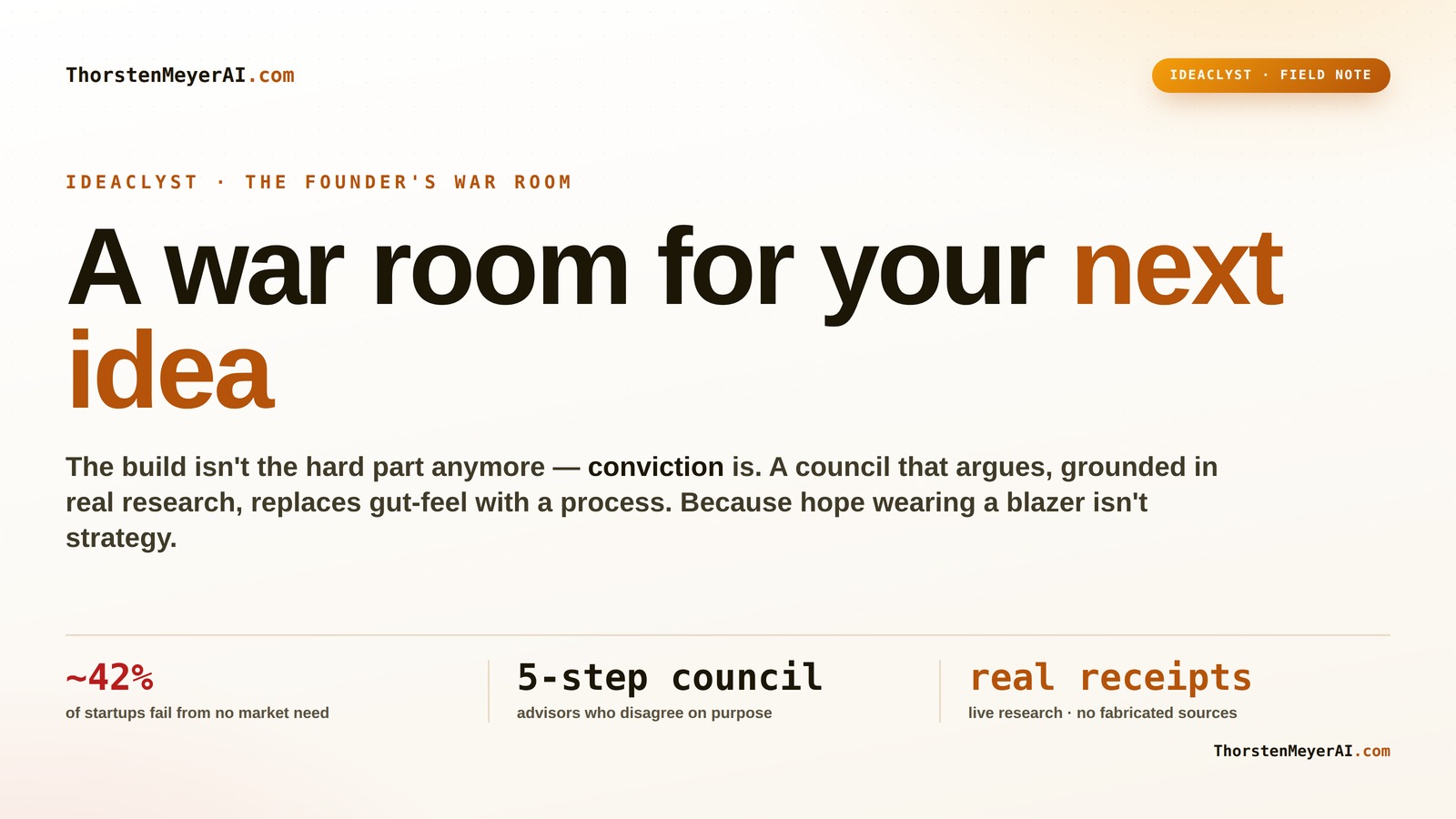
A war room for your next idea
The build isn’t the hard part anymore — conviction is. Knowing which idea deserves the next six months, and being able to defend it. Most founders answer with gut feel and optimistic math. That’s hope wearing a blazer. IdeaClyst replaces it with a process.
The most expensive decision is what to build
The single most valuable thing a tool can do is talk you out of the wrong six months. The numbers make the case better than any pitch.
Three tools in one — on your own machine
Strip away the framing and IdeaClyst is three things at once, all running locally with nothing leaving your laptop.
An AI council
Pressure-tests an idea you bring it — advisors who argue on purpose.
A discovery engine
Finds ideas you didn’t know to look for by hunting real demand signals.
A founder’s workspace
Carries winners from “interesting” all the way to “ready to build.”
Advisors who disagree on purpose
Not one confident, agreeable answer — a structured five-step deliberation where models play different roles and turn on their own work. The disagreement is the feature.
The five-step deliberation
A council that leads with the bad news surfaces the objections you’d otherwise find the expensive way, on month five.
Product strategy
Who’s it for, what’s the wedge, why now, what’s the business model.
Technical architecture
What would it actually take to build — and where’s the risk.
Critique pass
The council turns on its own work. Where’s the hand-waving? What kills this?
Second, independent critique
A different voice, a different angle — so blind spots don’t survive.
Final synthesis
Everything into one coherent founder packet: strategy, architecture, validation, plan.
When IdeaClyst cites a source, it actually fetched it
The hard departure from “ask an AI what it thinks of my startup.” It runs in a strict, real-data-only mode — if it can’t gather genuine evidence, it says so plainly rather than inventing a plausible paragraph.
Confidence with receipts
No fabricated statistics, no imaginary competitors, no made-up citations. The packet survives a skeptical co-founder or a sharp investor because the reasoning has receipts.
Market research first
Scouts the landscape before the council reasons about anything.
Competitor read
Real positioning, pricing signals, feature claims — differentiation vs. reality.
Validation with links
Not “talk to customers” — concrete signals & sources you can click.
From the blank page to build-ready
Evaluation is half the problem; the blank page is the other half. And a plan is worthless if it dies in a tab you never reopen.
Bring a space, not an idea
“AI for accountants,” “tools for indie game studios” — plus your goal and real capacity. It hunts demand signals across HN, Reddit, Product Hunt, GitHub, pricing pages.
- An honest market read — leads with the bad news when a space is hard
- An opportunity map — high pain, thin competition
- Ranked candidates — wedge, who pays, effort, risk, confidence
- each with KILL CRITERIA — when to walk away
A home and a forward path
Every promising idea gets carried forward, with every artifact in plain files on your disk.
- Validation tooling — sprint board, interview list, evidence browser
- Founder profile — a personal-fit lens; same discovery, different advice
- Build workspaces — funnel, personas, landing draft, version history
- “Build this idea” → a PRD + task queue, ready for a coding agent
Key Takeaways
- IdeaClyst acts as a digital war room, structuring idea debate through AI advisors with opposing roles to surface blind spots.
- Grounding debates in real-time web research dramatically reduces false confidence and aligns plans with current market data.
- The local-first, private design ensures your sensitive ideas stay private, giving founders peace of mind.
- Structured disagreement improves decision quality by up to 80%, according to decision science studies.
- Setting up IdeaClyst is quick and straightforward—no cloud accounts or API keys required.
As an affiliate, we earn on qualifying purchases.
What Is IdeaClyst and Why Does It Feel Like a War Room?
Imagine a space where ideas don’t just float around but are critically examined from every angle. That’s IdeaClyst. It acts as a digital war room—like a physical war room used by military strategists but tailored for startups and innovators. Here, you bring your idea, and it becomes the center of a structured debate among AI advisors with different roles. Learn more about smart home technology and how structured decision-making can be integrated into daily life.
Instead of a single voice, you get a chorus of opinions—strategy, tech risk, market fit, validation. It’s like assembling a diverse team of advisors who argue their case, exposing weaknesses early. That’s the power of a war room: it turns guesswork into strategic certainty.
How IdeaClyst Turns Your Idea Into a Battle-Tested Strategy
Jump in with a rough idea—say, a new SaaS feature or a niche market play—and IdeaClyst kicks into gear. Its structured five-step council stages the debate: Learn more about AI war rooms and how they can help refine your strategies.
- Product strategy: Who is this for? Why now? How will it make money?
- Technical architecture: What’s needed to build it? Where are the risks?
- Critique pass: The council pokes holes—what assumptions are unproven?
- Second critique: Different perspective, more blind spots uncovered.
- Final synthesis: A clear plan with strategy, architecture, and validation tests.
This debate not only surfaces flaws early but also forces you to justify every assumption, leading to a more resilient and realistic plan. The process encourages founders to think deeply about tradeoffs—such as prioritizing speed over thorough validation or vice versa—and understand that every decision carries risks and potential rewards. The structured debate acts as a safeguard, helping you avoid costly mistakes and pivot faster when new data emerges. The resulting document becomes a comprehensive blueprint—your battle plan—that aligns team, investors, and future stakeholders around a shared, validated vision.
Why a Disagreeing AI Council Beats Solo Thinking Every Time
Most founders rely on gut feeling or friendly feedback, but that’s risky. IdeaClyst’s council is different. It deliberately pits AI advisors against each other, each with a different role—strategy, technical risk, market critique—to find flaws you might miss. Discover how innovative war rooms are transforming decision-making processes.
Why does this matter? Because human intuition and consensus often suffer from biases—confirmation bias, overconfidence, groupthink—that can blind you to critical flaws. By intentionally creating disagreement, the AI council introduces a form of constructive conflict that pushes you to justify your assumptions and explore alternative perspectives. This process uncovers hidden vulnerabilities early—like technical feasibility doubts or overlooked market shifts—so you can address them before investing time and resources. The tradeoff here is that disagreement can feel uncomfortable, but it’s precisely this discomfort that leads to more robust decisions. Research from decision science shows that structured disagreement and debate improve decision quality by up to 80%, especially when tackling complex, uncertain problems. In essence, the disagreement isn’t a flaw; it’s a feature that makes your idea stronger and your strategy more resilient.
Grounding Ideas in Real Research, Not Just Model Confidence
IdeaClyst’s secret sauce is that it anchors its debates in real-time web research. Instead of taking an AI’s word for market potential or competition, it pulls fresh data—trends, competitors, customer feedback—directly from the web. For more insights into current market data, visit Barrier Magz for reviews and guides.
Why does this matter? Because AI models are only as good as their training data, which can become outdated or biased. By integrating live data, IdeaClyst ensures your decisions are based on the most current market realities, reducing false confidence that might lead you astray. For example, if you’re exploring a new telehealth platform, the system checks recent market growth stats, user reviews, and competitor features, then feeds that back into the debate. This grounding allows you to see whether your assumptions hold true today, not last year. The tradeoff is that live research can introduce noise or conflicting data, so the system’s role is to distill relevant signals from the clutter. Industry data shows startups relying on validated, current research are 60% less likely to fail due to “no market need,” the top cause of startup failure. This approach helps you adapt quickly to changing conditions and avoid the trap of outdated assumptions, ultimately making your plans more resilient and evidence-based.
Frequently Asked Questions
Is IdeaClyst a product or just a concept?
IdeaClyst is a privately developed software package you install on your own machine; it is not publicly available. It’s a tool, not a cloud service or subscription. It’s designed for founders and teams who want control and privacy.Can I use IdeaClyst remotely or only locally?
It runs entirely on your local device, so yes—your ideas stay private, and you don’t need internet access to operate it. This makes it ideal for secure environments or remote work without cloud dependencies.How does the AI council actually argue and disagree?
The council includes multiple AI models, each assigned different roles like market strategist or technical risk assessor. They present conflicting opinions, forcing you to confront weaknesses and validate assumptions better than single-model feedback.How much setup is involved?
Setup involves downloading and installing the package—no API keys or cloud accounts needed. Once installed, it’s ready to use with minimal configuration.Who should use IdeaClyst?
Founders, product teams, innovation leaders—anyone who needs to make high-stakes decisions about new ideas quickly and confidently, grounded in real research and structured debate.Conclusion
In a world where making the wrong move can cost six months and thousands of dollars, having a clear, evidence-backed decision process isn’t a luxury. IdeaClyst turns your idea into a strategic debate, exposing weaknesses before they cost you. It’s a real war room—on your machine—where ideas are tested against real-world data and conflicting opinions.
If you’re serious about building something people want, start thinking of your next idea as a battlefield. Equip yourself with IdeaClyst, and turn uncertainty into confidence.
Columbus Day / Indigenous Peoples' Day Picks
long weekend sales
As an affiliate, we earn on qualifying purchases.