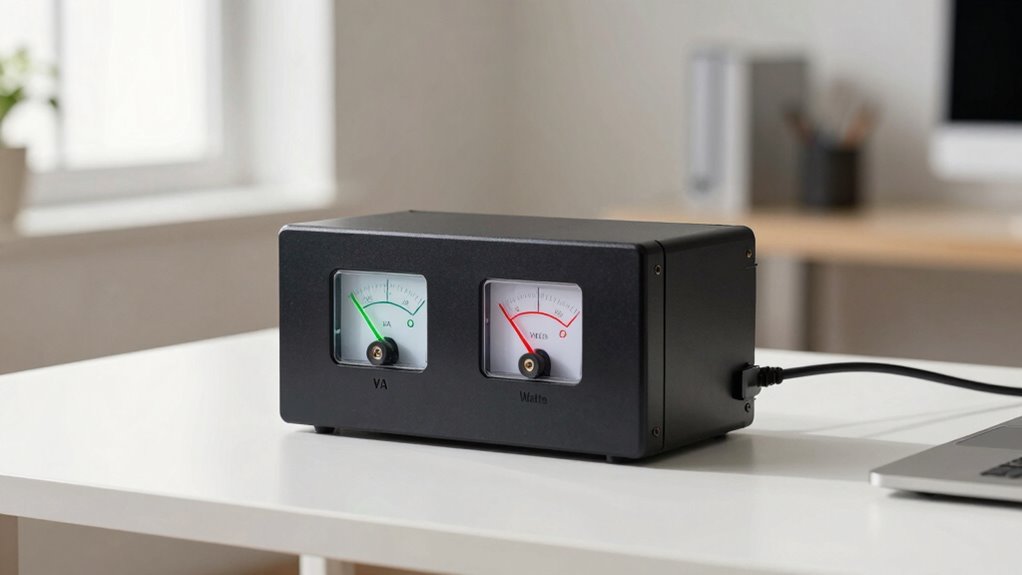

When choosing a UPS, VA shows its total apparent power capacity, while watts reveal the actual power your devices need. Think of VA as the overall size of the power supply, and watts as the real work your devices do. To guarantee your backup can handle your equipment, match the wattage with the UPS’s watt rating, but also consider the VA and how efficiently it converts power. If you want to get the full picture, keep exploring the details behind VA and watts.
Key Takeaways
- VA measures the total apparent power a UPS can supply, while Watts indicate the actual power used by connected devices.
- Watts provide a more accurate picture of real energy consumption, helping you size your UPS correctly.
- A higher power factor means more Watts per VA, making the UPS more efficient in supporting your devices.
- Matching the UPS’s VA and Watt ratings to your device’s power requirements prevents overloads.
- Choosing a UPS with good efficiency ratings reduces energy waste and saves on electricity costs.
A UPS battery backup is an essential device that protects your electronics from unexpected power outages and voltage fluctuations. When choosing a UPS, one of the most important factors to consider is its power capacity. Power capacity refers to how much electrical power the UPS can supply during an outage, which directly affects how long your devices stay powered and how many devices you can connect at once. Usually, power capacity is measured in volt-amperes (VA), which indicates the apparent power the unit can handle. Understanding VA ratings helps you determine whether the UPS can support your entire setup, especially if you have multiple devices or high-power equipment.
However, it’s also vital to look at efficiency ratings when evaluating a UPS. Efficiency ratings tell you how well the device converts the input power from your wall outlet into usable power for your electronics. A higher efficiency rating means less energy is wasted as heat, which can save you money on electricity bills and reduce the strain on the unit. Efficient UPSs not only lower operational costs but also tend to have a longer lifespan because they generate less heat and wear less over time. When comparing UPS models, pay attention to their efficiency ratings, especially if you’ll be running the unit continually or for extended periods.
It’s tempting to focus solely on the VA ratings, but remember that Watts provide a more precise measure of real power consumption. Watts reflect the actual power your devices draw and are essential for understanding how much load your UPS can handle. Many UPS manufacturers list both VA and Watt ratings, allowing you to match your equipment’s power needs accurately. For example, if your devices require 600 Watts, choosing a UPS with a VA rating that comfortably exceeds that wattage ensures you won’t overload the system. Keep in mind that the relationship between VA and Watts depends on the UPS’s power factor, which indicates how efficiently it converts apparent power into real power. A higher power factor means the UPS can deliver more real power relative to its VA rating. Additionally, selecting a UPS with a proper power factor ensures optimal performance and capacity for your setup.

GOLDENMATE 2000VA/1600W Lithium UPS Battery Backup & Surge Protector, White
- LiFePO4 Battery with Long Lifespan: Over 10 years, 3000+ charge cycles
- Cost-Effective and Reliable Power: Reduces TCO by over 40%
- Line-Interactive Sine Wave UPS: Ensures stable power supply and efficiency
As an affiliate, we earn on qualifying purchases.
As an affiliate, we earn on qualifying purchases.
Frequently Asked Questions
How Do VA and Watts Impact Battery Lifespan?
You impact your UPS battery lifespan through the power factor and battery efficiency. A higher power factor means your UPS uses power more effectively, reducing strain on the battery and prolonging its life. When you match watts to your load, you minimize unnecessary battery drain. Properly managing these factors guarantees your battery operates efficiently, lasts longer, and provides reliable backup when needed.
Can a Higher VA Rating Replace Wattage Considerations?
A higher VA rating can’t substitute wattage considerations because voltage compatibility and power efficiency matter more. VA indicates the apparent power, but wattage reflects real power your devices use. You need to make certain the UPS’s watt capacity matches your equipment’s needs for reliable backup. Ignoring wattage could lead to insufficient power supply, risking damage or shutdown. So, always consider both VA and wattage to choose the right UPS for your setup.
Do Different Devices Require Specific VA or Watt Ratings?
Think of your devices as different musical instruments needing the right tuning. Yes, they require specific VA or watt ratings to perform effectively. Voltage compatibility ensures your devices get the correct power, while power efficiency minimizes waste. Some devices, like sensitive electronics, need precise ratings to avoid damage, whereas others are more flexible. Always check each device’s requirements to match the UPS’s output, guaranteeing smooth operation without overstressing the system.
Is VA More Important Than Watts for Home Office Setups?
You should prioritize watts over VA for your home office setup because wattage reflects the actual power your devices use, guaranteeing your UPS can handle the load. Keep an eye on the power factor, which affects VA ratings; a higher power factor means better battery efficiency. By matching watt ratings closely with your devices’ needs, you ensure reliable backup power and maximize your UPS’s effectiveness.
How Do Power Surges Affect VA and Watt Ratings?
Power surges wreak havoc on your system’s voltage stability, making VA and watt ratings seem like mere paperweights. When a surge strikes, it forces the UPS to work overtime, risking overload and reducing its lifespan. Surge protection becomes your best friend, shielding your devices from voltage spikes. Remember, a surge can distort both VA and watt ratings, so invest in a UPS with robust surge protection to keep your home office safe and sound.
Conclusion
So, when choosing a UPS, remember: VA is like the size of a giant’s muscle, showing how much it can handle, while watts are the actual power your gadgets drink up. Imagine trying to lift a mountain—VA tells you the mountain’s size, and watts reveal how much effort each tool needs. Pick wisely, or your precious devices could be left in the dark, like tiny candles against a raging storm.